|
|
|

|

|

|
|
|



| |
|
|
|
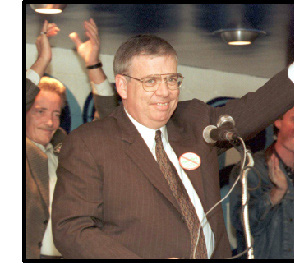
Few unions have a stronger reputation as scrappy and innovative organizers than the Hotel Employees and Restaurant Employees (HERE) union. But despite some dramatic success stories, most notably the large-scale unionization of booming Las Vegas over the past decade, HERE President John Wilhelm is not satisfied with the union's progress or power, especially as its core industries are increasingly dominated by a few global corporations. Although it has grown in the past few years (organizing about 7,000 workers so far this year), the union has only 260,000 members, down from 459,000 in 1971. At the union's convention here in mid-July, Wilhelm frankly told delegates that "the jury is out" on whether HERE could grow fast enough to survive as an independent union that effectively represents its members. But he ruled out merging with another union and outlined two ambitious strategies to accelerate organizing. First, he hopes to forge a more coherent national union out of the historically decentralized organization. Second, he wants to intensify the union's campaign on behalf of immigrant workers, launching civil rights-style "immigration freedom rides" to Washington next year. Immigrants make up large and growing majorities in many of the union's key locals, and by 2008 are likely to account for 80 percent of all workers in a 2 million worker hotel industry. By championing immigrant rights, Wilhelm believes the union can grow dramatically and do what's right. The key to survival--and power--is strategically focused organizing, Wilhelm insists,
All of these expanded or new activities are intended to give workers more power to confront corporate opposition. For example, HERE increasingly uses its political clout to pressure developers of new hotels, convention centers and other projects to agree to be neutral during organizing drives and to recognize the union when a majority of workers sign union cards. Some local or state governments have made neutrality a condition, but often the union uses its ability to influence government approval of developments to negotiate agreements directly with their promoters. The Boston local, for instance, now has nine neutrality and "card-check" agreements that could double its 5,000 members when hotels are opened (and potential agreements could triple the membership). Wilhelm also wants local unions, which bargain with individual hotels or metropolitan employer groups, to use their leverage at contract time to negotiate agreements that guarantee neutrality and card-check elections for any expansion, as locals in San Francisco, Las Vegas and New York have done to varying degrees. Wilhelm, who began working for HERE in 1969, made his mark organizing Yale clerical workers in the '80s and later rebuilding the damaged Las Vegas local. When former union President Edward Hanley stepped down in 1998, following charges of his financial mismanagement by a court-appointed monitor (see "Local Motion," page 19), Wilhelm was named president. The July convention elected him to his first full term and approved a greatly expanded national leadership team, including many more women (such as new Secretary-Treasurer Sherry Chiesa) and people of color. The union leadership is now dominated by a new generation of leaders devoted to aggressive organizing who better reflect the union's predominantly female and immigrant membership. So it was little surprise that a day at the beach for leaders gathered at the union's convention consisted of speeches along the oceanfront before a march on the luxury Loews Santa Monica Hotel, capped with street theater and the unfurling of a banner from a hotel window--"Justice for Loews Workers." For the past year and a half, the mostly Latino immigrant workers at Loews have pressed management to recognize the union through a card-check. The large numbers of undocumented immigrants who work in hotels are especially vulnerable to intimidation by employers, who threaten to call in the Immigration and Naturalization Service (despite INS policy to avoid intervening in labor disputes). In 1999, HERE's Minneapolis local successfully defended five undocumented Holiday Inn workers who had been threatened with deportation to Mexico after organizing a union. The movement for immigrant rights, which is growing especially in Latino communities, may offer the key to large-scale organizing. "I see all the pieces of the puzzle," says Maria Elena Durazo, a new general vice president and leader of the Los Angeles local. "But I don't know how all the elements fit together." A few pieces fit together in Las Vegas earlier this year when the union threatened to hold public hearings with elected officials about the overwhelmingly disproportionate actions taken by the Rio hotel management against immigrant workers trying to organize. Before the hearings occurred, the managers reversed course and agreed to a card-check election, which cemented the union victory. Wilhelm led the effort last year to reverse the AFL-CIO's position on immigration, advocating legalization of current undocumented workers and calling for an end to the policy of sanctions against employers who hire undocumented immigrants (which in practice are more often sanctions against workers). In June, Wilhelm joined a group of U.S. union leaders who traveled to Mexico to meet with Foreign Secretary Jorge Castaneda about upcoming talks between the Mexican and U.S. governments over new immigration policy. U.S. unions want to prevent the creation of a new bracero, or guest worker, plan that would permit workers to temporarily enter the country but only to work for a specific employer, who would then have extraordinary power over them. Castaneda, who accepted Wilhelm's unprecedented invitation to speak to the HERE convention, insisted that immigration reform had to involve a comprehensive package, including regularizing the status of Mexican workers currently in the United States, new legal channels for immigration, expanded temporary work visas, cooperation along the border and improved economic growth in Mexico--"either the whole enchilada or nothing." The union dialogue with Castaneda is part of a broader union strategy to fight for workers rights across borders. But HERE must contend with not only a transnational work force, but a trend over recent decades (especially during the '90s) toward concentrated control of markets by a handful of global corporations. Over most of HERE's history, employers were local, and the decentralized union matched the industry. But in just the past five years, the top 18 worldwide hotel companies have consolidated into eight firms, and a dozen gambling companies have shrunk to four with control of nearly half the U.S. market. "We all work for the same companies now," Wilhelm told delegates. "They plan nationally and globally. We don't. We pay a large price." Wilhelm hopes to line up the expiration dates of major city hotel contracts, to set minimum standards for contracts, and to encourage more locals in a region to cooperate. Simply merging small locals into larger ones hasn't worked, he argues, and the union needs national unity and strength, especially in organizing at the increasingly large and powerful hotel chains. For example, although HERE still represents workers at Hilton's biggest and most profitable hotels, only 24 percent of Hilton workers are now in the union (down from 62 percent) as a result of acquisitions of nonunion hotels and once-cooperative Hilton's more aggressive stance toward organizing. Coordination of locals, the international and global union partners will be crucial in tackling companies like Hilton or Marriott. "We can't take on this industry one hotel or local at a time," says San Francisco local President Mike Casey. But he also argues that the most successful and strongest locals have demonstrated that their power comes from involving union members more directly in on-the-job representation, bargaining and organizing. If Wilhelm succeeds on a grand scale, HERE--along with the Service
Employees and a few other unions--may be able to transform the service
sector much the way that the CIO unions revolutionized mass production
industry in the '30s. After all, Wilhelm says, those factory jobs
became a ticket to economic well-being only because of unionization.
Before that, they were seen as undesirable, high turnover, low-pay
jobs filled mainly by new immigrants--just as many hotel and food
service jobs are today.
Local Motion: Putting Chicago Back on Track Electing progressive leaders of national unions or the AFL-CIO is only one part of reviving the labor movement. It's equally important to breathe life into thousands of flabby, moribund local unions. But changing a local union is often a tough, controversial affair. Thirty years ago, Chicago's Hotel Employees and Restaurant Employees (HERE) Local 1 was a powerhouse, representing workers in all of the major downtown hotels. But the local--home base of Edward Hanley, the national union's president from 1973 to 1998--steadily has lost ground since then. With the recent opening of several new, nonunion hotels, the local now represents room cleaners, cooks, waiters, bartenders, bellmen and related workers in only 61 percent of the downtown hotel rooms. Along with this decline, wages and benefits also have fallen far behind other major cities: Room cleaners make only $8.43 an hour in Chicago compared to $14.68 an hour in top-ranked New York. To make matters worse, the local--still the third-largest in HERE with at least 14,500 members--fell into financial disarray, despite assistance from the national union. With the downtown hotel contract up for renewal next summer, the ability of the Chicago local to improve its contract and to organize nonunion hotels is critical for the entire union, especially since hotels are increasingly owned by national or multinational corporations. Putting Chicago on track is also important to John Wilhelm, who was named national union president in 1998 after Hanley retired in the wake of severe reprimands for financial misconduct from a federal monitor (appointed by the courts as part of a consent decree to resolve federal charges of organized crime involvement in the union). But as a contentious election for local officers in late June demonstrated, the Chicago local has proved a complicated case. In 1999, when the monitor barred the president of Local 1, Hanley's son Thomas, from union office for a year, his successor was longtime staffer Terry Maloney. But in the November 1999 local elections--the first leadership contest in 16 years--Maloney faced a strong challenge from a group of insurgents led by banquet waiter Pablo Garcia, who attacked the integrity and union performance of Hanley and Maloney. Although Maloney won, the "Chicago Reformers" slate garnered a respectable 38 percent of the modest turnout. Shortly afterward Wilhelm met with the local officers and, distressed at the state of the local, got them to agree to a "voluntary trusteeship." Wilhelm appointed Henry Tamarin, a longtime colleague from a New York local, as trustee and named Jim DuPont, an aggressive and imaginative organizer who headed the union's Oakland local, as assistant trustee. The trustees' strategy was to find leaders among workers in all job classifications, from cooks and maids to tipped employees, and train them to organize committees within the workplace and to conduct direct action. When Tamarin and DuPont arrived, they cut expenses and salaries, enforced dues collection and pushed staff to organize and represent workers more vigorously. They kept the existing business agents and other staff, arguing they should be given a chance to prove themselves. The insurgent reformers at first welcomed the trusteeship, but then protested its presence and the continued employment of the former officials. Tamarin gradually concluded that many of the staff were not working effectively on his program for rebuilding the local. He began replacing some business agents with staff who had gone through training in Las Vegas or other thriving locals. But the Reformers were still calling for an end to the trusteeship, and the Labor Department concluded that although there were adequate grounds to trustee the local, the union should have held a hearing. Research for the hearing revealed new evidence of misconduct by Maloney and other former officers, who were then fired and replaced with staff from other HERE locals. Although the internal union hearing officer concluded that the local had serious problems, Wilhelm decided in May to avoid continued litigation over the extension of the trusteeship and called for elections on June 27. Slates led by Maloney and Garcia--former rivals who cooperated but did not overcome differences to form a common slate--both focused harsh attacks on Tamarin and his "Better Contract Team," leveling accusations of racism, financial misconduct and incompetence, as well as portraying Tamarin's forces as outsiders taking over the local. Tamarin campaigned mainly on his experience and the promise of a strong campaign for a better contract. Tamarin had the advantage of incumbency, money and a staff that campaigned vigorously. Tamarin won with nearly 48 percent of the vote (to 29 percent for Garcia and 23 percent for Maloney. While turnout increased from two years ago, Garcia kept nearly the same level of support, and Maloney lost half of his. But both losing slates are filing challenges on numerous charges. "The international mounted a very cynical and corrupt campaign," argues Reformers vice presidential candidate Martin Preib, who insists that "there's no meaningful difference between Hanley and Wilhelm." Tamarin, who intends to reach out to supporters of the opposing slates, recognizes that he faces a challenge in uniting the local, building committees, and motivating the members for the possibility of a major strike in just a year. "The support we got is because people do want a better contract," he says. "That gives us the opportunity to work together to make it happen." DM
|