How Europe's Economic Collapse Is Fueling the War in Ukraine
A Marxist economist argues that the war in Ukraine cannot be understood without confronting the collapse of European capitalism and the loss of empire.
Richard D. Wolff and Glenn Diesen
Richard Wolff is professor emeritus of economics at the University of Massachusetts Amherst and the founder of Democracy at Work. He spoke with Glenn Diesen about how class analysis illuminates the economic dimensions of the Russia-Ukraine war, the long decline of European capitalism, and what the future holds for a continent that is running out of options. This interview has been edited and condensed.
Glenn Diesen: The economic dimension of the NATO-Russia conflict is often underestimated. Western governments have imposed sweeping sanctions on Russia — cutting its access to markets and banking systems, even seizing Russian sovereign funds — making Russia arguably the most sanctioned country in the world. Yet the Russian economy has not only survived but grown. How do you explain that?
Richard Wolff: I approach this through the lens of class analysis. I have enormous respect for what John Mearsheimer has contributed to understanding the struggle among great powers — his analysis is honest, careful, and exemplary. But for me, it begs one huge question: why do particular global powers do what they do, when they do it? To answer that question purely in terms of strategic maneuvering among players leaves out all of the social pressures that operate on any government, pushing it in one direction or another. Governments are not free to pursue any strategy they like, because some strategies are blocked off by their own domestic constraints. A proper analysis has to ask: why is this happening at all?
I would like to answer that by focusing on Europe, because it is my judgment — looking at the history of capitalism in Europe — that the active player here is above all Europe, and secondarily Russia. I am very mindful that Russia has been repeatedly invaded. Napoleon tried it. World War I, then Hitler with Operation Barbarossa, tried it. They all tried it, and they were all defeated. Russia reacted by pushing back once attacked.
So here is my argument. The major European countries — France, Britain, Germany, Italy — were in the 18th and 19th centuries enormous colonial powers. These were small national capitalisms that grew by developing massive overseas hinterlands once they had exhausted what they could extract at home. Compare the Netherlands with Indonesia, or the British Isles with the British Empire. Colonialism was what sustained their capitalist growth. But by 1914, they had run out of territory. Those who know their history will recall the 1884 Berlin Conference, where the European powers literally sat around a table and carved up Africa. After that, there was no more place to go.
What followed — and I lump World War I and World War II together because they unfolded only decades apart — was the mutual destruction of all the colonizing countries, with one exception: the United States. All the rest bombed each other to rubble, destroyed their economies, and killed enormous numbers of their people. Russia lost some 27 million people in World War II; the United States lost around 400,000. You could not have a starker contrast.
G.D.: And out of that emerged the postwar order, with the United States as hegemon.
R.W.: Exactly. The United States emerged from the war not weakened but strengthened — the war had pulled it out of the Great Depression in a way nothing else had. And so the United States moved in to inherit the empires. Not by running colonies the way the Europeans had, but by creating economic chains as powerful as, or stronger than, the old political controls. The dollar replaced the pound. And the Americans struck a famous division of labor with Europe: you fight your communist and socialist movements at home — which were genuinely dangerous after the war, because they had been the heroes of the resistance and enjoyed enormous popular support — and we will be your defense umbrella. You won’t have to spend money on the military. In exchange, spend on social welfare; that’s how you defeat the left. We will effectively fund it by taking defense expenditures off your books. That arrangement worked very well for the Americans, because it allowed them to pursue military Keynesianism at home under the banner of fighting the Soviet Union.
That arrangement is now in crisis, because the reverse has happened. Trump has pulled away the military umbrella. Europe is going to have to spend its own money on defense — and where will that come from? From social welfare. Maybe from borrowed money, which makes Europe even more subordinate.
G.D.: So how does the war in Ukraine fit into this picture?
R.W.: Here I take a cue from Zbigniew Brzezinski — a thinker from whom I could not be further removed politically, but who saw clearly what was at stake. My argument is this: the Europeans have never recovered from the loss of their empires, and they know it. They tied themselves to the United States after World War II because the alternatives — their own socialists and communists, Russia next door, an unpredictable America — were all too risky. But that didn’t solve their underlying problem. It postponed it.
When the Soviet Union collapsed, they had a moment of hope: the absorption of Eastern Europe, investments in Poland and Romania. But the major European powers could not compete with China — that competition was over before it began. They could not easily compete with the United States either. There was, however, one outlet: if they could destroy and dismember Russia, carve it up into half a dozen or a dozen smaller states, they could recapture something resembling a great European empire. Divide the pieces — the French get these four, the Germans get those six — and suddenly Europe is no longer the ever-more-distant third party in a world organized around the United States and China.
Brzezinski wrote in the 1990s that the grand European strategy would have to involve neutralizing Russia as a great power — not because of communism, which was a historical convenience by that point, but because Russia as a great power is what stands between Europe and its only remaining path to historical significance.
G.D.: That would explain the quasi-hysterical character of Europe’s demonization of Russia, which many observers have remarked on.
R.W.: I think it does. And it explains why we may be closer to war now than we arguably were at certain points during the Cold War. The Europeans are desperate — and I want to underscore that word. The demonization of Russia is driven by a historically accumulated sense of having no other option.
Take the current European leaders: Merz, Macron, and the others. They have personally staked their careers on the American alliance. And Trump has thrown them under the bus. They cannot go to their people and say, “We bet everything on the United States, which has now disrespected us on every level.” So they need something else to rally around. A defense buildup and the demonization of Russia serves that purpose, with the utopian promise of recreating the empire they lost in the 20th century and have found no substitute for since.
G.D.: And here in the United States, is there any real constituency for reversing course — for going back to the old arrangement with Europe?
R.W.: Almost none. It is not just Mr. Trump. There is a very clear understanding in Washington that the United States is itself a declining empire, and that it has to focus its time and energy on managing that decline. The perception here is that Europe is finished. I cannot tell you how often I hear it. When Trump says he is not sure what the United States would do if Russia attacked a NATO member, he means it literally. The Europeans have convinced themselves he doesn’t really mean it. He does.
Washington’s priorities are, in order: slow America’s own decline; counter China; and if that doesn’t work, negotiate something with China. Europe isn’t in the conversation. And when Ursula von der Leyen agreed with Trump to purchase hundreds of billions of dollars in liquefied natural gas from the United States, plus an equivalent European investment in the American economy over the next decade — what is that, if not tribute? Europe is becoming a tributary state. Its job is to deliver value to the United States.
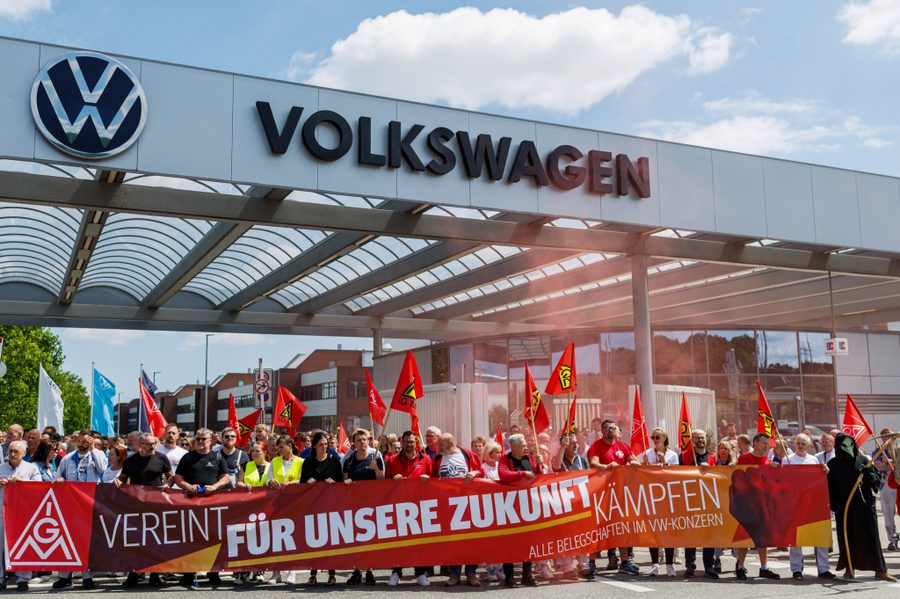
G.D.: Kaja Kallas, the EU foreign policy chief, has suggested openly that a dismembered Russia would be far easier to manage. But in the meantime, Europe’s economic model is failing on its own terms. Volkswagen is laying off tens of thousands of workers. The auto industry is hollowing out. What’s driving that?
R.W.: Yanis Varoufakis has been making this point correctly: the German economy is disproportionately organized around the automobile, and the auto industry is not merely shrinking — it faces possible elimination as we know it. I was in Paris a few months ago. I stepped into a taxi and noticed it was a BYD — a Chinese brand. I speak French, so I asked the driver about it. He said he was driving it because it was the cheapest and best car. He would have preferred a Peugeot, but a BYD is what he could afford. He told me the other drivers were pressuring the Macron government to allow more BYDs in because they want to buy fleets of them.
Europe has cut itself off from cheap Russian energy and is now buying American liquefied natural gas at many times the price. It is buying American weapons. It is signing trade deals that everyone openly acknowledges are terrible for Europe, but they are signed anyway as gestures of loyalty. All of this tribute makes Europe weaker, not stronger. And I think it draws contempt from Washington rather than affection, where this kind of subservience registers as confirmation that Europe no longer matters.
Let me go further. In the years before the Russian invasion, there was a massive program to build up the Ukrainian military. By the time Russia invaded, Ukraine had a larger army than most European countries — and it still could not prevail against Russia. Now add the Europeans, and you do not add very much. And behind Russia now is China, with a larger manufacturing base for missiles and drones than all of Europe combined. The Russians have a long border with China; the Iranians can supply Russia via the Caspian. What exactly are you undertaking if you challenge what they have now assembled?
Germany is talking about spending something like $800 billion on the military over the next ten years. Ten years. The United States spends roughly $900 billion per year, with proposals to increase that dramatically. You cannot catch up at the German pace. And Europe cannot sustain even that level of military spending without an austerity politics that would produce exactly the political instability — the rise of the far right, or left-wing alternatives like Jean-Luc Mélenchon’s France Insoumise — that European leaders are already losing sleep over. Marine Le Pen, the AfD: these are not aberrations. They are the product of a model that is failing its people.
G.D.: On the Russian economy specifically: it has shown remarkable resilience despite the sanctions. What explains that?
R.W.: I think the Russians have come to terms with their situation: they are junior partners of China, and they have structured their economy around that reality. The Chinese economy is four to five times larger than Russia’s, and the gap is growing. These are not equals. But Russia has something valuable to offer — a vast, resource-rich Asian landmass, and a military capability that China still needs time to match fully. So the two have an arrangement that is mutually beneficial. Russia has what Europe covets: room to grow horizontally, across the immensity of Asian Russia, with its resources, cities, forests, and land. And unlike Europe, it has a willing partner eager to help develop it.
G.D.: You’ve described a situation in which Europe has no good options — where all paths seem to lead toward further subordination or further instability. Is there a way out?
R.W.: There would be, but it is not on the menu. A Europe that recognized Russia as part of the European continent — the largest country in Europe, after all — could have negotiated a genuine, inclusive security architecture. It could have reduced its dependence on external security providers, diversified its economic relationships, and had a reasonably prosperous future. But that would require treating Russia as an equal, and European leaders are not capable of that. It would also require questioning the capitalist model itself — asking not just how to compete more aggressively, but whether an economy organized to maximize profits for a small number of shareholders is the right model at all.
This is the old Marxist question: what about the organization of your enterprises? An economy run to maximize wages and salaries — the income of the majority — rather than profits for a minority would behave very differently. I don’t say that as an ideologue. I say it because the insight here is becoming urgent. It may offer a way out of the dead end that otherwise confronts us. But as long as European leaders cannot even put inclusive security arrangements on the table, they will not be asking that question.
The hysteria, the demonization, the escalation — it is all driven by a historically accumulated desperation. They are not prepared to change their society to come to terms with reality. And so they go down with the ship.
Richard D. Wolff is professor of economics emeritus at the University of Massachusetts, Amherst, and a visiting professor in the Graduate Program in International Affairs of the New School University, in New York. Wolff’s weekly show, “Economic Update,” is syndicated by more than 100 radio stations and goes to 55 million TV receivers via Free Speech TV. His three recent books with Democracy at Work are The Sickness Is the System: When Capitalism Fails to Save Us From Pandemics or Itself, Understanding Marxism, and Understanding Socialism.
Glenn Diesen is a professor of Political Science focusing on geoeconomics and Eurasian integration.