The Elite 'OK' to Police Our Every Thought and Move
Adam Johnson joins Steven Thrasher to deconstruct the functions of liberalism, a theme deeply explored in each of their new books.
Adam Johnson and Steven Thrasher
In These Times is proud to be independent, pro-labor and anti-fascist. Support our work today and help left-wing journalism thrive.
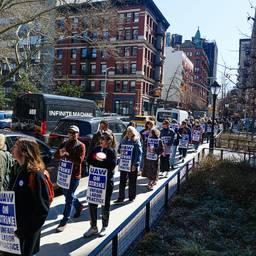
Over the last year and a half, the United States under Donald Trump has seen a deluge of brutal, targeted repression. The administration now has a long record of using Immigration and Customs Enforcement (ICE) to abduct and deport those fighting oppression, from union organizers in Washington to pro-Palestinian activists in New York.
And yet, as the authors of two recently released books discussed in a panel at Pilsen Community Books in Chicago, much of the groundwork for this reign of terror was laid by liberal institutions, from universities to major media outlets, during Joe Biden’s tenure.
In late May, Adam Johnson, author of How to Sell a Genocide: The Media’s Complicity in the Destruction of Gaza spoke with Steven Thrasher, author of The Overseer Class: A Manifesto, about their respective books’ efforts to catalogue the ways that many of the same elite voices now opposed to Trump resorted to similarly Orwellian and even violent tactics in their effort to quell the movement for Palestinian liberation after Oct. 7. Their talk dissects the way these powerful liberals, as Thrasher puts it, exist to “police the boundaries of what we’re allowed to think about and what we’re allowed to do.”
This conversation has been significantly edited for length and clarity.
Adam Johnson: First off, I want to say Steven’s book is a brilliant piece of journalism combining rigorous media analysis, memoir, cultural-political critique and, perhaps, most of all, a call to action. Along the way, we meet prominent academics who write books on James Baldwin, anti-apartheid citizens in the 1980s anti-colonial struggle and anti-racism who lined up to punish and sick armed police on anti-genocide activists in late 2023 and 2024. It’s reassuring to those of us who felt like we were being lied to and gaslit during that time period. But to orient the audience, can you give an overview of the thesis?
Steven Thrasher: It’s been hard for me to actually pinpoint when exactly I came up with this idea. Part of it began when I was reporting in Ferguson in 2014 for The Guardian when Michael Brown was killed. It actually was his birthday yesterday. He would have turned 30 yesterday.
Over the last decade or so, I feel pretty good about how the American people have broadly grown more and more critical of policing, of militarism, thinking about it structurally, seeing the ways that opinion polls will move to a majority of people thinking about defunding the police and a majority of people wanting to abolish ICE. As these structural critiques came up, I started really noticing Black cops over and over and over again. I realized that I was seeing Black cops so often on television. I was seeing the same actors playing Black cops in multiple projects.
So that was part of how I started thinking about overseers, but it was also largely from my experiences in academia. It really started at New York University when, in 2019, I was asked to give a graduation speech. I added a couple of sentences about Palestine. And it brought the hammer down on my head, and the person, Phil Harper, who was the one who most personally went after me, was not only Black and gay, but he was a member of my dissertation committee. Then I was coming to Northwestern, and I sort of thought, oh, there are these Black and, sometimes, Black and gay administrators or people around, and they’re really going to help me shepherd my career. Then I realized, oh no, they’re sent in to stop my career, or to keep people in line, to really police the boundaries of what we’re allowed to think about and what we’re allowed to do.
Johnson: I didn’t realize the extent to which there would be a major thematic overlap in our books, which I think it’s fair to say are fundamentally about the functions of liberalism. This is maybe not the most original point, but I think we identify unique manifestations of it when we look at the ways liberal institutions serve as both a release valve for capitalism and also its primary enforcer. When the rubber hits the road and the people in power are under any kind of existential criticism or threat, the hammer comes down, and the hammer is being wielded by a liberal nine times out of 10. And as I’m reading your book, I was routinely shocked by not so much the fact that you’re being picked on by psychos in Congress and the Zionist crybully groups, but the degree to which this is people who are Baldwin scholars and people who were anti-apartheid activists in the 80s. You know, the liberal is opposed to the injustice that happened 30 years ago, when it no longer matters. It’s literally leading left-wing anti-colonial scholars sicking police on students, and this is why Gaza really did solidify who was a fucking hack. So let’s talk about the fucking hacks. You have two different episodes, in 2019 and then, of course, 2024, during the encampment. Talk if you could about the ways in which you were disciplined for doing the thing that James Baldwin told you to do, and Toni Morrison told you to do, and anti-apartheid activists in the 80s told you to do.
Thrasher: In 2019, I was finishing my PhD at New York University. I was asked to give this speech, and I had two months to do so, and all this shit went down between when I was asked and when it happened. The biggest scandal was that every year, NYU would have something called the President’s Service Award, the students would choose clubs or groups that they wanted to honor, and then the president would present it to them. The students chose JVP and SJP, and it was a huge prediction of how things would play out over the next few years. The president didn’t show up. Everyone came to the ceremony, and the president wasn’t there. Then the next day, he blasted them in The Wall Street Journal, so everybody thought I was going to talk about this.
We were required to submit our remarks in advance, and I turned them in without saying anything about this: I added three sentences. I called Israel an apartheid state, and I knew that that, of course, would be very controversial. I’d had hasbara experiences as a journalist over the years, but I also said we all have to stand against anti-Semitism, Islamophobia, transphobia, queerphobia, because we’re going to be professors and we have to stand up for the least powerful amongst us. That did not feel controversial to me.
I could not imagine ever treating a student like this. I couldn’t imagine treating a Zionist student like this. There was one case where we knew a student had complained about something related to a discussion about Gaza, and in the six months in between, they never knew that I knew about their complaint, and yet we developed this very deep relationship, and they ended up being in the encampment. I ended up helping them get work published. We had the natural experience of having tension.
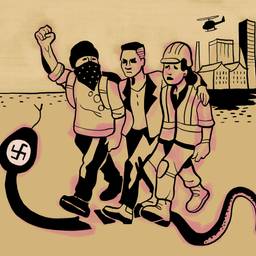

Johnson: I want to talk about the encampments, because the narrative that was given in the media was completely 180 degrees from what the encampments really were, which again were not sectarian, were not these proto-pogroms, it was interfaith, it was obviously intercultural and people showing solidarity with Gaza. Then you turn on CNN or Dana Bash, and you would think it was like a Nazi rally. It was a total Orwellian inversion of reality. So I want to talk about the encampments and what you experienced.
Thrasher: The Overseer Class was under contract; it was just signed right before October 7. Even before that, I knew that I wanted to write about what had happened to me at NYU in 2019. And there were encampments happening within weeks of October 7, but the one that lit the fire for the whole world was the Columbia one that happened when Minouche Shafik had gone to Congress. The day right after the first arrests, before the second big wave of arrests, I got onto the campus and spent the day there. That would have made me, I guess, an outside agitator. So I got into the journalism hall, Pulitzer Hall, and it was one of our alumni from Medill who’d actually somehow, through sheer force of her personality, set up a display and was putting up a picture of every journalist who’d been killed.
Students knew this without me having to say it. They all knew that it was obscene that journalism schools were not saying anything about the murder of these journalists. They knew it was obscene. Medill gives a “Courage” award every year, and they had just given one to Ukrainian journalists. They explicitly said in the press release that we’re not only giving it to them for being journalists, but because they sacrificed, protected women and children in their community. So they weren’t even on the objectivity schtick, and then they had nothing to say about Palestine. It’s just anti-Palestinian, anti-Arab racism.
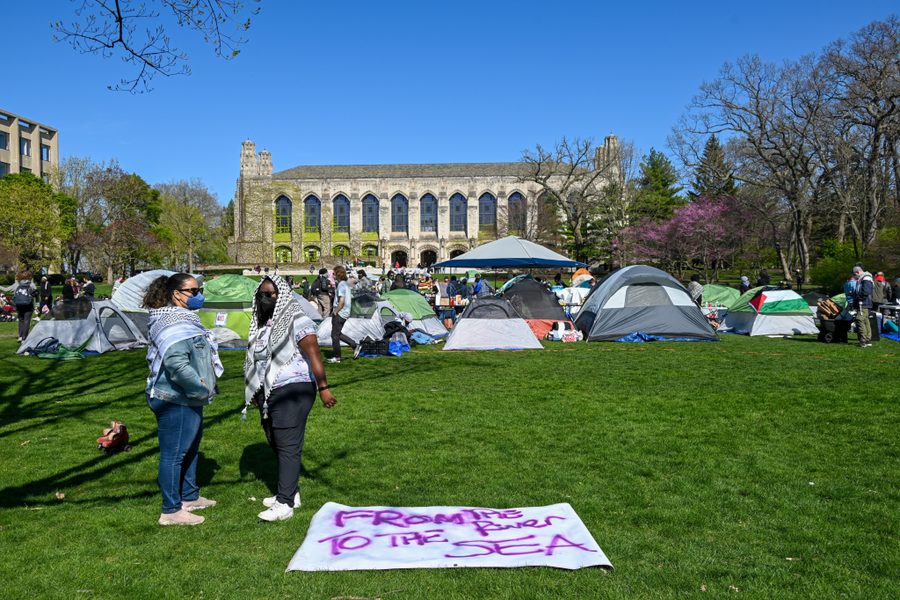
When I went to the encampment on the lawn, it was one of the most beautiful spaces that I’d been in. When I arrived, there were Jewish students surrounding Muslim students while they were praying, so they wouldn’t be photographed or harassed. It was a Friday, and there was a seder, and then the Muslim students were surrounding the Jewish students, so that they could pray afterwards. There were also Christian students, thinking about the role of Christian Zionism. So it was very clear that this was not anti-Semitism.
Johnson: As I document in the book, of the 25 top U.S. News and World Report universities, 12 of them issued neutrality statements in late 2023 and early 2024. All these liberal institutions had supported Ukraine. They all supported, ostensibly, anti-racism after George Floyd. And then, mysteriously, [starting] in late 2023, they all have these neutrality policies. And what it shows is that liberals can’t just say, “I’m a Zionist, I don’t really believe Palestinians are human, and I support U.S. Israeli imperialism,” because that’s tacky, that’s gauche, and it kind of betrays and belies the ostensibly universalist principles that they have. So they have to reverse engineer an ostensibly universalist position to be completely discriminatory towards Palestinians.
Thrasher: The person to do that is the overseer. The person to oversee that is the overseer. I was at Columbia on a Friday, I came back, and then Monday, Tuesday, Wednesday of that week, [encampments] started popping up all over the country. There were massive explosions of violence at USC, and I noticed most of the cops were Black at UT Austin. Then at NYU, my alma mater, it wasn’t really even an encampment; they were just on the one and only open public space that NYU owns, which now looks like a prison yard with bars and everything up around it. But professors surrounded their students, and I thought, all right, if I end up in that position, I’m gonna have to do the same thing.
Then we got word to our Educators for Justice in Palestine group at Northwestern that the students were going to do something, and they wanted professors to be with them. We said, all right, we’ll make sure there’s always four people who are with them. And I signed up for the first shift. I just woke up with nervousness. When I went, it was on Deering Meadow, which has a memorial dedicated to the students killed at Jackson State University and Kent State University, to student free expression.
The cops came in. We surrounded the students. It was actually the Black chief of police who beat me up.
At the 22 schools that I had written about in different ways, there was one Asian woman, and every other one was a Black man or Black woman, and I think two Latinos. It’s 86%. So I was like, let’s look at these 19 Black chiefs of police and at these primarily white institutions and compare the percentage of Black students — it’s 5%, and Black faculty is 6%. So that really helped me see how there are these overseers. We have diversified the disciplinarian apparatus, and the people put into these jobs are meant to be disciplinarians, and some of them are literal cops. I think something that is very frightening at universities is that many of these cops are also vice presidents, or they’re higher up in the college administration.
Johnson: One thing I really love about the book is that it is a deeply structural book, but at the same time, it’s also a very humble book. You’re not smug about it. You repeatedly talk about how people are products of structures. You talk about how you yourself have indulged in many of the things you criticize. You confess [in the book] that you wanted to apply to be a cop.
Thrasher: I did apply to be a cop.
Johnson: You did apply to be a cop. In another universe, you’re walking the beat somewhere in Queens. So, again, this is why you’re not self-righteous about it. To some extent, we are products of systems, but that’s not an excuse to crack in skulls when people protest genocide. Of course, you do go after what you view as the more pernicious goals of things like DEI and affinity groups, not obviously in the kind of right-wing shorthand, where it’s any Black person with an opinion you don’t like, but a kind of HR union-busting apparatus to some extent, or a way of co-opting.
You talk about the ways in which people are products of systems. But at the end, you talk about ways in which people within those systems can push back. And then you have this concept of a “Toni,” or someone who uses their position of power not to be an overseer but to actually lift people up and fight back. Talk about what a Toni is and where the overseer comes in.
Thrasher: Tokenism is a term from a sociologist named Rosabeth Moss Kanter. She was talking about people who are in minoritized positions. They’re put in figurehead positions, but they don’t have power. And that, I think, is different from overseers, who do have power and use that power to discipline and hurt people. They also withhold the power that they could use to say ‘no’ periodically.
I’m forgetting her name now, but the president of Boston University was enacting this content-neutral plan to take all the rainbow flags out of the university windows. And then, of course, students and faculty were not happy about this and put them back up in the windows. And then there were hundreds of them, and the university was threatening to go into every dorm room and every professor’s office and the LGBT center and take down all the pride flags. Some version of that happened all around the United States, because there was a massive purging.
I worked at something called the Institute of Sexual and Gender Minority Health and Wellbeing, and even though my colleagues there were pretty supportive of me, the Trump administration rampantly went after that institute. They’ve gone so harsh on trans issues, and trans issues have been a real flashpoint, as well as Palestine. And so there are ways that universities have purged a lot of these folks already. Anyway, this president at BU eventually did something I’ve never seen a college administrator do before. She said the policy was wrong. I’m ashamed that I enacted it, and we’re not going to go through with it. I can’t think of another time I’ve seen a college administrator do that.
Johnson: I didn’t realize you could do that. Obviously, you’re in those positions because you’re filtered out for banality and cowardice.
Thrasher: I write in the book about the painter Amy Sherald, who painted Michelle Obama. She’s probably one of the most, if not the most, famous Black women portrait painters in the world. And she was going to have her show move from The Whitney to the Smithsonian, but the Smithsonian wanted to take out the one painting she had of a trans person. It was called “Trans Forming Liberty,” and it portrayed the Statue of Liberty as a Black trans woman. And she just said, “No, absolutely not.” Lonnie Bunch III, who is a Black historian, was the secretary of the Smithsonian. They proposed to her, “Well, why don’t we just have a video of people discussing trans issues instead of the painting?” And she said, “Absolutely not.” She pulled the show. So a Toni is me riffing on Toni Morrison when she said, “I tell my students, when you get these jobs that you have been so brilliantly trained for, just remember that your real job is that if you are free, you need to free somebody else. If you have some power, then your job is to empower somebody else. This is not just a grab-bag candy game.”
For 50 years, In These Times has amplified the movements fighting for workers, against fascism and to build a more democratic future. Become a monthly sustainer today and keep independent journalism publishing for the next 50.

Get 10 print issues of our award-winning, worker-first journalism here!
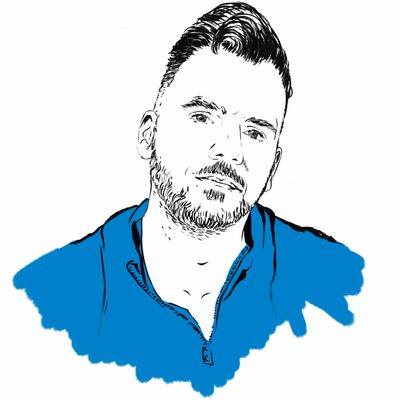
Adam H. Johnson is a media analyst and co-host of the Citations Needed podcast.
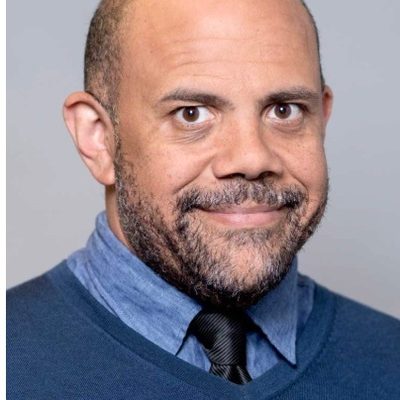
Dr. Steven W. Thrasher is a journalist, academic and author.