One early July morning in Austin, Texas, I sat slumped in a cavernous, featureless conference hall on the last day of Netroots Nation, the annual gathering of progressive bloggers. Half the attendees had already split town. Two days of events and two nights of vigorous celebration had left those who remained bleary-eyed, weakly nursing their bad coffee and stale muffins.
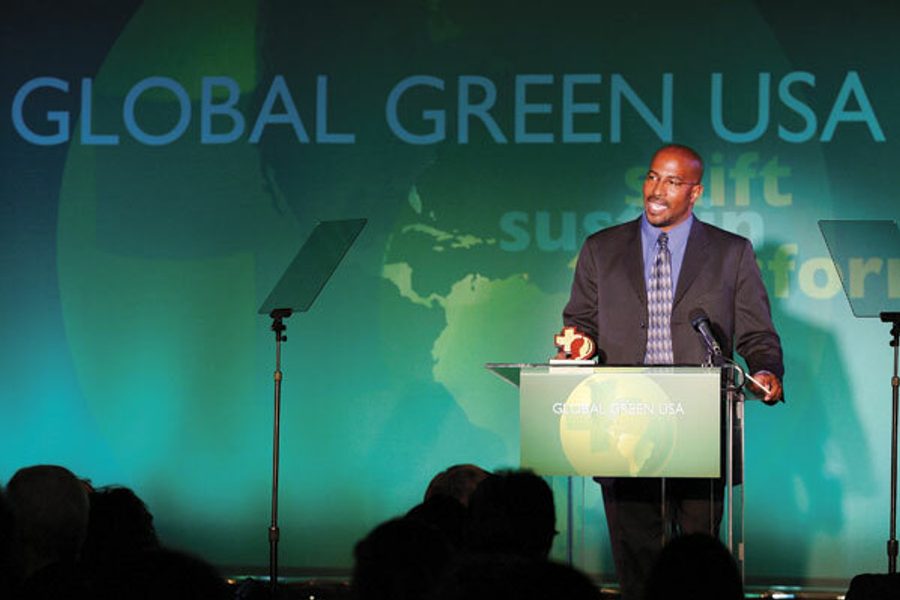
The morning’s only featured speaker was African-American activist Van Jones, co-founder of the national advocacy group Green for All, who had come straight off a plane from the North Pole. (Really.) Given his exhaustion – and ours – Jones could have been forgiven for phoning it in.
Instead, he began joking, cajoling and provoking, weaving an urgent narrative out of class, race, activism and the existential threat of global climate change. Sleepy bloggers sat up a little straighter and closed their laptops. They began nodding, then cheering, then rising to their feet, stomping and shouting. After a half hour, the previously somnolent room hummed with energy.
It’s not just bloggers and activists – Jones has also gotten rapturous reception from business executives, politicians and community groups.
In fact, it’s difficult to think of another progressive activist who has created as much national buzz as quickly. His self-effacing humor, sharp intellect and unapologetic idealism call to mind another black orator who recently found success.
It is not lost on Jones – who, as co-founder of the Ella Baker Center for Human Rights, spent much of the ’90s organizing around criminal justice and urban issues – that he received exponentially more attention after he started talking green, or that affluent white environmentalists take a certain unearned satisfaction from having him at their meetings and among their ranks. But he has used the spotlight to drive home a message that he has now put to paper in The Green Collar Economy: How One Solution Can Fix Our Two Biggest Problems (HarperOne, October).
The message is fairly simple: Meeting the challenge of global climate change will involve an enormous amount of work – solarizing and retrofitting buildings for energy efficiency, manufacturing electric cars and parts for wind turbines, building public transit systems and smarter electrical grids, and much more.
The next few decades will see the creation of millions of blue-collar jobs that serve to meliorate social and environmental ills – known as “green-collar” jobs.
Jones argues that these jobs should be directed to those who have been most harmed by the “pollution-based economy” – such as ex-felons, recovering addicts, at-risk youth, the working poor, those who have seen their jobs outsourced, and people of color (who have disproportionately suffered from high rates of asthma, cancer and other ailments tied to environmental toxins).
Further, government and the private sector should work together to ensure that they are good jobs, with living wages, decent benefits and clear career paths.
It’s not just a matter of justice, says Jones, but of simple necessity. There will never be sufficient political action on climate change if the only group pushing it is the “eco-elite.” To realize the scale of changes needed – and at the speed needed – will require the broadest possible coalition, big enough to take on the “military-petroleum complex,” as Jones calls it.
That means bringing in the working class and many people of color by focusing on kitchen table issues – jobs, economic security and health. It means toning down the polar bears and Priuses and bringing out the hard hats and caulk guns.
Everyone who isn’t mobilized into the “green growth coalition” will be mobilized against it, warns Jones, just as poor people of color turned out against California’s Proposition 87 in 2006. In that referendum, oil companies spent millions convincing people that the measure, which would have taxed oil companies to pay for clean energy, would increase the price of fuel and food.
The call for green jobs that Jones (among others) helped launch has been taken up by President-elect Barack Obama, House Speaker Nancy Pelosi (D-Calif.), Senate Speaker Harry Reid (D-Nev.), several dozen governors, and – via the Mayors Climate Protection Agreement – more than 900 U.S. mayors.
Just as the green growth narrative gained strength, the country was hit by a devastating economic crisis. Broad consensus has coalesced around the need for large-scale public stimulus spending, just as broad consensus has coalesced around the need for green infrastructure, clean energy, energy efficiency and green-job training.
Van Jones, it would appear, is riding the zeitgeist.
It’s a shame, then, that his book captures so little of his personal magnetism and energy. As a sketch of the green growth movement’s rationale and agenda, The Green Collar Economy is competent – but merely competent. The book often reads like a book report or a lawyer’s brief.
Those who have heard Jones speak will have difficulty hearing his voice behind the earnest, flat-footed prose. Certainly, some of his humor would have served to leaven the heavy proceedings.
At the literary level, Jones has a difficulty that is common with first-time nonfiction writers – how to mix abstraction and anecdote, telling and showing.
Large swaths of high-toned rhetoric are interspersed here and there with awkward lists of examples. Many individual passages shine, but it will take another book or two before Jones masters the art of letting his stories make his points for him.
The author’s natural voice can be most clearly heard where he describes the challenges of building a “hybrid movement” – a “movement at the intersection of the social justice and ecology movements, of entrepreneurship and activism, of inner change and social change.”
Few have better insight into both sides of those divides than Jones, who has spent a career shuttling from Oakland to Marin County, from poverty to affluence, and from concern over the next paycheck to concern over Arctic ice shelves. He has lobbied legislators. He has pitched to idealistic college activists and to weary single moms.
In the process, he has cultivated a kind of deliberate, pragmatic empathy. And the lessons he draws from that – about how liberals can develop a more confident and inclusive approach to power, reclaim a convincing populism and begin working across conventional barriers – are worth the price of the book.
The scientific and economic arguments for urgent action on climate change are impeccable.
The politics are ripe.
The policy proposals – which Jones lays out in great detail over two chapters – are credible.
But the notion that the fractured, isolated camps of the progressive coalition can overcome their hang-ups and unite to shape a just and sustainable future … let’s just say that requires large measures of hope.
Then again, there’s a lot of that going around these days.