Anti-Austerity Alliance Wins in Illinois
A 300-member coalition helps raise taxes to save essential services.
David Moberg
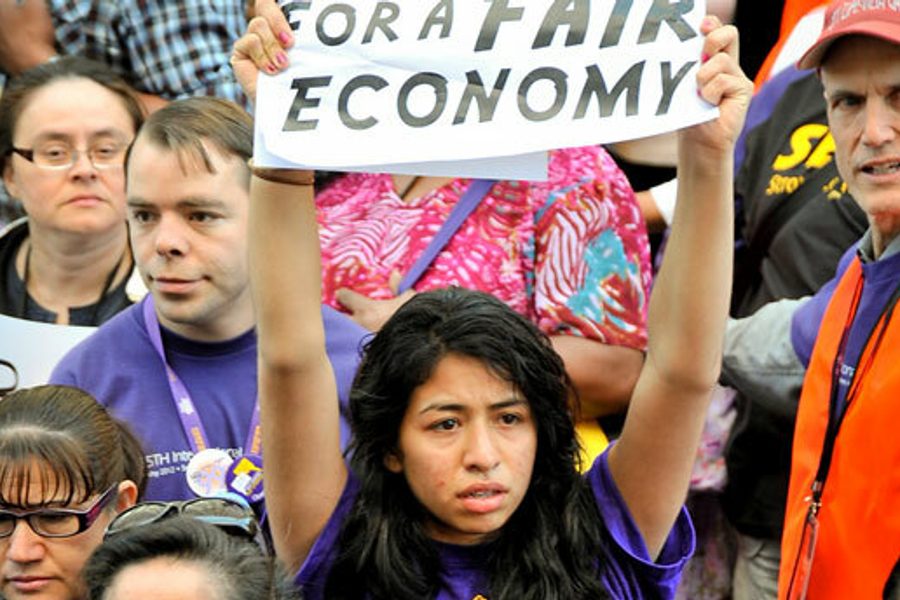
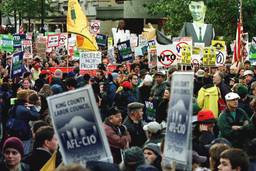
Last April, Sandra Wiekerson took a day off from her work caring for elderly people in their homes on Chicago’s northwest side. She joined 15,000 other Illinoisans in the state capital of Springfield for a historic rally and lobbying day.
“Raise my taxes,” they chanted. “Show some guts, stop the cuts.” Participants in the ‘Save Our State’ rally, one of the largest demonstrations ever directed at the Illinois legislature, urged the state government to raise taxes so it could pay for essential services, including $6 billion in unpaid bills carried over from the previous year.
The Responsible Budget Coalition (RBC) called the rally as part of a long, multifaceted campaign to fix fundamental flaws in the state’s tax structure that the recession worsened. The RBC is comprised of more than 300 groups, including social service agencies reimbursed by the state, public employee unions, and community, religious and citizen advocacy groups concerned about the welfare of vulnerable populations.
Wiekerson, 58, represents both dimensions: As a member of the Service Employees International Union (SEIU), she wants to preserve her own job. But she is also committed to her clients, who include an elderly man with heart problems and glaucoma, confined to a wheelchair with no family to help him.
“If the agency closes, who is going to take care of them?” she asks. “I see myself in these people, and I hope there will be somebody who will be around for me. We should ask the question, ‘Am I my brother’s keeper?’ “
Anatomy of a crisis
That question may not have been on Illinois state legislators’ minds during a January lame duck session. More likely, it was how the state could pay its bills. But by the narrowest of margins, Democratic lawmakers passed a substantial increase in state income taxes – 67 percent higher for individuals and 46 percent higher for corporations (that is, for the less than one-third of Illinois corporations who pay any income tax). The newly re-elected Democratic Gov. Pat Quinn swiftly signed the bill into law.
The Illinois tax package is among the largest of the revenue increases that have been enacted since the financial crisis began. According to the Center on Budget and Policy Priorities (CBPP), 30 states have already taken such measures, including 12 that have raised income taxes. During the past two years, 46 states including Illinois have also reduced public services.
The tax hike only did “the bare minimum they had to do,” certainly not all that the coalition wanted, says Ralph Martire, executive director of the Chicago-based Center for Tax and Budget Accountability, a member of RBC. The increase is temporary. It provides no relief for lower-income taxpayers from the constitutionally mandated flat tax. It imposes a spending cap. And until the legislature approves new bonding authority, it does not permit the state to promptly pay its old bills.
Without new revenue, Illinois faced a $15 billion budget deficit. Even before the recession deepened its fiscal crisis, the state suffered from a severe structural deficit, which grew out of a tax regime that disproportionately burdens lower-income people and does not generate enough revenue to meet growing state needs.
Illinois does not face deficits because it is poor (it ranks fourteenth among states in per capita output in 2009) or because it is profligate. It spends far below average in proportion to its wealth and capacity; in 2008 it ranked forty-fourth in total state and local taxes as a percentage of income.
The problem is that during the past two decades, Illinois leaders have been spineless and irresponsible. Republican Gov. Jim Edgar embraced progressive tax reform after being elected in 1994, but his own party rebuffed his plan. Then, in 2002, Democrat Rod Blagojevich was elected governor, promising “no new taxes” at a time when his party could have easily raised and reformed taxes in Illinois.
Opportunism knocks
It’s a familiar story playing out (in less severe fashion) across the country, as states governments currently face their “most difficult year on record,” CBPP reports. These state budget crises have ominously drawn a response by a new conservative crop of Republican governors and legislators (see Frontline story, page 11), joined by some Democrats like New York Gov. Andrew Cuomo, to promote deep budget, service and job cuts that will surely hinder the recovery. At the federal level, Newt Gingrich and other right-wingers propose granting states the right to declare bankruptcy as a tool to escape pension obligations.
In a broadside attack on unions and worker rights, politicians are exploiting the current crisis to promote restrictions on collective action by both public- and private-sector workers. Proposed restrictions include new right-to-work laws; elimination of public workers’ rights to unionize or strike; rollback of state minimum wages; and prohibiting union recognition through majority sign-up.
Unions are resisting these assaults with public education campaigns that rebut the misconception that public workers are overpaid and have unaffordable pensions, and that shift blame for the crisis from workers back to Wall Street. Paul Booth, assistant to the president at AFSCME (American Federation of State, County and Municipal Workers), says that his union is also “appealing to rank and file members of organized labor to take matters in their own hands.”
Unions and progressive allies in many states are taking matters in hand by preparing their own set of initiatives. These include granting workers paid sick days and family leave, raising the minimum wage, enforcing laws against “wage theft” and progressively raising taxes. For example, Citizen Action New York is proposing measures to create jobs and improve schools with revenue from higher taxes on millionaires.
The RBC’s victory “gives people a sense that it could happen elsewhere and provides a model for organizing,” says Jeff Blum, executive director of USAction, a national coalition of groups like Citizen Action/Illinois, which helped to raise Illinois’ income taxes. “We can’t just be defensive.”
Building and executing the campaign
It’s obvious that progressives should take the offensive and promote fairer taxation and closing corporate tax loopholes. So how did they do it in Illinois, with substantial (albeit imperfect) results?
Over the years, various budget coalitions have formed to promote higher, more progressive income taxes and sales taxes on services, most recently with a promise of more school aid and property tax relief. But the business people and hedge fund investors who in 2007 had been part of that effort – dubbed A+ Illinois – dropped their support for tax hikes to better fund public schools. Instead, by late 2008, most began promoting charter schools.
Citizen Action, AFSCME and other groups began re-forming a coalition in early 2009, soon joined by another coalition started by SEIU. By the summer of that year, John Bouman, director of the Sargent Shriver National Center on Poverty Law, had assembled a broad coalition by overcoming past tensions among different constituencies, such as social service and education advocates, provider agencies or firms and unions, low-income groups focused on progressive taxes and organizations focused on raising revenue. The RBC was born.
RBC initially united on four principles: no major service cuts, significant new revenue, more tax fairness, payment of back bills and later, no built-in spending constraints. But House Speaker Michael Madigan – a powerful but conservative and cynical Democratic leader – wanted a bill that would draw some Republican votes, giving House Democrats bipartisan cover in the next election.
Nevertheless, RBC pressure solidified Democratic lawmakers’ support for a tax hike. And the work of many coalition members enabled Quinn, who supported an increase, to narrowly win re-election, even if some endorsed him reluctantly following his cuts to services and to new workers’ pensions. In negotiations Madigan prevailed, but the concessions he forced won no GOP votes.
“Madigan thinks the state spends too much, and he doesn’t much care about improving education or human services,” says AFSCME community and political affairs director John Cameron. “So forcing him to pass any tax increase is a victory for the progressive movement. But it is what it is.”
That is to say, it’s a real, if limited, achievement showing what savvy, inclusive organizing can do in these hard times.

Get 10 print issues of our award-winning, worker-first journalism here!

David Moberg, a former senior editor of In These Times, was on staff with the magazine from when it began publishing in 1976 until his passing in July 2022. Before joining In These Times, he completed his work for a Ph.D. in anthropology at the University of Chicago and worked for Newsweek. He received fellowships from the John D. and Catherine T. MacArthur Foundation and the Nation Institute for research on the new global economy.