Trump’s Attacks on SCOTUS Are Personal—But Real Court Reform Should Be a Progressive Priority
The president keeps attacking the Supreme Court after its tariff ruling, but SCOTUS rules for the wealthy and obstructs progressive policies. Court reform must be a priority.
Shahrzad Shams and Todd N. Tucker
This article was originally published by Roosevelt Institute and was reprinted with permission.
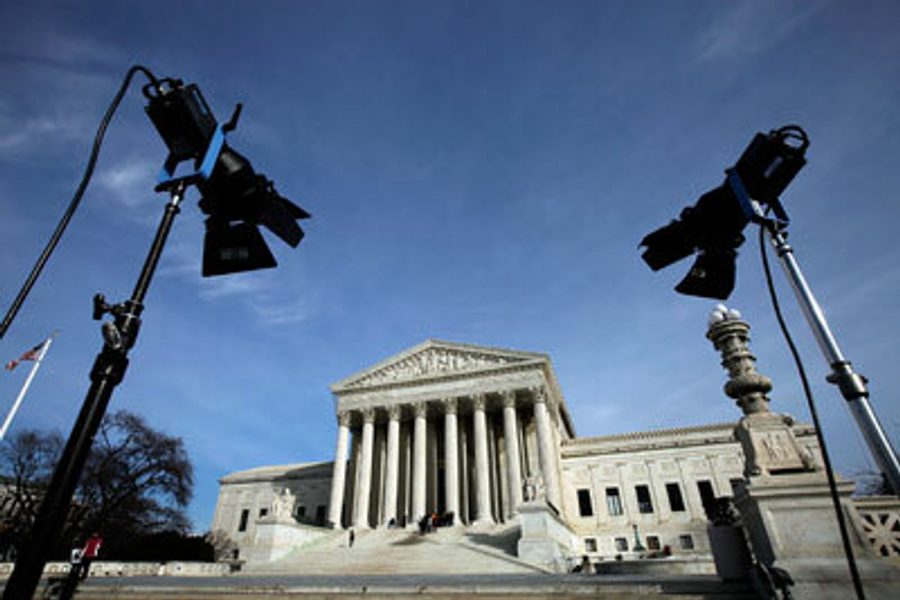
It seems like a lifetime ago, but last Tuesday, something really important in U.S. constitutional history happened. In the longest-ever State of the Union speech, while staring directly at the four Supreme Court justices sitting just feet away, President Donald Trump repeatedly referred to the Court’s anti-tariff decision in Learning Resources, Inc. v. Trump as “unfortunate” and “disappointing.” In a press conference just days before, he was even more pointed, saying “the Court was swayed by foreign interests,” and that the justices who opposed his tariffs were a “disgrace,” “fools and lap dogs,” and “very unpatriotic and disloyal to our Constitution.” He even appeared to passingly entertain the idea that the Court should be expanded from nine to 21 members. One week later, the president took to Truth Social to query whether the “highly disappointing, to say the least,” decision could be reheard or readjudicated.
These episodes were some of the most direct verbal assaults by a president on the judiciary in U.S. history. Even former President Franklin D. Roosevelt (FDR), who confronted a Supreme Court dead set against his New Deal, disguised his court-packing plan in the language of improving efficiency,1 whereas Trump all but brazenly admitted his attacks were retaliatory. Some observers will understandably see this diatribe as just the latest insult to U.S. democracy by a president who has proved willing to weaponize the power of the state against his political enemies. And while Trump’s reasons for disparaging the Court are, of course, rooted in his petulant inability to handle being told no, his comments reminded us of how rare it is to hear progressives (whose preferred policies the Court has often overturned) call out a branch of government that is itself broken.
The Roberts Court has long been one of the most inhumane, anti-labor, pro – Big Business benches in U.S. history. And in the last few years, the reactionary majority has repeatedly sided with Trump by granting him absolute immunity, functionally greenlighting his attempts to limit birthright citizenship, and allowing immigration agents to continue racially profiling in conducting their stops. And while the tariff case had some of the reactionary justices bucking the head of the party most aligned with their ideological leanings, as former Biden official Bharat Ramamurti noted, they were not bucking the desires of capital — and the decision will actually worsen inequality.
Nonetheless, the libertarian law firms that brought the cases met their apparent goals. Chief Justice John Roberts and Justices Neil Gorsuch and Amy Coney Barrett expanded the “major questions” doctrine’s deregulatory impulse toward foreign policy and Trump’s priorities; Justices Brett Kavanaugh, Clarence Thomas, and Samuel Alito continued to bless the doctrine as applied on the homefront to progressive priorities like fighting climate change, student debt, and pandemics; and the liberal justices came closer to the doctrine by interpreting a trade delegation narrowly. (This is despite the fact that the policy history, dating back to the FDR administration through the 1970s, would have argued for a broad interpretation).
After arguing before the decision that Trump could better rebalance trade through other statutes, opponents of activist trade policy are now making clear they want to pare back those other statutes as well. For instance, in legal filings before appellate courts in July 2025, Ilya Somin of the Cato Institute and fellow counsel argued that it is “Section 122, not IEEPA, that governs where — as here — the President seeks to impose special tariffs in response to trade deficits. That statute gives the President the flexibility he needs to remedy problems associated with those deficits.” But now that Trump is actually using that other statute, Somin maintains: “If allowed to stand, this action would undermine the constitutional system almost as much as the IEEPA tariffs did.”
As recounted in a series of blogs and briefs over the last year, the immediate sources of Trump’s anger were the successful legal challenges against his tariff actions under the International Emergencies Economic Powers Act (IEEPA). While news reports understandably highlighted the top-line fact that the right-wing Court ruled by majority against Trump, the story beneath the surface was more complicated. At both the appellate and Supreme Court level, there were at least four different camps, with no single rationale commanding a majority as to why Trump’s tariffs were illegal. What’s more, dissenting opinions were issued by jurists appointed by the “free trade”-oriented presidents George H.W. Bush (1 jurist), George W. Bush (3 jurists), and Barack Obama (2 jurists) — with only one of the jurists (Kavanaugh) being appointed by the trade skeptic Trump himself.
Long before Trump decided something was amiss with the Court, others were well aware. Over 2019 and 2020, under pressure from progressives and a public dissatisfied with the Court’s increasingly rightward turn, court reform was central in the public policy debate. But Trump’s predecessor, former President Joe Biden, was notably reluctant to take on fundamental democracy reforms. In 2020, he ducked questions on the Court, allowing only that the body was “getting out of whack.” As president, he mothballed Court reform by appointing a powerless Presidential Commission on the Supreme Court, which recommended against Court expansion, and instead expressed openness to term limits — despite the infeasibility of such a proposal. Even when, in 2022, the Court overturned Roe v. Wade, taking away the fundamental right to choose, Biden issued a few executive orders aimed at safeguarding some reproductive health services, and pledged to attempt to codify Roe, an idea that became moot when it failed in the Senate. (Activists faulted him for dampening enthusiasm on the question in 2022.) But he crucially failed to take any real action to rein in the Court. It was not until 2024 that he announced his support for Supreme Court term limits and an ethics code — relatively modest reforms that close observers deemed “mostly useless.”
Or rewind still further, to one of the previous (relatively recent) high-water marks of presidents confronting the Court: Sixteen years ago, former President Barack Obama delivered a State of the Union address that generated a fair bit of controversy, though not for the right reasons. Speaking just days after the Supreme Court handed down Citizens United v. FEC, Obama criticized the ruling before Congress and the American people: “With all due deference to separation of powers, last week the Supreme Court reversed a century of law that I believe will open the floodgates for special interests — including foreign corporations — to spend without limit in our elections.” As the camera panned across the chamber, watchful observers took note of Alito in the crowd, shaking his head, scowl on his face, and appearing to mouth the words “not true.” (Last week, the justices in contrast remained stoic.) Obama went on to declare that he didn’t “think American elections should be bankrolled by America’s most powerful interests, or worse, by foreign enemies. They should be decided by the American people.”
It was a tepid statement — benign, if not outright commonsensical. And yet, Obama got flak for it. Roberts called the address a “political pep rally,” centrist voices wrung their hands about institutional decorum, and legal bloggers who rushed to fact-check the president noted that, technically (*pushes glasses up bridge of nose*), Alito “had a point” and was correct to discount Obama’s description of the holding of the case. (Technically, the Court hadn’t “reversed a century of law” as the president had claimed — the majority in Citizens United declined to resolve the question of foreign corporate spending, leaving existing statutory prohibitions in place.)
If this were an isolated case of amateur political-theater criticism, we could write it off as the spectacle it was. But the inertia on Court reform cannot be solely attributed to Obama or even Biden. It reflects a deeper and wider problem with our country’s political-cultural mythology surrounding the Court in general — and Roberts in particular — as some sort of neutral and detached arbiter of the truth that operates wholly outside the domain of partisan politics.
Take liberal legal commentator and Harvard law professor Noah Feldman, who wrote in 2015 that “Roberts deserves admiration, not contempt.” Or The Atlantic’s Jeffery Rosen, who in 2020 claimed that Roberts was “establishing his own preeminence by working with his colleagues to maintain the Court’s bipartisan legitimacy.” That same year, writing for the New York Times, liberal legal scholar Akhil Reed Amar expressed his relief that in an era of rampant political polarization, the Roberts Court was “outperforming” the rest of government and the media when it came to scaling back on partisanship: “Fortunately, there is no aisle on the Supreme Court bench, literally or figuratively.”
Sentiments like these pop up in the mainstream legal discourse just about every time the Roberts Court avoids handing down a worst-case-scenario decision. This time around was no exception, when The Atlantic’s center-right commentator David Frum likened the Court’s tariff decision to parliamentary reassertion of the taxation prerogative in the 1640s English Civil War, or when the outlet’s center-left writer Idrees Kahloon celebrated the Court’s decision because it would block future progressive administrations from instituting carbon-based tariffs. All of these episodes follow from the standard narrative that FDR’s greatest error was his own effort to expand the ranks of the Court — even though the mere threat of doing so succeeded in jolting the judiciary from opposing to supporting the New Deal.
The short answer: yes. But it requires a willingness to question the trajectory we have been on in recent decades to an unchecked judicial supremacy. As one of us, Shams, wrote, the Roberts Court has invented judicial doctrines like major questions, which enables the judiciary to second-guess Congress’s delegation of power to the executive branch — even when it does so clearly and intentionally — if a regulation could have a major economic impact. Given that such doctrines can be applied or not applied on a case-by-case basis, this amounts to a judicial policy veto on decisions that were democratically made.
Americans don’t have to accept this state of affairs. As the other of us, Tucker, wrote in a Roosevelt report, Off-Balance: Five Strategies for a Judiciary That Supports Democracy, former presidents from Abraham Lincoln to FDR reshaped the Court to better reflect the popular will and protect human rights. Should there again be an opportunity to push forward meaningful progressive reforms, it’s imperative that we follow in their footsteps and demonstrate the will to take meaningful structural action against the Court.
Notably, since last week, Trump has eased on his anti-Court rhetoric and appears to be complying with at least the immediate implications of the opinion. He is also not asking Congress to do anything differently, which House Speaker Mike Johnson ecstatically endorsed last week. Instead, in typical Trump fashion, he is attacking the Court for lack of loyalty to him personally, and certainly not for excessive loyalty to the business class. His most sycophantic followers are following his lead, expressing irritation with the decision but not proposing to do anything structural about it. (See the posts from right-wing talkers like John Eastman and Mark Levin.)
This leaves a lane wide open for progressives to advance reform by outflanking Trump’s mere rhetoric with actual policy and movement-building to rebalance the Court. The Left has the ideas and the moral authority. What remains to be seen is if finally, at long last, there is the will to make transformational reform a progressive priority and put it at the center of the public debate.
- Of course, his public communications were much more explicit about this systemic critique of the Court, as Josh Chafetz notes on Bluesky and we write in our 2018 report.

Get 10 print issues of our award-winning, worker-first journalism here!
Shahrzad Shams is the deputy director for the race and democracy team at Roosevelt Institute, where she focuses on advancing racial equity, combating authoritarianism, and fighting for an inclusive multiracial democracy and economy.
Todd N. Tucker, a political scientist, serves as director of the industrial policy and trade program at Roosevelt Institute and leads Roosevelt’s work on the role of governance and institutions, both national and international, in facilitating economic transformation.


