The Pro-Democracy and Climate Movements Just Scored a Win In an Unexpected Place
Arizona residents recently won a major fight for democratic public ownership of their electric utility.
Marjorie Kelly and Thomas M. Hanna
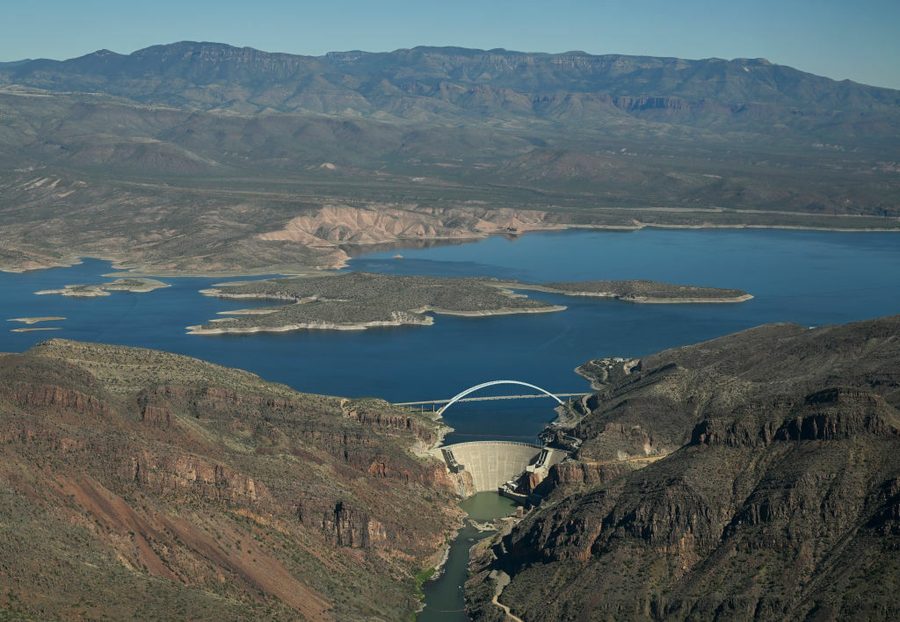
With household electricity prices climbing, and resistance to massive AI data centers growing, Arizona residents have taken matters into their own hands. This April, in a local election for the power utility board of the Salt River Project (SRP), green energy candidates won a majority of seats. In a nationally watched win for a more democratic and sustainable economy, the newly empowered SRP Clean Energy Team will now hold an eight-to-six majority on the district board of one of the nation’s largest publicly owned electric utilities.
This election is part of a growing effort to assert democratic control over local electric utilities. More than a dozen communities now have active campaigns to bring electric utilities into public ownership, and where public or cooperative utilities already exist, there are emerging opportunities to make these institutions more democratically accountable and participatory. That’s the case with the Salt River Project, where the recent board election saw a massive spike in public interest and involvement.
Efforts like this are part of a growing international paradigm and movement called Democratic Public Ownership (DPO) — which The Democracy Collaborative has helped develop and popularize over the past several years. DPO is about reimagining publicly owned enterprises, services, and assets on the basis of broad-based public participation and control, justice, equitably shared prosperity, and social and ecological progress. It is also about how these institutions interact with, and support, the movement to build a more democratic political and economic system.
A battle in the desert
The Salt River Project delivers power and water to communities in central Arizona and Phoenix, one of the nation’s hottest and driest cities. The election for the board of the power utility (which is a subdivision of the State of Arizona) pitted reform-minded clean energy candidates against a group of mostly incumbent utility insiders. The latter were supported by business organizations and the right-wing organization Turning Point Action (the partner organization to Turning Point USA), which pumped hundreds of thousands of dollars into its chosen candidates.
Despite this unprecedented spending — and archaic voting rules that give large landholders enhanced voting rights — the SRP Clean Energy Team still managed to secure a majority. The victory means that advocates for renewable energy and affordability will now have a chance to influence utility policy and operations in the state.
Describing what she hopes is a new era for democratic accountability, SRP board member Sandra Kennedy, of the clean energy slate, said: “I can say that the board members have just kind of been followers of management, so whatever management wanted, they got it. I think it’s a new day.”
Today’s rapidly evolving energy environment makes these types of campaigns more urgent — and potentially more winnable. With the U.S.-Israeli war on Iran devastating petroleum supplies, and with data centers ratcheting up electricity demand and costs, the need to rapidly increase the production of green energy is more evident than ever. At the same time, under President Donald Trump, the federal government has largely retreated from its past role in actively advancing this process, and state progress has been uneven at best.
Local residents are beginning to step into the vacuum. The message is simple: the people and the planet cannot wait for Washington or state governments to act on issues like green energy and affordability. There is an opportunity, here and now, to intervene directly to begin building a more democratic energy sector, responsive to planetary sustainability and the needs of people and communities.
From public ownership to democratic public ownership
There are around 2,000 existing publicly owned utilities in the United States and its territories today which, along with cooperatives, provide power to around 28% of the nation’s customers. They serve as an example of what can, potentially, be achieved through public ownership. On average, publicly owned utilities have residential electric rates that are around 2.5 cents per kilowatt-hour lower than for-profit, investor-owned utilities. They are also more reliable, experiencing outages lasting an average of 1.2 hours compared to 2.3 hours for investor-owned utilities. Publicly owned utilities also return a higher share of their operating revenues back to local communities than investor-owned utilities do (5.1% vs. 4.7%).
This potential to lower costs, improve service, and reinvest in communities — alongside the goal of increasing renewable energy generation — has motivated numerous municipalization and other public power campaigns in recent years. Some of these have been successful, while others, like the effort to take over two large investor-owned utilities in Maine, have failed amid intense industry opposition.
In California, there is an ongoing effort to convert the massive investor-owned Pacific Gas & Electric (PG&E) — which has been widely criticized for poor service and maintenance — into a publicly owned utility (or group of utilities) focused on affordability and clean energy. In February, California State Sen. Scott Wiener introduced the PG&E Breakup Bill, to allow cities to transition to municipal power more easily. San Francisco, in particular, is seeking to buy out PG&E’s local infrastructure, which has been an ongoing community campaign since 2019.
On the other side of the country, in New York, there have been several recent efforts to expand public ownership and control of energy. In 2023, the state passed the Build Public Renewables Act, which authorized the publicly owned New York Power Authority (NYPA) to begin directly building renewable energy generation. More recently, in December 2025, the Public Power Democracy Act was introduced in the state legislature. This legislation would restructure how NYPA is governed, adding greater accountability and requiring that appointees include experts in consumer advocacy and environmental justice. A more comprehensive piece of legislation, the New York Utility Democracy Act — which would put the entire state power system into public ownership, with democratically elected boards — has been discussed but has yet to be introduced.
While public ownership of energy utilities and infrastructure has the potential to deliver economic, social, and ecological benefits, none of this is guaranteed. Around the world, there are plenty of examples of publicly owned companies with poor track records (just as there are with private companies). As the Salt River Project fight in central Arizona demonstrates, what makes publicly owned utilities unique — and potentially uniquely transformative — is that they are, at least in theory, democratically accountable and contestable.
Whether oriented around existing or new utilities, public power campaigns can become more effective when they embrace DPO; one important principle of which is the concept of embedding and replicating genuine participation within a publicly owned enterprise. As history has demonstrated time and again, democratic processes need constant tending, adapting, and refinement to ensure that participation and accountability don’t whither and atrophy over time, and to maintain support for public ownership across multiple constituencies.
In the Salt River Project case, such a process of embedding democratic processes could include an effort to revise the outdated voting laws based on land ownership, alongside other approaches that codify and empower true and lasting community participation.
The work ahead
The U.S. energy system is at a critical inflection point: rising costs, climate imperatives, and geopolitical instability are exposing the limits of both market-driven and centralized approaches, while opening new space for local, democratic intervention. The growing interest in public ownership — and, more importantly, in DPO — reflects an increasing recognition that who owns and governs energy infrastructure matters as much as how electricity is generated.
Existing publicly owned utilities already demonstrate tangible advantages in cost, reliability, and community reinvestment, but these benefits are not automatic; they must be actively claimed, defended, and deepened through democratic governance, active participation and institutional reform.
A just and sustainable energy transition is possible, but it will require communities across the country to fundamentally and democratically reshape institutions from the ground up in order to serve people and the planet alike.

Get 10 print issues of our award-winning, worker-first journalism here!
Marjorie Kelly is Distinguished Senior Fellow at The Democracy Collaborative.
Thomas M. Hanna is Vice President of Research and Policy at The Democracy Collaborative.