Notes on Our Connected Crusades for Liberation
Three poems from Cortney Lamar Charleston’s new collection, “It’s Important I Remember.”
Cortney Lamar Charleston


As I compose this note, we are four months into the 250th year since the United States declared its independence. Two months in, our government had already kidnapped the president of a sovereign nation and commandeered oil tankers in the Caribbean (after months of bombing civilian boats). One more month in, we had littoral combat ships, several destroyers and two aircraft carriers stationed in the Arabian and Mediterranean Seas, facilitating (ongoing) strikes on Iran. One of the aircraft carriers is named for President Abraham Lincoln, who presided over this country’s ripping itself in two — I just find that interesting. The second aircraft carrier is named for President Gerald Ford, who pardoned his predecessor, Richard Nixon, setting the precedent of no accountability for lawless American presidents — again, I just find that interesting.
The poems presented here live in my new collection, It’s Important I Remember. It navigates the anxieties stirred by rising white nationalist autocracy within the United States by turning to the archives for narratives of Black American resistance and resilience that provide instruction for our current struggle. The larger book is born out of domestic disturbances, and yet these selected poems explicitly look beyond American borders. Why? Because American belligerence as we know it at home is precisely how it’s known abroad; the same pathologies that maintain racial caste and further the extraction of wealth from the margins of society to redirect it toward the top are the same beliefs that enact imperialist violence in our names. These three poems acknowledge and remind us that nowhere in the world are crusades for liberation disconnected from one another. In fact, it’s quite the opposite, especially for a person with my positionality: The disproportionate geopolitical, military and economic power of my country makes it imperative that I and other Americans work to disabuse it of its delusion of exceptionalism and, consequently, its habit of extinguishing or consuming Black and brown lives on either side of an imaginary line.
dropping the atomic bomb on Japan was only one of them.
Rather than the big bomb, the president could’ve chosen to
rain fire with smaller shells over a wider swath of the country.
Rather than the big bomb, the president could’ve chosen to
land the troops on shore and sweep from city to city,
town to town, fighting trained soldiers
and civilians armed with crude weapons and will.
Rather than the big bomb, the president could’ve chosen—
the big bomb, but steered it to an island without any settlements
to scare Japan into surrender as their brass took in the mushroom cloud
through binoculars a safe distance away.
In weighing options, conversion between metrics gets complicated
and the president—this president — was a simple man:
War requires that one life and one life do not equal.
The president, with his advisors, reviewed the maps
and marked the targets — Hiroshima, Nagasaki—
for their military relevance and for the fact their buildings hadn’t
been toppled yet, meaning the bomb’s might would be without doubt.
The day Nagasaki disappeared, three days after Hiroshima
dissolved into dust, President Truman returned correspondence
to Reverend Samuel McCrea Cavert, who had pleaded
for the bombing to cease: When you have to deal with a beast,
you have to treat him as a beast.
The Manhattan Project, which produced the atomic bombs
for the United States, cost 2.2 billion dollars to bring
to its expected conclusion. Two bombs leveled two cities
and brought the largest armed conflict in history to a close.
A dozen American prisoners of war died to do so, in Hiroshima,
but in yet another miracle of Western ingenuity,
no additional human lives were lost.
because there’s a tendency to misremember things
about this man— as we do with every other—
a man that America once titled a terrorist.
It’s a paranormal phenomenon from what I’ve read—
the Mandela effect—but that doesn’t refute the pictures in our heads
being authentic to their time like grain is to film.
Factually speaking, he did emerge from prison that day in 1990,
triumphant and brass like a trumpet, his hand in Winnie’s
hand, held high above their heads
as if a fight had been called favorably in the late rounds.
Twenty-seven years of imprisonment
washed most of the race from his hair; hard labor
in the limestone quarry pulled his eyelids as close as the lips sit
in the absence of expression, but, even still,
light had a slim chance through to the soul.
And chances were slim
the day his cell doors slid back: the bullets were still
flying over Bishop Tutu’s protestations,
the world’s eyes watching for godlessness.
By that point in time, Madiba was about as dangerous
as my grandfather was after he’d already been my grandfather
for two decades, more war stories than war
making found inside his mellowed musculature.
The old revolutionary’s release from confinement was an appeal
to finally put the guns down against apartheid,
an attempt to pinch quiet the bomb’s fuse.
To my mind, when people recall overhearing he passed away
while behind bars, this is what they may be stumbling over:
I did not plan it in a spirit of recklessness,
nor because I have any love
for violence. I planned it as a result
of a calm and sober assessment
of the political situation that had arisen
after many years of tyranny,
exploitation, and oppression
of my people by the whites.
The man who delivered those words—
that man was a spear for the nation.
That man was prepared to die and did, in a sense,
though not senselessly by assassin or firing squad—
if anything, it must have been surreal to feel
one’s body becoming rigid in symbolism as it does in death,
to witness your enemies give way to your exaltation
as hero for holding them to fire they deserved
but still, in so many ways, were spared.
I mean, I know it would’ve killed me.
At least a little bit.
On the inside.
Inside the bronze that has
taken my widely recognizable shape.
know who many of us, at times, refer to as po-po or five-o
or twelve. Palestinians refer to them as voyeurs, as trainees
come to the Holy Land to learn the arts of surveillance, crowd
control, and use of force from deputies graded out as savants.
Heaven has a ghetto in Gaza; Jesus of Nazareth was executed
by the authorities in the West Bank once upon a Gospel, after
Judas Iscariot snitched about his whereabouts for silver. Where
the natives live, boys become men if they’re lucky — otherwise they
grow up to be ghosts their siblings wish would rise again in flesh,
as Deja and them did when Mike Brown was put down by the cop
like a gorilla that discovered the delight of smiling. The city rose
up from the concrete in a bloom of boom, fires everywhere,
little ballads of rage riffing on Baldwin’s prescient writings.
911 dialed 9/11 and tactical units swarmed peopled streets
as though an army meeting foreign adversaries at the border
of the idea of a nation, building fences with their bodies—
shields up, helmets on, masks readied — not sparing property
our anger as action so much as putting a safe space between
themselves and what they deserved from those they swear at
rather than protect. They served us the gas of grief and wailing,
cannister after cannister, that only folks half a world from Ferguson
could teach us how to cope with as our bodies tried coughing up
our very souls and American lies scorched the linings of our lungs.
They tweeted advice to us from a prison with a view of a teasing sea
that many of our countryfolk, on this side of the same cruel coin,
pay a pretty penny to vacation unaware of the poems we’re passing
to one another that would be contraband in hell, as Assata attests—
what we wrote with quills plucked from pigeons because the doves
fell dead from the sky darkened by ash and bad intentions, packed to the
horizon with helicopters turning circles to stay above us, keeping watch
as well as station close to the throne of God, the creator we share with our
adversaries like lands those of us engaged in struggle know nothing beyond.

Get 10 print issues of our award-winning, worker-first journalism here!
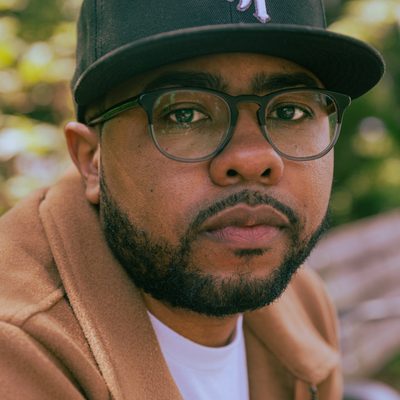
Cortney Lamar Charleston is a Pushcart Prize winner and author of It’s Important I Remember (Northwestern University Press, 2026), Telepathologies (Saturnalia, 2017) and Doppelgangbanger (Haymarket, 2021).