The Possibilities of Grief as a Rupture
Abolition Judaism and rethinking the holiday of Tisha B’Av
Andrue Kahn and Dania Rajendra

In These Times is proud to be independent, pro-labor and anti-fascist. Support our work today and help left-wing journalism thrive.
The Jewish holiday of Tisha B’Av next week is built — entirely — around grief. Originally focused on the destructions of the Temple in Jerusalem by both the Babylonians and Romans, it’s now come to encompass every catastrophe to befall Jews from the expulsion from Spain in 1492 to the outbreak of World War I to the mass deportation of Jews to the Treblinka death camp in 1942.
The traditional way to observe the holiday is to perform Jewish mourning rituals while recounting these histories along with the poetic record of the Babylonian destruction of Jerusalem, the Book of Lamentations. It can be a powerful practice, with deep possibility for personal and political transformation — if we face what we’re mourning.
During the 19th century in the United States, the early Reform Rabbi David Einhorn, a slavery abolitionist, rewrote the meaning of Tisha B’Av in his prayer book Olat Tamid. He acknowledged the horrors that accompanied the destruction of the Temples, but refused to make the rebuilding of a physical Temple, or a return to a single Jerusalem, the point. The mourning, in his hands, had the capacity to be turned into hope, even celebration: the coming of a new and global Jerusalem, an Olam Ha’Bah, a just society built everywhere by Jews working alongside their neighbors.
Contemporary rabbis have mostly abandoned this tradition, instead using this holiday to recount a litany of horrors to reinforce the idea that Jews are a uniquely oppressed people whose trauma is what unifies and defines us as Jews. This produces an artificial separation of Jews from our neighbors, evoking grief to amplify a right-wing lie that we are alone in our experiences. It also reinforces the stature of legacy Jewish institutions (what we call “Fortress Judaism”) that since the Second Red Scare have expelled leftist Jews from communal life — political repression that has worsened since October 7, when support for the genocide has become “a defining feature of employability” in Jewish institutions.
The end of that level of coercive control is leading most Jewish clergy to take wild swings in the discourse. Hundreds of rabbis lobbed another bad-faith accusation of antisemitism at New York Mayor Zohran Mamdani, this time for quoting Italian Communist philosopher Antonio Gramsci on interregnum, the time between the end of the old world and the beginning of the new.
Gramsci’s interregnum is apt for this moment in Jewish communal life, as poll after poll shows that American Jews’ identification as Zionists is plummeting, now representing as low as a third. But what will replace it? In this in-between time, it’s time to reclaim the tradition Rabbi Einhorn exemplified: cross-referencing our sacred texts and the meanings we make from them with the ideas of our neighbors and friends.
The organization that we are both working to revive, the American Council for Judaism, rests on the foundation of these innovations. Founded by Reform rabbis who were seeking to maintain and continue the trajectory of the radical theology of Einhorn and his cohort in the face of expanding Zionism, we are renewing this tradition through what we’re calling Abolition Judaism.
It stands in solidarity with Palestinians and refuses Zionists’ remaking the Jewish idea of universal redemption through literalizing it into a state, a border, and eventually a genocide. This Tisha B’Av, we hold many griefs. We grieve the destruction in Gaza, and the lamentations still being written there. And we grieve that the institutional world of American Jewish life has, in large part, doubled down on their assent to genocide. Unlike many others, we don’t grieve the rupture — we are glad for what the rupture reveals. We grieve the ongoing commitment to genocide on the part of so many.
We find that by reading Lamentations, we can practice summoning the courage, and the discipline, to imagine not just the world to come (the post-messianic age, or “Olam ha’Bah”) but — perhaps a more difficult task — possible paths to it.

Lex Rofeberg explained during our recent appearance on the podcast Judaism Unbound that Lamentations is a book that faces things — by attempting to contain them, and then finally giving way to its rupture. Its first chapters strain to hold catastrophe inside an alphabetic acrostic, a poem in which each line begins with the next consecutive letter through the alphabet, as if grief could be turned into an orderly task list, submit to being managed. In the final chapter of Lamentations, the structure fails, and abandons the acrostic entirely — because grief cannot be contained. It can only be faced, integrated, lived with, and synthesized as part of us, individually and collectively — it’s the latter that holds the kernel of politics, because it can orient us, together, to the future.
“We’ve reached the limits of what moral outrage can do [to stop the genocide],” says In These Times Columnist Eman Abdelhadi, “without material political power behind it.” Through accepting this, we can use our grief. It can open us up to more material analyses of why American Jewish institutions are working so hard to discredit candidates who are tying the genocide in Gaza with racial and economic repression in the United States.
“The tear gas canisters, both in Gaza and in Ferguson, all said, “Made in the USA,” said Darializa Chevalier, who was victorious in her New York Democratic primary, “[It made me realize], oh, these are not similar systems; these are the same system.”
When we face this reality, we can look through it towards the future — and what’s possible. “One of the things that I was really excited to be able to say to people on this campaign was ‘babies, not bombs,’ ” Chevalier said. “I want to lead with the value of life, lead with the things that everyone in our society benefits from when we take care of our babies.”

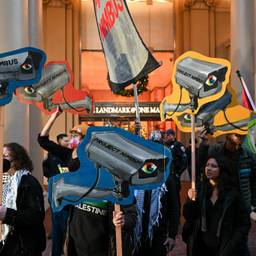

The anti-democratic impulses, including those in the Jewish institutional world, are fighting to limit ambitions for the future. This circumscribes the possibilities for Jews and our neighbors by discrediting candidates who link curtailing capitalism with ending the ongoing genocide in Gaza, the worsening settler violence in the West Bank and the resumed bombing in Lebanon and Iran.
Theory helps us understand the specific ways capitalism manufactures grief in order to chart that course forward — and why it produces Jewish institutions like the ones we have, in order to figure out how to make the ones we need. American Jews and non-Jews alike need and deserve Jewish religious institutions that inform and sustain our solidarities with our neighbors, help us imagine a life-giving, life-affirming future for everyone.
This Tisha b’Av, we invite Jews observing to see where grief can foster more connection, rather than less, with the grieving communities of the world. We can then dream together of the world as “emancipation in rehearsal,” as Ruth Wilson Gilmore once described abolition , or, as Rabbi Einhorn described it in his prayer book Olat Tamid, “rebuilt in righteousness universal, and saved by justice flowing like a stream through all the lands.”
At the end of Lamentations comes a line Jews who attend synagogue regularly may recognize — it’s sung weekly at the end of the Torah service (the reading from the sacred scroll that contains the first five books of the Hebrew Bible): “Take us back, Eternal One, and let us return; renew our days as of old” (or, in Hebrew, Hashiveinu Adonai eilecha v’nashuva, chadesh yameinu k’kedem.) — “Renew our days as of old” is the reminder that our tradition is to face the wreckage of the world and — in this interregnum — build something new.
For 50 years, In These Times has amplified the movements fighting for workers, against fascism and to build a more democratic future. Become a monthly sustainer today and keep independent journalism publishing for the next 50.

Get 10 print issues of our award-winning, worker-first journalism here!

Rabbi Andrue Kahn is a Brooklyn-based Reform rabbi.

Dania Rajendra was the founding director of the Athena coalition and has served on the boards of the International Labor Communications Association, Political Research Associates, and Jews for Racial and Economic Justice. She was also a longtime member of the advisory board of In These Times. She now sits on the international advisory board of the Diaspora Alliance.