AI’s Rise is Being Fueled by the Sprawling U.S. Military State
Can an increasingly precarious tech workforce be a site of antiwar resistance?
Sarah Lazare

In These Times is proud to be independent, pro-labor and anti-fascist. Support our work today and help left-wing journalism thrive.
Hossam Nasr was never under the impression Microsoft is a force for good, but says he “did genuinely believe it to be one of the lesser evil big tech companies.” So when he graduated with a computer science degree, he took a job there and moved to its Seattle campus in 2021. “I sort of felt like I had to work at a big tech company,” he recalls, “because that was the definition of what success in my field looks like.”
To his horror, he discovered the cloud storage service he worked on, Azure, provided the Israeli military with artificial intelligence tools essential to the post-October 2023 onslaught on Gaza. He says he was unaware his labor had been contributing to the very military operations filling his social media feed with massacres at refugee camps, bombed-out apartments, and lifeless children pulled from the rubble.
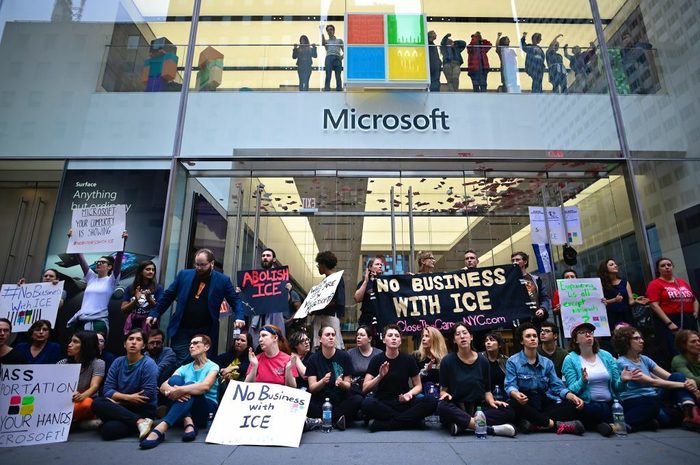
To fight back, Nasr helped start an internal worker organizing effort, No Azure for Apartheid, and in late October of 2024, he organized a vigil on the Microsoft campus “to honor the victims of the genocide.”
The next day, he says he received “a phone call that said my employment was terminated, effective immediately.”
Silicon Valley sells itself as an engine for human progress, in which technology can conquer problems and improve society. But in protesting his employer, Nasr joined an increasingly vocal minority of tech workers who are so concerned about their own complicity in war crimes they are risking their jobs to organize against their companies’ war production. “Tech workers at the heart of Microsoft are waging one of the most significant and under-covered labor battles in the U.S. right now,” labor journalist Maximillian Alvarez, who has reported diligently on tech worker organizing, noted in a September 2025 report for Working People Podcast and The Real News Network.
Big Tech is, in fact, a weapons industry in the business of identifying bomb targets, spying on oppressed and occupied populations, and providing the infrastructure that enables crimes against humanity. The tech sector has always profited from war, but such profits, generated by contracts with the U.S. military and foreign ones like Israel’s, are increasingly central to the industry’s model for accumulating wealth — and power. From 2019 to 2022, the top five contracts granted by military and intelligence agencies to major tech companies totaled more than $62 billion, according to a 2024 report for Costs of War at Brown University, by anthropologist Roberto J. González. Amazon provides cloud storage services, and Palantir provides surveillance, that have been critical to Israel’s war on Gaza since October 2023 that has been denounced by scholars and human rights observers as a genocide.
While the worker revolt against Silicon Valley’s war crimes represents a small fraction of the overall workforce, this is the sector of America’s war industry with the most internal protest and refusal. Groups like No Tech for Apartheid are organizing from within Amazon and Google, while groups like Purge Palantir are building external pressure against the company, often in concert with workers in other industries who don’t want their companies to contract with Palantir. In many cases, workers who get fired from their tech jobs in retaliation for dissenting against their employer are still organizing with the movement years later. The present wave of organizing goes back more than five years but has grown significantly since Israel’s 2023 onslaught on Gaza, which raised the stakes for tech workers concerned about their own complicity.
“I knew that I had to do anything and everything I have in my power,” says Nasr, “in whatever sort of domain I find myself in, whether that’s work or school or just in the streets in Seattle, or anything I can think of, to just try to make the genocide stop.”
Since the mid-20th century, military contracts helped make Silicon Valley what it is, funding early research in microwave electronics, missiles, satellites, and semiconductors. An early precursor to the internet emerged from ARPANET, a collaboration between a Pentagon agency and university researchers.
Ash Carter, former President Barack Obama’s defense secretary, made a deliberate effort to strengthen the Pentagon’s relationship with this sector, laying the groundwork for Project Maven, which launched in 2017 during Trump’s first term and used machine learning to help with military intelligence and drone strikes, which was a hallmark of Obama’s administration and escalated under Trump.
Thousands of Google engineers, including senior positions, voiced their objection — some quitting in protest — when they found out, including through news reports in Gizmodo and The Intercept, that their employer was one of the companies contracted to work on Project Maven.
“We believe that Google should not be in the business of war,” reads an open letter from 2018. “Therefore we ask that Project Maven be cancelled, and that Google draft, publicize and enforce a clear policy stating that neither Google nor its contractors will ever build warfare technology.”
In response to the uproar, Google publicized it would not renew the project, and that it would avoid working on weapons projects that violate “internationally accepted norms.” But such Pentagon contracts remain core to its business model. These companies don’t only get public funding. From 2021 through 2023, venture capital firms invested $100 billion into military tech startups.
The tech industry still gets far fewer military funds than the traditional weapons sector — hardware and manufacturing remain capital-intensive processes no matter how clever the LLM’s get — but attracting Pentagon contracts is a good way for tech companies to transition from the highly precarious startup phase to more established companies. In fact, there’s a name for it in military acquisition circles: crossing the “Valley of Death” refers to the process of going from the development phase to the contract procurement phase. “To be in Silicon Valley and to be for not using it for the military is very difficult now, because all the venture capital money, the heads of the industry, that’s what they’re pushing,” says William Hartung, senior research fellow for the Quincy Institute for Responsible Statecraft.
Within this incentive structure, plenty of companies that seemingly had nothing to do with war are making their way into the military industry. “Why this beauty startup just picked up a major defense contract,” reads one 2024 headline from Fast Company. The article tells the story of a startup called Debut Biotechnology, which started off focusing on biomanufacturing in the cosmetics industry, but then got a $2 million contract to plan a “bioindustrial manufacturing production” facility for the Pentagon. An electric vehicle battery startup called Sion Power made a similar transition, shifting “commercialize high-energy lithium-metal battery cells for drones
and other defense-related products,” according to a CNBC article published in March 2026.
Even the most limited ethical parameters are opposed. In early 2026, the tech company Anthropic said it objected to use of its technology for autonomous weapons targeting or domestic surveillance, though it did not fundamentally object to contracting with the U.S. military. The Department of War responded by dropping a $200 million contract and trying to bar military contractors from doing business with Anthropic.
“If you had any doubt about the guardrails being off, this is it,” González says. “The reason they were let go was essentially because they wanted to maintain some level of control over how the products were used, and I would say it was a pretty modest set of ethical guidelines.”
Guardrails or not, the Silicon Valley weapons industry is on the rise. “We’re at a pivotal moment, a generational shift,” says Ben Freeman, director of the Democratizing Foreign Policy program at the Quincy Institute. “You’ve had the dominance of the so-called defense prime contractors — Lockheed Martin, Boeing, Raytheon, General Dynamics, and Northrop Grumman — and they have far and away gotten a lion’s share of DOD contracts. Whenever anybody would seemingly oppose them, most of the time, they would either squeeze them out or they would buy them out.”
“What we’re seeing right now with the defense tech sector is a fundamentally different thing, because these are companies that can’t be bought out, because they’re by and large run by extremely wealthy people — or if not wealthy people, financially backed by very, very wealthy people. The Elon Musks and the Palmer Luckeys of the world, who are not willing to be bought out by the primes. So you’re really seeing for the first time in a generation firms coming into the defense sector that have the ability to compete directly with the primary weapons contractors and threaten their bottom lines.”
Silicon Valley now has a small army of lobbyists jockeying for lucrative Pentagon contracts. There are more than 3,500 lobbyists working on issues related to AI, which means one of every four lobbyists at the federal level is now working within this sector. But it might not be a zero-sum competition. With Trump’s budget for military and defense exceeding $1.5 trillion, it may be the case that there is simply enough for everyone.
“Unfortunately, what we’re really seeing is that a rising tide is lifting all defense contractors, whether they be the old guard firms or defense tech firms,” Freeman says. “Trump, over these last two years, just proposed these remarkably higher Pentagon budgets, and instead of forcing hard decisions at the Pentagon, everybody is getting a slice of a bigger Pentagon budget pie.”
I spoke to one worker for Cisco Systems (Cisco), a multinational communications and networking tech company that in 2000 was the most valuable corporation in the world with a market cap above $579 billion. That individual had been laid off a week prior; they were part of a larger wave of layoffs, and they don’t know if their activism played a role. They explained that many workers going into Big Tech do not, at first, understand the full extent of these military ties.
“I can’t even count the number of times that I’ve talked with someone and they say something like, “I didn’t sign up to help kill people,” says the Cisco worker, who asked to remain anonymous because they still organize with the internal anti-war worker group Bridge to Humanity. “It’s not just activists, but also from employees who aren’t participating in any formal protest or organizing.”
When another Cisco worker, Shaad Hussain, started looking for tech jobs, he was clear that he did not want to work for the weapons industry. When he was offered a job at Cisco, he was pleased to learn that the product he would work on, the company’s Catalyst Center, was used for hospitals and universities. He tells me he thought he “would be working on something that benefits society.”
But after October 2023, he discovered that the company provides both hardware and infrastructure to support Israel’s military operations. In May, Drop Site News published a report based on leaked documents which show that Cisco is aggressively pursuing new contracts with Israel’s military and intelligence establishment.
While he has certainty that his company was working with Israel, he is less clear on whether the Catalyst Center he worked on was part of this collaboration. One of the challenges is that many of these products are also used for civilian purposes. And tech workers suspect that, in response to worker organizing and P.R. concerns, companies obfuscate military relationships, or play down the more lethal uses of their technology.
But for Hussain, it was enough to have confirmation that the company he was working for was enabling Israel’s military operations, and he joined internal organizing efforts. Workers circulated an open letter, emailed the CEO with their concerns, and aired these concerns on company-wide calls. “In March 2025 they actually instituted a policy saying that there could be no more discussion of the ‘Middle East conflict’ in company-wide circles,” Hussain says. An employee who challenged the free speech restriction, and was a known advocate for the rights of Palestinians, was fired immediately after the policy was rolled out, a development documented by Drop Site News.
“At that point, we realized that this internal advocacy isn’t going to do much,” he recalls. “So we decided to go to Cisco Live, which is their main annual event that they host, where they invite employees, shareholders, and customers to see what’s new. The CEO got on stage, and I kind of just called him out in front of the audience.” Hussain was fired immediately after.
History shows that groups of marginalized workers, even where they don’t have unions, can wield their power to win surprising victories, and oppose crimes against humanity. The Coalition of Immokalee Workers (CIW) calls itself a “worker-based human rights organization,” and in the 1990s, it successfully opposed slavery among farmworkers, helping free more than 1,200 workers who had been held against their will in the southeastern United States. When the organization learned that Taco Bell was a key buyer of tomatoes grown in Immokalee, Florida — where wages had stagnated since 1978, at 40 cents for each 32-pound bucket picked — the coalition launched a boycott, and in 2003, outside the Taco Bell headquarters in Irvine, California, 50 Florida farmworkers held a 10-day hunger strike, resulting in three hospitalizations. In 2005, CIW announced that it was suspending the boycott, after Taco Bell agreed to all of its demands, including a pay increase of a penny per pound, which nearly doubled farmworkers’ wages.
Corporate campaigns can cross national borders, as the union SINALTRAINAL showed when it called in the early 2000s for a boycott of Coca-Cola, which it deemed “Killer Coke,” after union organizers were allegedly murdered by paramilitaries at bottling plants in Colombia. These examples, however, involve workers organizing corporate campaigns to advocate for their own rights, but what about going up against one’s employer to be in solidarity with people in another part of the world? Gabi Schubiner worked at Google when No Tech for Apartheid was founded in 2021 and is now an organizer for the group. They told me that many tech workers “see ourselves in the lineage of the Polaroid Workers’ Revolutionary Movement.”
In 1970, a small group of Black workers at Polaroid found out their employer was selling equipment being used by the South African government to make race identification cards and passbooks used to enforce apartheid. They responded by protesting and organizing a global boycott of their employer. “We presented Polaroid with three demands: that Polaroid get out of South Africa, that they announce in the U.S. and South Africa simultaneously their abhorrence for apartheid, and that they turn over their profits to the liberation movements,” Caroline Hunter, who worked as a chemist for the company, recalled to Democracy Now! in 2013. Workers started crashing speeches and lectures by company leaders, and they held press conferences calling for others to join in the boycott.
In response to public pressure, Polaroid announced in 1971 that it would require its distributors to pay good salaries to non-white workers and contribute to education funds for Black South Africans. The approach was in line with the practices of other companies, like General Motors, which claimed that as long as they engaged in fair labor standards in their own workplaces, it was okay to defy Black South Africans’ call for a global boycott. But the Polaroid Revolutionary Workers Movement (PRWM) rejected what they derided as a shallow PR effort. In 1977, Polaroid finally cut its ties with apartheid South Africa, after a report in the Boston Globe revealed the company had continued to sell products to the apartheid government. Speaking at the Bard Graduate Center in 2023, Hunter recalled, “We figured this is David and Goliath. The least we could do is throw a rock.”
There are signs tech worker organizing is ‘throwing a rock.’ In September 2025, Microsoft terminated a portion of its contract with the Israeli military Unit 8200, which is focused on intelligence and surveillance, after an investigation by +972 Magazine, Local Call, and the Guardian revealed that Azure was being used to process “a sweeping and intrusive system that collects and stores recordings of millions of mobile phone calls made each day by Palestinians in Gaza and the West Bank.”
In a statement, No Azure for Apartheid celebrated that “the first domino has fallen, but said, “this action is insufficient. Microsoft’s decision today only cuts a specific subset of its cloud and AI services to a specific unit in the Israeli military.” Services provided to other Israeli military units, “and the vast majority of Microsoft’s tech sales to the Israeli military, continue to be untouched,” the group said.
Worker protests continued, and in May, Microsoft fired the general manager of Microsoft Israel, Alon Haimovich, and other senior staffers. Again, No Azure for Apartheid marked the win, proclaiming in a statement that the firing “comes at the heels of relentless pressure from our campaign as well as the collective efforts of countless workers and partners from around the world.” But the group warned the company “continues its pattern of conducting sham investigations while colluding with and continuing to supply cloud and AI arms to the Israeli military and government to power occupation, genocide, and apartheid in Palestine. We refuse to allow Microsoft to scapegoat one or a handful of individuals to wipe its hands clean of its complicity in genocide.”
Nasr says, “I do think this is an important and significant direct result of the organizing work we are doing.” But, he cautions, “this was approved and known about at the highest levels of Microsoft.”
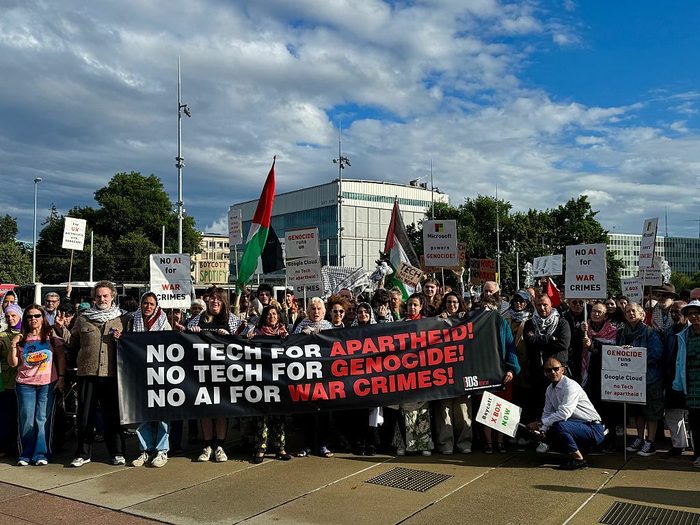
Following the firings, Microsoft workers and former workers are mobilizing more, not less. On June 2 and 3, No Azure for Apartheid staged multiple protests targeting the company’s annual “Build” conference for the third year in a row. In addition to holding rallies, they helped commission a plane that hauled a banner reading, “MSFT powers genocide.” And protesters took to kayaks in the San Francisco Bay by the Golden Gate Bridge, which was near the conference, chanting, “Microsoft you will learn, in our millions we’ll return!”
When I asked Microsoft about the concerns and allegations workers shared with me for this article, a company spokesperson said, “We provide commercial technology to customers globally and expect its use to align with applicable laws and our policies. We respect employees’ rights to express their views and provide channels to raise concerns, while requiring workplace activity to follow company policies and not disrupt business operations.”
But, Abdo Mohamed, a former Microsoft worker who was fired after organizing the same vigil as Nasr, tells me, “Microsoft and its executives are still regurgitating the same lies and PR statements in a desperate attempt to whitewash how they have enabled and abetted war crimes and crimes against humanity.”
He added, “We, the workers, whose labor is being exploited, whose voices have been silenced and ignored, whose livelihoods have been threatened with retaliatory firings, doxxing, and brutal arrests refuse to be cogs in the genocidal machine powered by Microsoft technologies.”
While it may seem that these workers are up against overwhelming forces, Noam Perry, the strategic research coordinator at AFSC’s Action Center for Corporate Accountability, says that such organizing can have a surprising impact in the long term. “There are deep currents that take a long time to materialize, and we might never understand what contributed to what, but I see the arms industry being on the defensive in many aspects,” he says. “It’s not that they’re suffering financially, but they have a PR crisis, and I think Google and Amazon and Microsoft and Cisco and others understand that they have a PR crisis that they need to solve in one way or another.”
Perry draws lessons from his own work organizing in support for the Palestinian-led call for Boycott, Divestment, and Sanctions (BDS) of Israel. “Sometimes in BDS work we don’t have an impact directly on the target that we are campaigning against but we see an impact on the industry. Other companies will look at that and say, ‘Oh, we don’t even want to get into that controversy, right?’”
Tech workers are engaged in discussions and debates about how to effectively organize the sector, where those who risk and lose their jobs face severe retaliation and little institutional political support. Democrats, for example, are not lining up to demand that the 50 workers fired from Google in 2024 be reinstated. Meanwhile, tech CEOs are accumulating tremendous capital and power. Elon Musk’s wealth has surpassed that of John D. Rockefeller, when adjusted for inflation. Seven out of the 10 richest people in the world hail from the tech industry. These CEOs are, in turn, increasingly allying with the Trump administration, a bloc symbolized at a 2025 ceremony at Joint Base Myer-Henderson Hall in Arlington, Virginia, where current and former tech executives, dressed in combat gear, swore an oath to defend the United States.
“Our approach and our thinking about it from the beginning has been to recognize the limits of our power,” Nasr says. “We’re working toward a majoritarian union. That is definitely the north star.” But in the meantime, he says, “there’s just so much urgency to act. And if we wait and our hands are tied behind our backs until we get there, we know that we’re just not going to be able to meet the moment.”
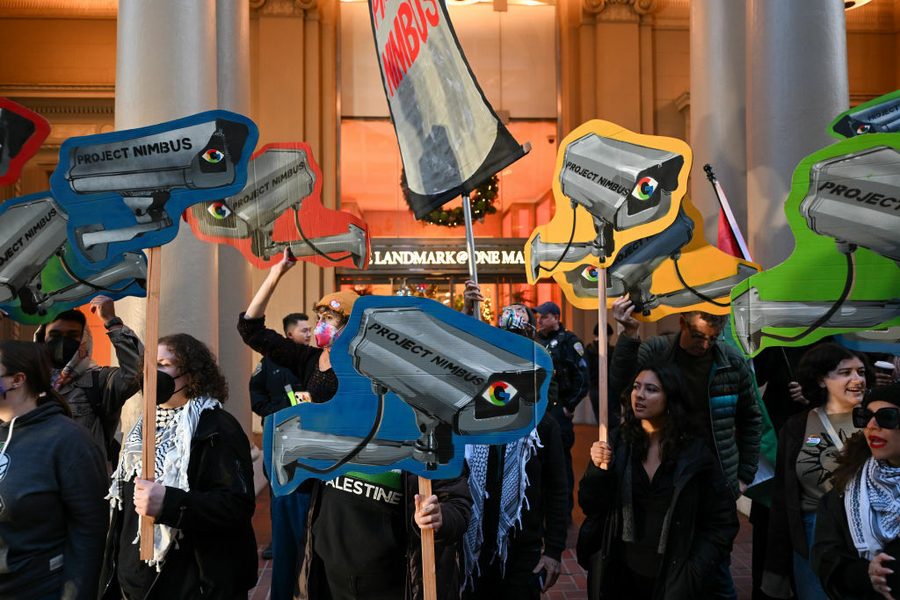
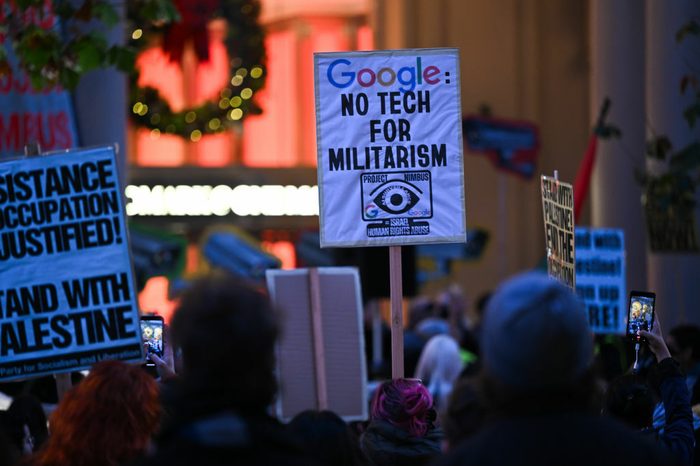
Organizers with No Tech for Apartheid are grappling with big questions about what kind of organizing model can be most effective. In 2021, Amazon and Google entered into a $1.2 billion contract to provide cloud technology for the Israeli government and military, under the banner of Project Nimbus. A group of anonymous Amazon and Google workers released a statement condemning the deal, warning that “this technology allows for further surveillance of and unlawful data collection on Palestinians, and facilitates expansion of Israel’s illegal settlements on Palestinian land.” Even the company’s own outside consultants warned about the ethical implications of providing AI to the Israeli government, saying “Google Cloud services could be used for, or linked to, the facilitation of human rights violations, including Israeli activity in the West Bank.”
Confirming the concerns, an investigation published in 2024 by +972 and Local Call found that Amazon Web Services “provides Israel’s Military Intelligence Directorate with a server farm which is used to store masses of intelligence information that assists the army in the war.”
“The vast amount of information stored in Amazon’s cloud, the military sources testified, even helped on rare occasions to confirm aerial assassination strikes in Gaza,” according to the investigation, “strikes that would have also killed and harmed Palestinian civilians.”
Following the escalated Israeli assault on Gaza that began in October 2023, worker protests against Project Nimbus grew more urgent. Workers staged sit-ins and protests at Google offices in New York City and Sunnyvale, Calif. The company responded by firing 50 Google workers, yet they continue to organize.
When I asked Google about the firing, and workers’ concerns and allegations, the company told me, “We have been very clear that the Nimbus contract is for workloads running on our commercial cloud by Israeli government ministries, who agree to comply with the Terms of Service and Acceptable Use Policy that govern it.” But the company has given this response verbatim to so many reporters that AFSC quotes the line on an informational webpage. “This seems to be a misleading statement as it was later revealed that the Nimbus contract is not subject to Google’s regular terms of service but instead to terms that have been dictated by the Israeli government,” AFSC writes.
Schubiner from No Tech for Apartheid told me, “We’ve reoriented around base building as a strategy. I think it’s the only way right now to generate the amount of power that we need to win our admittedly quite large demands. All of the other forms of power that we have are relatively easy for the companies to resist, because the companies are monopolies, because they’re global, because they just have so much more power.”
“Our assessment is that while it’s possible to make some wins through community pressure, to make structural change and target the systems and the really large cloud contracts that underlie so much of the relationship between militaries and big tech, we need to build a large base of workers that are capable of resisting internally and likely withholding labor at some level.”
But the reach of this sector is so broad that, ultimately, it’s not just tech workers who are part of its machinery. Andrew Gesler is a registered nurse in the anesthesia recovery unit at Maine Medical Center, and he is concerned about his employer’s contract with Palantir, a tech giant that specializes in mass surveillance, data collection, and using machine learning to assess that data. Palantir openly and proudly works with the U.S. military, with the Israeli military, and with ICE, and uses AI to identify people to kill and detain. In April 2026, the company published a manifesto on X that proclaims, “The ability of free and democratic societies to prevail requires something more than moral appeal. It requires hard power, and hard power in this century will be built on software.”
In April 2025, the company started a recruitment campaign at elite U.S. colleges in which it put up posters that said, “A moment of reckoning has arrived for the West.” As Alberto Toscano reported for In These Times, the ads stated that Palantir doesn’t create tech products to merely “ensure America’s future,” but to “dominate.”
Gesler and his coworkers, whose field is premised on helping people, were concerned to discover Palantir has a presence in their hospital. “This is an evil company that I want nothing to do with,” says Gesler, who is a member of the Maine State Nurses Association/National Nurses Organizing Committee.
This strategy, of treating Palantir as a morally rotten company no one should do business with, has notched up some wins for a global campaign called “Purge Palantir.” London’s mayor blocked a £50 million ($66 million) contract, and New York City’s public hospital system said it wouldn’t renew a contract, just to name a few. Cardano, a Dutch investment firm, said in May it had “adopted a strict sustainable investment policy grounded in international standards” and removed Palantir shares from its portfolio. Advocates say that Palantir is so expert at snuffing out internal dissent that pressure must come from the outside.
Maine Medical claims that the company is helping patients fight denials of their health insurance, but Gesler is both skeptical, and doesn’t care what the tool is being used for. “We don’t want any part of this dangerous corporate — honestly, I’ll call it fascist — machine. Being a nurse, being a humanitarian, being a person who is here to help people, I don’t want anything to do with this company.”
For tech workers trying to organize within their jobsites, part of the challenge can be getting their coworkers to identify not with founders, but with the working class, from nurses like Gesler, to contractors and janitors in their own industry.
They are up against CEOs who increasingly talk about their own workforce as a hostile force, and use their power to oppose policies that help the working class. Elon Musk displayed this approach when he took over Twitter (where workers had been trying to organize a union) and promptly laid off 80% of the staff in 2023, then went on to take the same hatchet to public programs for the poor as the unelected yet all-powerful leader of Department of Government Efficiency (DOGE) in 2025. The powerful venture capitalist Marc Andreessen, who is a regular at Mar-a-Lago, derided his own workers as “professional activists” in a January 2023 interview with The New York Times, clearly irked by a boom of organizing in the tech sector that has taken off since 2017. Peter Thiel, a key purveyor of a philosophy that Naomi Klein and Astra Taylor describe as “end times fascism,” is openly hostile to worker consciousness, deriding the dangers when you “proletarianize the young people,” while directly funding efforts to defeat California’s billionaire wealth tax.
“The tech worker that stereotypically people think about is that white collar worker who is getting kombucha on tap, who’s getting paid six figures,” says Abdo Mohamed, a former Microsoft worker who was fired for organizing the same vigil as Nasr, and has continued organizing with No Azure for Apartheid. “But there are actually a lot of workers who are vendors and contractors who are not able to afford the right health care or are not able to get their sick leave, and they’re working for the same companies. There are people who are cafeteria workers who are fighting for their union recognition at these tech companies, and there are people who are in Third World countries that are being paid less than $1 a day to kind of label the AI that is happening.”
“One of the key aspects, at least in our campaign, is that we are trying to emphasize that we are all workers, despite the different material conditions, and we need to try and build a trust across the different formations of workers. Because at the end of the day, the power that gets wielded by each formation has a different angle of pressure.”
And being a worker in this industry, he underscores, involves grappling with a troubling reality. “Our labor is being exploited to enable this genocide, and you draw a line at that.”
This article is a joint publication of In These Times and Workday Magazine, a nonprofit newsroom devoted to holding the powerful accountable through the perspective of workers.
For 50 years, In These Times has amplified the movements fighting for workers, against fascism and to build a more democratic future. Become a monthly sustainer today and keep independent journalism publishing for the next 50.
Thank you for reading this story. At a time when corporate media is dominating the web and our airwaves, independent journalism is more important than ever, and that’s what we provide at In These Times. We offer some of the best reporting, investigations and analysis on the growing movements for justice in the U.S.—and our work is firmly pro-labor and anti-fascist. To continue producing it, we need your support.
If you believe in the power of an independent press, please make a donation to In These Times today. By becoming a sustaining member, you can ensure that our work reaches even more readers.
And if you become a sustainer right now, you'll get a free year-long print subscription and a special subscribers-only print from artist Molly Crabapple.
Thank you.

Get 10 print issues of our award-winning, worker-first journalism here!

Sarah Lazare is the editor of Workday Magazine and a contributing editor for In These Times. She tweets at @sarahlazare.