Why Mayors Across the Country Are Signing On To a Haymarket Declaration This May Day
Chicago Mayor Brandon Johnson explains why a coalition of mayors has come together to commemorate the legacy of May Day and defend workers from attacks by the Trump administration.
Brandon Johnson

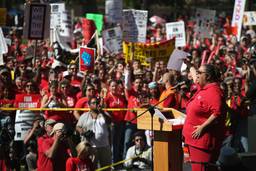
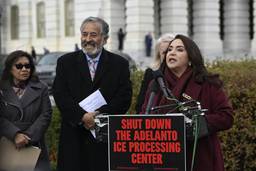
On April 30, the day before May Day, Chicago Mayor Brandon Johnson joined a coalition of mayors from cities across the United States to sign the Haymarket Declaration—a joint recognition of May Day and the anniversary of the Haymarket Affair in Chicago, as well as a commitment to use the power of cities to defend democracy and workers’ rights.
Joining Mayor Johnson in signing the declaration are Mayors Katie Wilson of Seattle, Keith Wilson of Portland, Karen Bass of Los Angeles, Ras Baraka of Newark, Jacob Frey of Minneapolis, James Solomon of Jersey City, Satya Rhodes-Conway of Madison and Dorcey Applyrs of Albany.
The Haymarket Declaration “commits participating mayors to pursue local actions which protect the First Amendment and the right to peacefully protest and organize; advance workers’ rights and economic justice; lower costs and defend essential services; expand access to good-paying jobs; build safer communities through prevention and trust; defend immigrant communities; protect voting rights and local elections; and align public spending around shared values.”
Below is a transcript of Mayor Johnson’s remarks during the announcement of the declaration.
— — —
I am honored and grateful to stand with my fellow mayors in solidarity today. From Seattle and Los Angeles to Newark and Jersey City, leaders from every corner of the country are represented here. This nationwide collaboration and shared commitment to democracy is exactly what this moment calls for. We are gathered today on the eve of May Day, or International Workers’ Day. As the mayor of Chicago and as a former social studies teacher here in Chicago, I feel a sense of responsibility to shed a bit of light on what this day commemorates.
In 1884, the workers in Chicago and across the country who were fed up with the long hours they worked sparked a nationwide movement to win an eight-hour workday. Interestingly, the eight-hour workday was already protected by law at that time. The problem was the federal government wouldn’t actually enforce their law and robber barons did everything they could to dodge accountability. Two years later, May 1, 1886, organizing efforts culminated in a strike by industrial workers across the United States.
Marching under the banner of “eight hours for work, eight hours for rest, and eight hours for what we will,” working Chicagoans came together to demand respect in the workplace. But on May 3, 1886, after a mysterious bomb went off at a peaceful demonstration at the McCormick Reaper plant in Chicago, police officers clashed with picketers and killed striking workers. Eight union leaders were put on trial for the riot and seven were sentenced to death.
Justice came only years later when Illinois Gov. John P. Altgeld pardoned the surviving prisoners and condemned the system that convicted them, and in 1889, when a delegate from the American Federation of Labor recommended that May 1 be set aside as International Labor Day in memory of the Haymarket martyrs. Now almost the entire world commemorates May Day. It is a living tradition where we honor our past and commit to our future.
The Haymarket Affair tells the story of workers who fought for dignity, fairness, and protection under the law, who were met with violence and oppression for doing so. While the story lives in our history books, it is a story that continues to unfold in the present.
Across the country, we are seeing fundamental rights be tested by the federal government. The right to organize, to vote, and to protect our protest are all at risk. At the same time, residents in our cities are confronting the challenges of rising costs, unemployment, a lack of affordable housing, and new challenges brought on by the federal government’s decision to gut programs like SNAP, Medicaid, and Medicare. It is becoming that much harder for families to make ends meet. But as I said before, history is certainly repeating itself. We’ve seen similar challenges from the federal government before, and that means we know the solutions.
The labor leaders and workers in 1886 didn’t give up after the Haymarket riot. They didn’t even give up after the subsequent arrests and executions. They kept on fighting in solidarity, moving towards the future that they knew was right, and today mayors across the country honor May Day, not just with words but with action, taking a page out of our forbearers book.
I’m honored to sign onto the Haymarket Declaration, a symbol of solidarity and a shared commitment to pursue local actions across a broad set of priorities, from protecting our First Amendment rights to building safer and welcoming communities. As city leaders, we have a responsibility and the authority to respond to our people’s needs and to stand up for our democracy. And like the union laborers and workers who achieved our rights and dignity, we must remain unified in our effort. We must remain strong in this effort because we are stronger together. And while the federal government falls short of its responsibilities and authority, city government is stepping up to lead.
I’m deeply grateful to all of the mayors and cities that are committing to the Haymarket Declaration. I know that with this bold step we will defend our residents’ rights and deliver the services that they deserve. I look forward to our continued partnership with mayors and leaders across the country, and I look forward to commemorating May Day with the people of Chicago tomorrow.
For those in Chicago who want to continue the struggle against billionaires and authoritarianism after May Day, please join In These Times for a special event on May 5 at 7 p.m. CST: May Day! What’s Next? There will be a special panel featuring Congresswoman Delia C. Ramirez, In These Times columnist Eman Abdelhadi, CTU Vice President Jackson Potter, UWF member Jasson Perez, and moderated by In These Times Senior Editor Miles Kampf-Lassin. Get your tickets now!

Get 10 print issues of our award-winning, worker-first journalism here!
Brandon Johnson is the 57th mayor of Chicago.