How Labor Journalists Contend With a Constricted and Polarized Media Landscape
A conversation with Maximillian Alvarez, Hamilton Nolan, Kim Kelly and Alex Press on the state of organized worker’s movements, unions and reporting in the age of AI.
Maximillian Alvarez
In These Times is proud to be independent, pro-labor and anti-fascist. Support our work today and help left-wing journalism thrive.
The consolidation of American media outlets, the proliferation of AI into everyday life and “end-times fascism” has thrown the world into unprecedented crises. The labor movement, too, has had some recent setbacks — contending with politicization within unions, AI regulation in such contracts and declining participation in organized labor.
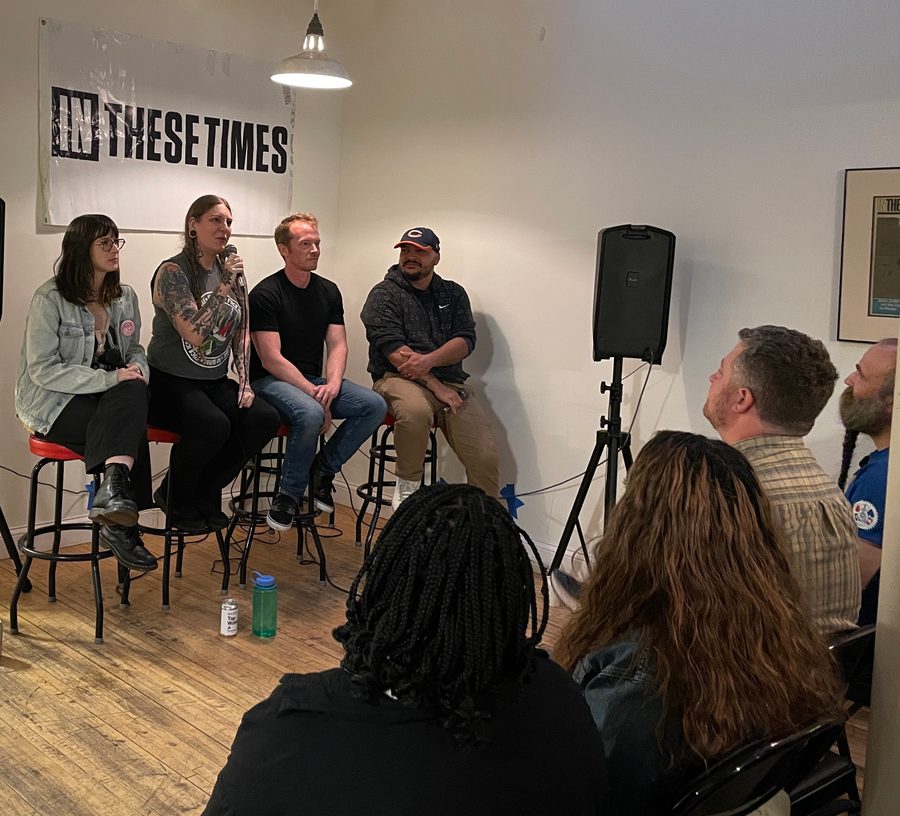
To better understand how these issues are impacting American democracy, journalism and the U.S. labor movement, In These Times recently hosted a panel discussion at our Chicago office featuring The Real News Network Editor-in-Chief Maximillian Alvarez joined in conversation with labor reporters Hamilton Nolan, Kim Kelly and Alex Press.
As Kelly puts it: “There have always been nosy people that saw some injustice, saw something horrible, oppressive, disgusting and said: ‘I’m going to figure out what’s going on, I’m going to tell some people about that.’”
This conversation has been edited for length and clarity.
Maximillian Alvarez: Welcome, Chicago, to this live edition of Working People. Today for this show we’re going to go in a different direction than we normally do. I was listening to some old episodes and thinking about what my career and these stories meant to me. In These Times was one of the first outlets that even responded to an email of mine, and then they partnered with this podcast. I wanted to ask you guys if you could just talk a bit about how you became a labor journalist.
Hamilton Nolan: Thank you, Max. I had radical parents, but when I went into journalism, I didn’t have any connection to labor. But, as I wrote and reported about why America is fucked up, the roads kept leading back to labor… I was also working at Gawker, sometimes writing about labor. We successfully unionized Gawker, and it was one of the first big online media companies to organize, followed shortly by Vice and HuffPost and tons of other places… I kept going back to labor issues, and eventually I turned into a full-time labor reporter. I felt compelled to keep writing about it.
Kim Kelly: I don’t know if there is an orthodox path towards labor reporting. I ended up as a labor reporter, not by accident, but certainly not really by intent. I spent most of my life in the heavy metal world as a music journalist and a roadie, and I was the heavy metal editor at Vice. A couple weeks after I got hired full-time, a couple of co-workers pulled me aside and said, “Hey, we’re thinking about unionizing. What do you think about that?” I was like, “Oh, thank God,” because I’m from a union family — all steelworkers, teachers and construction workers. I knew what a good thing unions were for workers, but I never thought I’d get a chance to participate because I was just a writer.
By the time I got laid off in 2019, I think we had about 500 people across the company organized. I started thinking, “Do people know they can do this? Maybe I should tell them.” I fell into it, but I’m glad that I ended up becoming a labor reporter in this way, because I got exposed to labor and involved in labor the way that most people do by organizing my workplace, and that’s a perspective I try to bring into everything I do.
Alex Press: My path was actually not that dissimilar from Kim’s. I already was very much on the activist left. Naturally, as soon as I landed at Northeastern University, I helped start a grad union there. I think it took us nine years, but they did eventually join the UAW and get the vote. I said, “I’ll write an article about this fight,” and The Nation agreed to publish.
I remember my PhD advisor sitting down and saying, “So I just want to give you a heads up, you’re probably not going to stick around academia because you can’t be writing about your employer in a national magazine and starting a grad union, and it’s your first year of grad school.” So, sure enough, I ended up leaving and going to Jacobin magazine after a few years of grad school. I never stopped writing about the labor movement and I hope I never do.
Alvarez: Let’s start with the labor question, and then we’re gonna move on to some bigger stuff. Hamilton, you wrote a great piece last year about how Biden, for all the shit that everyone in this room could point to and say Biden wasn’t the most fucking pro-union president ever, you could argue that he absolutely was. I wanted to use that as the springboard for all of y’all to talk about where the organized labor movement is, and also, is it up to this moment?
Nolan: There’s a duality of writing about labor, which is: on the one hand, you’re telling all these incredible stories, right? And then, on the other hand, the big picture is we’re getting our ass kicked constantly, and you have to be honest about both those things. But, the big story of the labor movement is decline, and the most interesting question to me about organized labor in America is: “Why are we losing? Why does union density keep going down every year?”
When I look around at those same institutions in labor, I wonder “Where’s the change?… Where’s the vision from the top?” It’s not there within the labor movement. The closer you get to the grassroots labor movement, the more inspiring it is, and the closer you get to the top, less inspiring it is.
Press: The vision isn’t at the top, because it never is, right? That’s not where it happens. Why is it that there are such amazing people at the rank and file, but there doesn’t seem to be a way to cohere lessons we learn from the grassroots and coordinate this at the top level?
I don’t think we’re prepared for the moment. I think we are seeing incredible losses and tragedies, whether it’s union members being deported or working people in general being killed in the streets, but I know that many of us would like to change that and stop that… You see this incredible courage, but how do we translate that up across the country?
Kelly: The work, the history and the present of labor that I’m most interested in is the people that have kind of been left out and what they’ve done in spite of that. Some of the organizing I’m most excited about in this country is the work that sex workers are doing. They’re organizing, they’re unionizing, they’re striking, they’re making it work, and they’re not asking for permission from a system that was not built to give them power. Everyone’s too hard to organize if you don’t try.
Organizing from below is the only way we’re going to get anywhere, the only way we have gotten anywhere. Even our major labor laws were never passed with everyone in mind. I still feel so much of the energy in this movement is people who have seen the ways in which the current movement, especially in its current state, does not serve them and have found ways to either organize within it to make it better for them.
Alvarez: Those were all such phenomenal answers, and I wanted to throw in one other example. When it comes to the hopes that maybe we had naively, like that the organized labor movement in the United States of America in 2026 was going to stand up as this stalwart force against fascism — if our fucking whole federal government collapsed like a house of cards, I don’t have a whole lot of faith in our institutions here. But, I know a lot of unions are doing a lot of good stuff and a lot of union members are doing everything that they can.
Those types of acts can feel small in the moment but they have such massive ripple effects, rarely do we get to see that manifest like we did in Minneapolis. That was the ripple effect made manifest by people who were probably in this room right now. Labor got behind it, but you don’t need to be in a union to act like one, I guess, is the takeaway from that great panel answer to that.
So, AI. Is it good or bad?.
Nolan: I’m on [an] AI committee at the Writers Guild, and we have decided it’s bad. None of us are gonna get out of this unscathed, even in the best-case scenario. This is going to be a brutal, brutal fight.
The real front line of AI regulation in America is union contracts. That’s the reality, that union contracts probably have more meaningful AI regulation in America than all legislation so far combined. So that’s a little scary, but it’s also, if you’re in a union, that’s where actual material regulation of AI is happening.
Kelly: So, AI, do we have any hardcore fans here? Okay, so in the words of our problematic faves, metalcore icons Earth Crisis, you know what I’m gonna say: “destroy the machines.”
It’s certainly going to become harder and harder for people like me who are trying to tell these stories and keep a foothold in journalism. I take a little bit of comfort in knowing that even if AI trained on every single thing I’ve ever written — which, good luck if it gets into the early 2000s — it’s still not gonna be able to sit next to someone at a bar and go: “Tell me about what’s going on with your job. How are your kids? How are you feeling? What did your boss say?”
That human connection is what makes journalism matter — a machine can’t do that. I really hope that that means as much to the rest of the world as it means to me and it means to us. Again, shout out to In These Times for giving us a place to do that.
Alex: To me, at least, and I think for many people in the international labor movement’s history, it’s not that you’re anti-tech. But, under capitalism — technology, from development stage through deployment stage — will always be engineered based on what’s profitable for a specific subset of the population, it’s not going to be for social good.
I think the writers and the actors were the canary in the coal mine three years ago about how serious this is about to be, and we’ve seen that they’ve proven quite correct on that. So, when we talk about, say, getting provisions about no jobs can be replaced by AI; certain provisions like that are absolutely important and some unions and union members have been winning on that, especially writers and journalists.
Alvarez: I would just ask of those union members who are going to have those debates: Everyone needs a job and it’s not really any working person’s purview to think beyond, “I got to provide for me and mine.”
But, as someone who does that type of reporting now on sacrifice zones, toxic pollution and all that, I can’t not see it. I see the toxic husks of industries past peppered throughout this landscape. We have to also think about that because I’m talking to residents living near these data centers and they’re describing horrors to me. They’re getting heart palpitations, they’re bleeding from their ears, it sounds like living on an airport runway. Imagine that 24/7, you would go insane.
It shouldn’t be our job to think about all that, but clearly no one else is taking it into consideration, so if not us, who? Because the people who are making the decisions are the ones plopping those fucking things down in our communities, I don’t care how many jobs they provide and frankly, neither do the people who own them. It’s on us to think for the future.
These billionaires are destroying our planet, they’re going to war and destroying other countries and profiting from it, but they are also gobbling up every legacy and social media platform they can and using them to warp our brains, warp our sense of reality and make our jobs impossible.
Nolan: I’ve been covering Donald Trump since the fucking 2015 Iowa caucus. That was 2015, and this motherfucker is the most powerful political figure of my lifetime now. Unfortunately, I think it’s a very, very deep question: “Why does the worst guy in America have the most power?”
I think capitalism is probably the short answer, everything that we are seeing from the UFC fights on the lawn to Donald Trump to East Palestine is the inevitable operations of capitalism playing out according to its own logic.
Kelly: That was a moment for journalism too… around 2017… when the alt-right as we knew it shriveled and died. But now those same guys are in charge of us, so we didn’t win that war, but we did show that there is power in journalism.
We have a very long and fucked-up history here in America, but there have always been nosy people that saw some injustice, saw something horrible, oppressive, disgusting and said: “I’m going to figure out what’s going on, I’m going to tell some people about that,” and it has always mattered.
It hasn’t always won the war, solved the problem or saved people’s lives, but sometimes it has.
Press: I think a lot of people have forgotten the baseline critique of corporate media, which is that it’s for-profit and it’s geared towards an affluent consumer base, so not the working class. Great journalists work in mainstream media, but they’re now suffering and not able to do their work. I want to build institutions that can reach working-class people in America that are not subservient to the ultra-rich, whether it’s their funders or their advertisers, or that’s their targeted audience. And In These Times — it’s one of those institutions.
Alvarez: One of my first bylines was at In These Times. I remember it was a piece that I co-authored with a UAW member on strike. In These Times worked with us, me and this union member who wasn’t used to writing for online magazines. That struck me as incredibly special.
Nolan: I worked at Gawker, which was around for about a little over 10 years, and then it disappeared. The next place I worked, called Splinter, that place was around about three years before it disappeared, and In These Times been around 50 fucking years.
The older I get, the more I really appreciate the importance of the institutions that we have in our movements.
Kelly: There’s a lot of publications out there, and I’ve written for most of them. This really is a special place, they do the hard-hitting reporting, the in-depth analysis, all the things you want from a publication — and they also give us space to do what we really want to do.
Press: I think it’s a world of difference to have outlets that understand and actually see the working class as both their readership, their contributors, and the community that they’re in a conversation with. I just want to thank In These Times so much for continuing to exist. I know it’s not easy.
This episode of the Working People Podcast was published on June 18.
For 50 years, In These Times has amplified the movements fighting for workers, against fascism and to build a more democratic future. Become a monthly sustainer today and keep independent journalism publishing for the next 50.

Get 10 print issues of our award-winning, worker-first journalism here!

Maximillian Alvarez is editor-in-chief at the Real News Network and host of the podcast Working People, available at InTheseTimes.com. He is also the author of The Work of Living: Working People Talk About Their Lives and the Year the World Broke.