A Conversation With Graduate Student Workers on Strike at Harvard
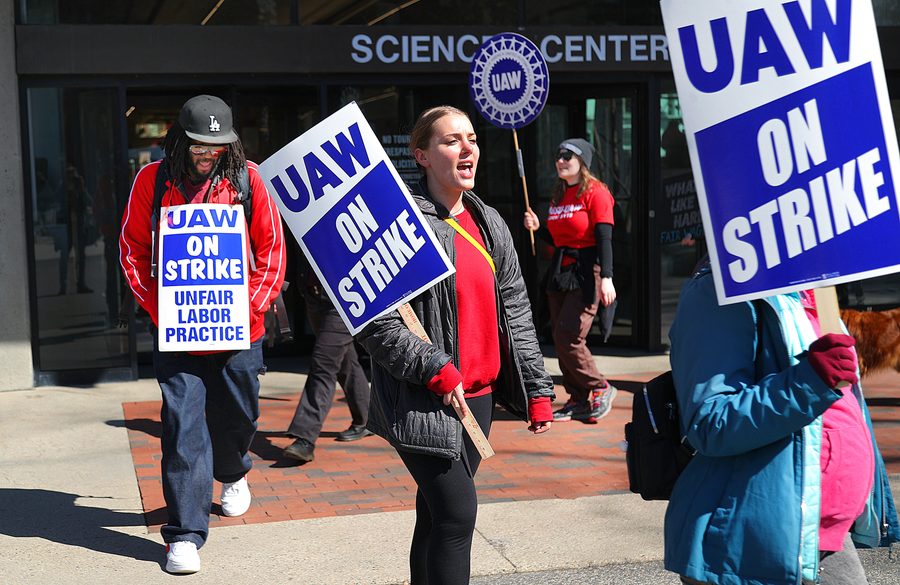
More than 4,000 UAW members are on strike at Harvard University.
Maximillian Alvarez
Maximillian Alvarez: Welcome everyone to Working People, a podcast about the lives, jobs, dreams and struggles of the working class today. Working People is a proud member of the Labor Radio Podcast Network and is brought to you in partnership with In These Times magazine and The Real News Network. This show is produced by Jules Taylor and made possible by the support of listeners like you.
We’ve got an important episode today about a strike in Cambridge, Massachusetts, that is happening right now and involves over 4,000 UAW members at Harvard University.
Now, the strike began at the end of April, and according to the public announcement, which was released by the Harvard Graduate Students Union: “After 14 months of contract negotiations and nearly a year without an active contract, over 4,000 workers represented by the Harvard Graduate Students Union (HGSU-UAW Local 5118) launched a strike of indefinite length on April 21. This move follows a strike authorization vote in which 79% of the union’s voting-eligible members participated, with 96% voting in favor. Graduate student workers will suspend teaching and research labor until Harvard’s bargaining team takes substantive action in addressing the union’s key issues: pay that keeps pace with the rise in cost of living, recourse for harassment and discrimination, support for non-citizen students, protections for academic freedom and ‘fair share fees’ to equitably distribute the expenses of union representation, among others.
“The union is also bargaining for improved workplace conditions that allow graduate student workers to contribute to the university’s mission without fear of harassment or retaliation. Under the current system, graduate students filing claims of workplace harassment and discrimination can only seek recourse through internal processes, leaving the University as the sole arbiter of its own conduct. HGSU-UAW has proposed optional grievance processes in which claims can be adjudicated by third party arbitrators selected jointly by the university and the union. Such protections are standard among graduate student worker contracts at comparable institutions like NYU, UPenn, MIT, University of California and Stanford.
“Claire Trawick, a PhD student in Material Science and Mechanical Engineering, shared why this process of real recourse is so important for student workers: ‘When I told my advisor about the ongoing sexual harassment I had been experiencing in lab, he told my accusers I had tried to report them and then effectively fired me by refusing to sign my advising agreement.’”
Now in an email sent to the Harvard community just days before the strike began, Harvard Provost John F. Manning and Executive Vice President Meredith Weenick, defended the University’s position on wages and union security, saying that Harvard’s proposal of a 10% increase for salaried appointments is “in line with recent agreements,” while also rejecting the union’s demands to standardize research assistant base salaries and restructure other pay scales. Manning and Weenick also claimed that the union’s demand for a third party arbitration process would establish a “distinct and separate set of non-discrimination, harassment and antibullying processes for union members,” which they say would “conflict not only with federal regulations for Title IX complaints, but also with the University’s policy that members of our community should have access to the same procedures.”
I am really grateful to be joined on the show today by three guests. Sara Speller is a fifth-year PhD student in the Music Department at Harvard and the president of the Harvard Graduate Students Union. Sara works as a Teaching Fellow for the Music Department and the Department for the Studies of Women, Gender and Sexuality. Zoë Feder is a seventh-year PhD student in the program in Biological and Biomedical Sciences at Harvard Medical School and a research assistant in the Microbiology Department. And Zoë works in a bacterial genetics lab. And Jacob Wolf is a third-year PhD student in the Harvard Graduate School of Education who works as a Teaching Fellow in courses about designing learning experiences. Why are you as graduate student workers on strike right now, and what have the past two weeks on strike look like for you?
Sara Speller: The way that we’ve been framing this, and I think it’s very, very true is that all we’re asking for are adequate pay and adequate protections for all of our workers.
I take specific umbrage with the claim that we are trying to create like a secondary way of making sure that harassment and discrimination is dealt with for only us because what we’ve said at the table is we want everyone to have access to an arbitration that is neutral, does not rely on the goodwill of the internal processes at Harvard.
Pay equity is so vital and will make the classroom experience so much better and healthier. Because what we have right now are people juggling three, four individual classes and dealing with all kinds of different assignments and job work that they have to do within that.
If the Teaching Fellows were able to feel comfortable in the fact that we can pay rent; we can take care of ourselves; we can take care of our dependents; we can keep ourselves protected on a legal front for our noncitizens and international workers by being able to afford or receive payment for having immigration lawyers on hand, how much better would the learning environment here be – at the richest university in the world? I think they can afford to do that, and they should because what we care about is teaching and learning.
As for the last few weeks on strike, it’s been very difficult. I love my job, but it also has been very rewarding — especially I’ve been President for about two years — and it’s so beautiful seeing people come together from all different corners of the University, getting to know each other and sharing in the camaraderie and solidarity.
Zoë Feder: I have been aware of and seen firsthand this ever present issue of harassment, the sort of threat of harassment and discrimination in academic spaces without appropriate tools to protect people.
In my time as a graduate student worker, I’ve been a part of many different discussions and committees at different forms and levels, and I feel really that our union is the first organization that I’ve been a part of where we’ve made material progress and protecting people from the day to day harassment and discrimination that they experience. And so one of the big motivations for me in joining the strike is to address this.
Our union and our contract, I’ve found, have been the most effective tools, so I’m putting all of my energy into strengthening those tools because I’ve seen through experience that’s the fastest and most effective way for me to help protect my co workers from harassment and discrimination.
Jacob Wolf: As I’ve tapped into this union organizing and been working to connect with rank and file members at the School of Education, where I primarily do my work and research, I’ve just learned how much misinformation there is about the union across our campus, and how hard it is to correct that misinformation when the work structures at Harvard are so intentionally, in my opinion, complicated. Everything across all of these various schools and departments functions differently.
People often don’t know if they’re eligible for union membership or if their work is protected by the union. When people experience instances of some kind of contract violation, whether that be harassment or even not receiving the wages that they’re supposed to be receiving, they often don’t know that they have union support.
My understanding is that that’s kind of the case across higher ed. Many higher ed institutions have engaged in intentional union busting through these kinds of opaque structures that make it hard for people to know what their rights are. The strike has really energized me around our proposals for union security. Things like making it such that all graduate students who are eligible for union membership would have to make an intentional decision, either to join the union or to pay reduced “fair share fee” that would still contribute to the work that the union still performs for all students through bargaining and through contract enforcement.
Everyone across the university has different forms of compensation. It’s totally unfair that folks who are more advanced in their programs are making so much less than folks who are earlier in their programs. But even me, someone who’s earlier in my program, I’m still very concerned about our wages not keeping up with inflation.
Right now our contract is a pay cut, and that is, not only is it unacceptable, it’s unlivable. When we say we’re fighting for a living wage, it is not a euphemism.
Alvarez: There’s a big perception disconnect here – which I’ve tried to address with this show over the course of many years to get people to understand – just because Harvard is, as Sara said, the richest higher ed institution in the world, and it’s got this massive endowment, venerable reputation, yada yada yada. That does not mean that the like grad student workers who are teaching a lot of the classes are even able to pay their own damn rent. And this is the case in higher ed institutions across the country.
I say that as a former grad student who was living below the poverty line it’s par for the course. And we’re always told, ‘Well, it’s not a real job. You’re getting an education. The pay and the work are disconnected in this weird way.’ And that’s just not the case. No, we’re workers. We need to make a living. We need to keep a roof over our head and have a employer-employee relationship with the university telling us what labor to do to get our paycheck.
I want to thank our guests, Sara Speller, Zoë Feder and Jacob Wolf, all graduate student workers at Harvard University, and all members or officers of the Harvard Graduate Students Union, which has been on strike since April 21. You can stay up to date on the strike and follow the grad union using the links that we provided for y’all in the show notes for this episode.
I want to thank you all for listening for caring. We’ll see y’all back here next time for another episode of Working People. And in the meantime, go explore all the great work that we’re doing at The Real News Network, where we do grassroots reporting that lifts up the voices and stories from the front lines of struggle. I’m Maximilian Alvarez. Solidarity forever.
This episode of the Working People Podcast was published on May 12.

Get 10 print issues of our award-winning, worker-first journalism here!

Maximillian Alvarez is editor-in-chief at the Real News Network and host of the podcast Working People, available at InTheseTimes.com. He is also the author of The Work of Living: Working People Talk About Their Lives and the Year the World Broke.


