Iranian Artists Keep the Spirit of “Woman, Life, Freedom” Alive
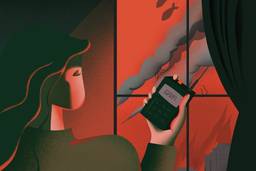
“Raised fists, flowing scarves and bold female figures,” Rouzbehani says. “All these elements reflect the movement’s core spirit: autonomy, resistance and hope.”
Alessandra Bajec


The 2022 “Woman, Life, Freedom” protests erupted in Iran following the shocking death of 22-year-old Jina Mahsa Amini, in police custody. Like many Iranians in the diaspora, illustrator Roshi Rouzbehani was filled with grief, rage and a profound duty to speak out. She felt compelled to create art that echoed what so many were experiencing, and to share the images online to help bring global attention to her people’s struggle.
“Art became both a personal coping mechanism and a form of activism for me,” Rouzbehani tells In These Times. Now based in the UK, she left Iran in 2011 to seek safety from political pressures.
In the year of the women-led uprising, the Iranian regime’s security forces killed hundreds of protesters and threatened the lives of numerous journalists, and detained, tortured and persecuted thousands more. Artists, musicians and cultural workers in Iran — particularly those involved in protest art and human rights activism — continue to face escalating repression, including arbitrary arrests, jail sentences, concert bans and strict censorship.
“Raised fists, flowing scarves and bold female figures,” Rouzbehani says. “All these elements reflect the movement’s core spirit: autonomy, resistance and hope.”
Growing up under a regime with laws and norms that severely restrict women’s freedoms left a lasting mark on Rouzbehani. The mandatory hijab, the strict controls on women’s dress and the limits on public behavior remain key tactics of enforcing gender segregation in Iran, with those who defy th“Raised fists, flowing scarves and bold female figures,” Rouzbehani says. “All these elements reflect the movement’s core spirit: autonomy, resistance and hope.”ese rules risking harassment, arrest, physical violence and worse.
Resilience has long defined Rouzbehani’s work, but the “Woman, Life, Freedom” uprising brought the themes of social justice and gender equality into sharper focus. Other experiences, such as her aunt’s four years as a political prisoner and a plethora of family stories rooted in resistance, also deeply shaped her artistic voice. Now based in London, Rouzbehani’s artwork has shifted toward quieter forms of dissent rooted in collective memory and cultural identity, driven by a desire to preserve narratives that might otherwise be lost
In her solo exhibition at Amnesty International UK, Rouzbehani presented an untitled piece from her collection that visually reflects on the “Woman, Life, Freedom” movement. The illustration is of a defiant woman figure with flowing red hair that morphs into three bird-like shapes, carrying the words “women,” “life” and “freedom.” Her new book, Migrated Keepsakes, tells the stories of Iranian women in the diaspora through the personal objects they brought with them when they migrated. Each of these intimate items speaks to survival, defiance, cultural preservation and hope, anchoring them to a homeland left behind.
Rouzbehani knows the legacy of Iran’s 2022 upheaval extends far beyond protest imagery. While the movement evolves, she points out, its impact continues to resonate by pushing artistic boundaries, reclaiming overlooked narratives and amplifying voices too long silenced.

“It lives in the way Iranian artists claim space, speak their truths and challenge systems of oppression across every medium,” she says.
As Jina Mahsa Amini’s death made international headlines, Los Angeles-based animator and illustrator Forouzan Safari was overcome with anger. Using Iranian social media, she began creating images that captured the time of the women-led protests in her home country, which she left in 2013. That witnessing of Iranian women bravely rising against an oppressive theocracy gave Safari’s work new depth.
“Now, I don’t have any mandatory hijab on my characters anymore. I show women free, exercising without headscarves, walking, riding bikes, doing activities we’re not allowed to do culturally or politically,” the digital creator says, gesturing toward characters whose facial expressions and bodies display strength and endurance. One of Safari’s early 2025 visuals depicts four women in bodysuits, hair down, striking a dance pose inside a mosque on Isfahan’s Naqsh-e Jahan Square.

“I wanted to take the religious part out,” Safari explains, “to imagine women moving freely or dancing.”
Challenging the dominant perception of the site as Islamic art, she goes on to say: “To me, it’s just Iranian architecture.”
For Safari, art remains one of the few freedoms the Iranian authorities cannot strip away. Making illustrations is her way of channeling a deep emotional responsibility toward her country. “Art is my survival,” she says. “I feel like this is the only way I can do something.”

Her artwork envisions a freer future for Iranian women. In December 2024, she sketched an illustration of singer Parastoo Ahmadi, who was detained after livestreaming a traditional Persian music performance without wearing a hijab, a bold and historic act of defiance against Iran’s hijab mandate.
Another untitled piece, from April 2025, shows women and men dancing under Isfahan’s Khaju Bridge as a crowd claps and cheers (page 36). It captures the vibrant tradition of locals gathering beneath the historic bridge, with bright whites highlighting the women at the center, set against a dark architectural arcade. The piece conveys a sense of acceptance of men and women socializing together, in contrast with reallife scenes under the famous bridge, in which mostly men currently gather at night to sing, dance and play music.
When the 2022 rallies erupted in her native Iran, installation artist Parastou Forouhar wanted to help sustain the upheaval by building a supportive network to document the movement. This led Forouhar to co-found Art/Culture/Action, a global collective of Iranian artists and cultural practitioners that documents censorship, amplifies voices of Iranian creatives and preserves the memory of resistance. One month into the mass mobilizations, Forouhar and more than 6,000 Iranian cultural figures signed a statement in support of arts student demonstrations. In December, the group called for an international boycott of regime-affiliated cultural groups, in protest of the growing repression in Iran’s arts scene.
“It was important to make the art students who were at the very forefront of the uprising more visible and highlight their contributions,” Forouhar says.


Forouhar, who has lived in exile in Germany since 1991, has been using her art to confront Iranian politics and Islamic fundamentalism. Her life and work were decisively influenced by the murder of her parents, prominent opposition politicians, by Iran’s Ministry of Intelligence in 1998, part of a series of political assassinations of dissidents. For 26 years, Forouhar has annually visited Tehran to organize a memorial for her parents and demand justice for victims of political killings.
Through her work, she often finds beauty in images underlaid with patterns of violence and injustice. In her Butterfly series, delicate shapes and colors are built from faceless figures enduring scenes of inhumanity and torture, highlighting the contrast between freedom and oppression. “The butterflies appear beautiful from a distance, but at a closer look, you see pain and harm,” Forouhar says. “Each echoes moments of an uprising.”

Reflecting on the protest movement’s legacy, Forouhar notes that it sowed the seeds of a cultural revolution, challenging the system at its core as people continued to practice civil disobedience in everyday life. “Every time I visit Iran, I’m inspired by how people push back against the regime, standing firm in their rights,” Forouhar says.
Tehran-based poet Ali Asadollahi quotes from the etching on Mahsa Amini’s gravestone: “You will not die. Your name will become a symbol.” Remembering the charged days of nationwide rallies, he remarks how the brutal death of the young woman and its aftermath shaped his work, prompting him to explore visual and research-based poetry that rejects conventional forms.
Asadollahi’s writings are known for poetic innovation and political consciousness. A line from a quatrain he wrote in 2019, “Do not forget the blood,” appeared on walls in and beyond Tehran and was widely shared online during and after the upheaval, in tribute to the martyrs of the security crackdown.


One of his visual poems, from March 2025, reads: “You cannot read this poem if you were not shot in the eyes.” It honors those blinded by the security forces who deliberately aimed for the eyes of protesters.
Another quatrain, from July 2025, evokes the ongoing fight for liberation: “May this sorrow and mourning herald joy. May our ruin foretell the dawn of rebuilding. The broken cypress whispered to the blossoms: If there’s life left, let it be sacrificed for freedom.”
In 2022, Asadollahi was detained for more than three months, including a month in solitary confinement, after publishing verses on his website that paid homage to Nika Shakarami, a 16-year-old girl who died in the anti-government demonstrations. During his interrogation, authorities questioned him about nearly all of his poems, including one commemorating Neda Agha-Soltan, a young Iranian woman who was fatally shot during the 2009 Green Movement protests. “In this oppressive environment, any word or protest can be defined as an act against national security, and poetry is no exception,” he reflects.

Although the “Woman, Life, Freedom” movement has not achieved sweeping legal change, it has sparked a shift in social consciousness: Everyday acts of resistance are growing and more people are refusing to accept suppressive norms. Even as repression persists, Asadollahi’s love for his homeland continues to drive his writing.
“Iran is my sole reason and motivation,” the poet says.


Get 10 print issues of our award-winning, worker-first journalism here!

Alessandra Bajec is a freelance journalist specializing in the Middle East and North Africa. Her work has appeared in The New Arab, Al Jazeera English and The New Humanitarian, among other places.