How One Landlord Tried to Silence Tenants—and the Story of Their Rent Strike
To settle their eviction cases, Chicago tenants agreed to stop speaking publicly about their landlord. His attempt to hold them liable for past statements to the media could set a chilling precedent, experts say.
Hope Davis
This article was produced by Shelterforce, a national nonprofit publication covering housing. It is republished here with permission.
In late August 2025, I sat in on a meeting of Chicago’s Belden Sawyer Tenant Association (BSTA) and interviewed members about their six-month rent strike for Shelterforce. The tenant union formed and launched its rent strike after members learned their once affordable building would be converted into luxury apartments by its new owner, Andrew Millard.
Tenants told me they paid $1,200 - $1,500 per month to rent their apartments in Logan Square, a Chicago neighborhood that is becoming increasingly expensive. They didn’t know the building at the corner of Belden and Sawyer avenues was up for sale before Millard and his company Concord Capital bought it in late 2024.
Then, tenants received notice that their leases would not be renewed. Millard and Concord planned to renovate and rent apartments for $2,400 per month with one to three basement apartments set at $1,116 per month.
BSTA launched the rent strike last March to build leverage and pressure Millard to negotiate terms that would allow them to stay in their apartments. The union demanded that Millard not renovate, renew leases annually, and negotiate rent rates with the union.

That spring, Millard filed eviction cases against the striking union members. In July, I started speaking with a member about covering the strike.
In late August, the first trial date in the rent strikers’ eviction cases was approaching, and members were working with lawyers to reach a settlement with Millard that would avoid trial.
BSTA and its allies spent the week of August 25 picketing in front of the offices of Concord Capital and 33 Realty Management, the firms through which Millard owned and managed their building. (Millard founded 33 Realty but has since sold it and says he has no ownership stake.)
The picket was meant to apply pressure for the pre-trial talks. During that time, union members thought they had reached an agreement that would allow them to leave the building without evictions on their records and with the back rent forgiven. By the end of that week, however, the deal had fallen through.
The following weekend, on August 31, I joined BSTA members for their union meeting and a group interview. Negotiations resumed the following week, and by mid-September, an end was in sight. Millard and striking BSTA members signed an agreement that forgave $5,000 in back rent per tenant and sealed the eviction cases. In exchange, each tenant party to the agreement would pay 33 Realty Management nearly $5,000, waive their rights under Chicago’s Residential Landlord and Tenant Ordinance (RLTO), and refrain from “making public statements” about Millard or his businesses or picketing in front of his properties.
Starting Sept. 13, 2025, about a week before they signed the agreement, tenants declined to speak to me about anything the agreement prohibited them from discussing. However, we continued to talk about matters related to tenant organizing in general and the future of BSTA after moving out of the building.
The order, which Shelterforce has since obtained from BSTA’s lawyer, states that “Parties will refrain from making public statements now or in the future about the other Party, or its related entities (33 Management, Evernest, Concord Capital) and its employees and/or its properties including but not limited to media, instagram, yelp, or other sites.” It goes on to say that “Defendant [BSTA members] will remove any documents, photos, profiles, websites or statements from any websites or public spaces or the like regarding the plaintiff [Millard and his related companies].”
BSTA complied with the order, taking down press releases and any mention of Millard from its website and social media.
My article for Shelterforce was still in progress at the time, and I needed to give Millard a chance to respond to the assertions in it that referenced him or his related businesses. Since I didn’t have access to the exact wording of the order at the time, I spoke with the lawyer representing BSTA members before contacting Millard for comment. I wanted to make sure I didn’t put my sources at risk, even though they had spoken to me well before signing anything (or even having decided to sign anything).
I emailed Millard for comment in late September 2025 and did not receive a reply.
On Oct. 17, 2025, I sent Millard a final “no surprises” email listing the article’s claims about him and his related businesses so he could respond.
In less than half an hour, Millard had copied two of his attorneys on the email thread, writing, “As part of our settlement this lying, defamation, business interference, etc was supposed to go away. Clearly it hasn’t and I’d like you to speak with their attorneys for damages if this article is written.”
Minutes later, one of Millard’s attorneys, Jordan A. Finfer, wrote to me claiming union members “agreed, as a condition of the settlement, to recant all prior statements” and threatening to seek “remedies” if the article went forward. In fact, as we learned later, the signed settlement order applies only to statements “made now or in the future.” The agreement does compel the union to remove statements from “websites or public spaces,” but it does not state that members must disclose or recant statements already shared with a journalist. Finfer and Millard did not respond to requests for comment.
Adriel Colón-Casiano, a tenants rights attorney practicing in upstate New York, found this response questionable. He says if they wanted to know what had already been said, Millard’s attorneys should have required such disclosure in the agreement. They did not.
Eric Sirota, director of the Tenant Advocacy Clinic at Northwestern University’s Pritzker School of Law, adds that under Chicago’s RLTO and Illinois’s anti-retaliation law, tenants have a protected right to speak to the press about code violations or unlawful practices by a landlord. While BSTA’s initial claims didn’t specifically allege code violations or unlawful practices, Sirota says it’s important that tenants remain able to speak to the press in case those things come up.
“There’s just nothing nefarious about it,” Sirota says. “It’s one of the main ways tenant unions advocate.”
The union emailed me on Oct. 20, 2025, requesting that “although we made all statements … before the signing of this agreement,” I not print “any statements” from them “concerning Drew Millard, 33 Realty/Evernest, or any of his other companies.”
Another of Millard’s attorneys, Thomas J. Raleigh, notified me later in the day on Oct. 20, 2025, that motions for noncompliance had been filed against the BSTA members and wrote, “Maybe speak to the tenants and then make a decision. They have a lot to lose if this article gets published.”
Because the agreement did not limit past speech, Colón-Casiano says, Millard’s attorneys essentially tried to invalidate the contract based on conduct it did not cover.
On Oct. 23, 2025, Raleigh contacted me again, writing, “Our motions against the tenants for violating the terms of the agreed order … are up next Tuesday. What is your position? If you dont respond, I’ll assume you plan to move forward with your original article.”
Sirota describes this correspondence as “extortionary.”
Despite Raleigh’s implications, Shelterforce, not being a party to the order, had no legal obligation to withhold comments made to us on the record, and the tenants had no legal leverage to compel Shelterforce not to run the story. It is also highly questionable whether the tenants could legally be held retroactively accountable for statements they made before the agreement was negotiated. Millard’s requests seem to be well outside the scope of the agreement the tenants signed.
Raleigh did not respond to requests for comment.

Although we found it troubling, Shelterforce still honored the tenants’ request to remove their previous statements because it aligns with the publication’s values to minimize risk to the tenants that they did not choose to take. I committed to rewriting the story to rely solely on other sources for the facts about Millard and his businesses, quoting BTSA members only regarding their organizing work.
We informed Raleigh of this decision on Oct. 27, 2025. He asked what would be included in the article instead; we declined to answer. After the cases’ final status hearings on Nov. 4, 2025, Raleigh withdrew the motions for noncompliance. The tenants moved out at the end of October as planned under the terms of the original settlement. The tenants in another building who were engaged in similar legal issues with Millard moved out in February 2026, and we published our revised article in March 2026.
Also on Oct. 27, 2025, I received copies of the motions, which included the original settlement agreement, from the tenants’ lawyers. In the motions, 33 Management requests that the judge issue eviction orders against the tenants and unseal the cases unless the tenants “[take] action to ensure this article is not published.” The motions state that Millard would not have entered into the agreement had he known about my article, and claim that before signing, in response to a query, the tenants’ lawyers represented to Millard’s lawyers that no “gotchas” would emerge that should have been considered in the agreement.
In response to this claim, Sam Barth with the Law Center for Better Housing, who served as the tenants’ attorney, wrote in an email, “As I’m sure I told the attorney at the time the motion was filed, I fail to see how a conversation that occurred well before the agreement was signed and does not violate the terms of the agreement could be considered a ‘gotcha.’ … This kind of unsupported testimony in a motion is inadmissible and could not be used in court as the basis of a ruling.”
Many eviction cases end with an agreement between the landlord and tenant. While the tenant might still have to move out, an agreement can mean they avoid having an eviction judgment entered against them and/or they have back rent forgiven. As in the case of BSTA members, the parties can also agree to seal the case so that records of the eviction filings don’t harm tenants’ chances of finding housing in the future.
Sirota says these deals are like the two parties “calling it even.” When a plaintiff and a defendant settle a lawsuit, they essentially waive some liability and agree not to sue each other or press their claims further. While such a settlement might allow tenants to waive their rights under the RLTO to sue that landlord for past actions, Sirota says a landlord cannot force tenants to sign away their rights to future protected acts in order to settle. At the very least, Sirota says, an agreement could not stop tenants from speaking about issues while they still live in the landlord’s property.
Sirota and Colón-Casiano have seen plenty of eviction settlement cases, and they both found aspects of this one to be concerning.
Sirota says it’s unacceptable for landlords to include in a settlement that tenants can’t speak out about issues they’re experiencing in the home or with the landlord.
“I don’t think a landlord can tell tenants to stop complaining about conditions. Full stop,” he says.

Sirota adds that a landlord should not be able to renege on an agreement because tenants engaged in protected activity before entering that agreement.
Colón-Casiano argues that parts of the agreement between Millard and BSTA could amount to housing discrimination and retaliation “because they are preventing and encumbering the formation of a tenant union” in a state that protects tenant organizing as a right.
For example, the agreement doesn’t just bar the tenants from picketing outside Millard’s properties; it states, “Defendants shall not contact or communicate with other tenants of Plaintiff or other tenants of its related entities/affiliates.”
“If you walk out [into the hall] and say, ‘Hey, do you smell smoke?’ you’re technically breaking that agreement,” Colón-Casiano says. “If your landlord is stopping you from talking to other tenants, clearly the purpose of that is to encumber you from forming a tenant union.”
BSTA members continued to communicate with one another in peace. However, abiding by their settlement agreement means members cannot speak to tenants at Millard’s other properties. This includes members of Fuerzas Inquilinos de Broadway y Cuyler (FIBC), a tenant union at an Uptown property owned by Millard and Concord Capital that followed BSTA in launching a rent strike. Like BSTA, FIBC fought being displaced to make way for higher-income tenants. FIBC also filed a lawsuit against the owners and management claiming that actions taken to remove the tenants amounted to housing discrimination.
“My opinion is that that violates public policy and injures the public — beyond the parties to this agreement — because it makes it harder for the public to have safe housing,” Sirota says.
Because of this, the agreement could violate the Illinois Consumer Fraud and Deceptive Business Practices Act, which Sirota says “prohibits unfair and deceptive conduct towards consumers.” He adds that case law defines unfairness as “conduct that is oppressive, unscrupulous, or in violation of public policy.”
“When people participate in a tenant union, it doesn’t just benefit them,” he says. “It benefits other residents, and it benefits future residents because the union could ensure that capital repairs are made that will benefit whoever lives in the building for generations to come.”
The fight over publishing my story isn’t the first time Millard has tried to force union members to change the behavior of people who were not party to the agreement.
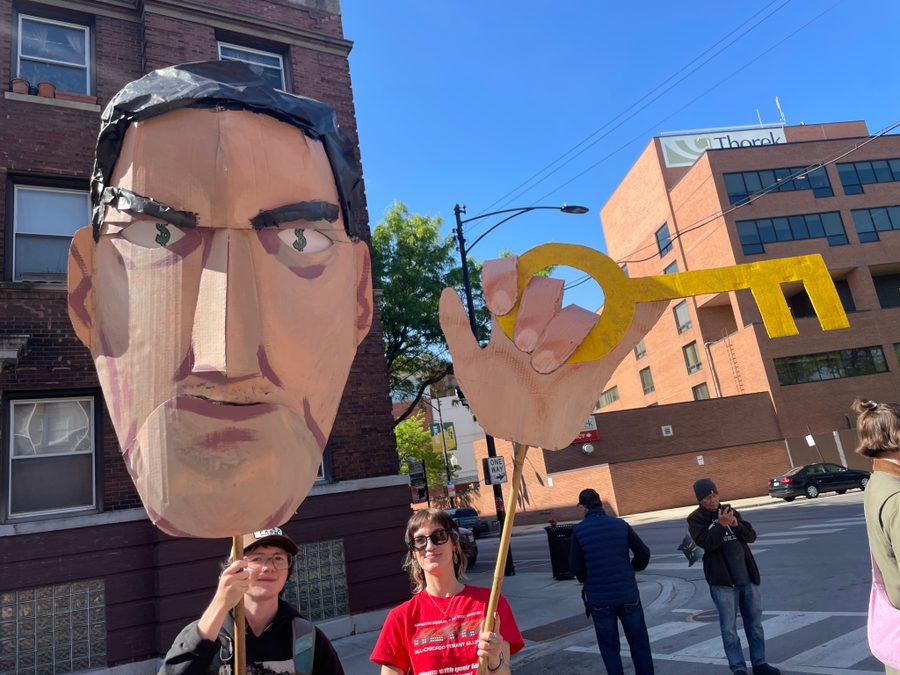
From its early days, BSTA has worked with the All-Chicago Tenant Alliance (ACTA), a group that helps organize tenant unions and rent strikes. While protesting with BSTA outside Millard’s offices and home, ACTA members brought a large paper-maché model of Millard’s head with money signs in its eyes.
ACTA organizer Maya Odendahl tells Shelterforce that Millard tried to gain possession of the head — which belongs to ACTA — in negotiations with BSTA. Odendahl shared a message purporting to quote an earlier version of the order as saying, “Plaintiff will waive all late fees and rent increases not mentioned above in exchange for the paper maché head.”
At another point, Odendahl says, Millard asserted he would only agree to settle if BSTA agreed to deliver the head to him “in good condition.”
Odendahl explains that she wouldn’t normally know the specifics of these negotiations, but BSTA had to explain them in order to ask ACTA for the head. She speculates that Millard had to drop the request because he couldn’t legally compel the union members to give him something that was never their property.
ACTA has also worked with FIBC. Members of FIBC also launched a rent strike in the spring of 2025 and settled eviction cases with Millard early this year, Odendahl says.
Odendahl tells Shelterforce that Millard asked striking FIBC members to convince ACTA to remove its social media posts about him to reach a settlement. She said that ACTA granted this request as a show of good faith.
When I contacted Millard again for comment before publishing my revised article, he agreed to speak with me. We had a friendly Zoom interview at the end of February, during which he shared his side of the story. By then, the story, out of legal necessity, focused less on the original landlord-tenant conflict and more on BSTA’s ongoing organizing.
Parts of that conversation were included in the final version of my article. Some didn’t fit into the new focus. Other parts of Millard’s story couldn’t ethically be included because BSTA members couldn’t respond to them without violating their agreement with him. As a result, I had to remove conflicting claims from both Millard and the tenants.
In subsequent email exchanges to clarify final pre-publication questions, Millard asked whether we planned to publish “a narrative exclusively siding with bsta” or a “balanced piece.” When the piece was published, he thanked us for a “very fair and well written” article.
Anne Marie Tamburro, press freedom counsel for the Society of Professional Journalists, researches the use of “gag rules” that bar government employees from speaking to the press — and says BSTA’s agreement seems similar. She notes that these tactics are not new.
“It’s an analogous situation in that you have this actor basically holding hostage something necessary to this person’s livelihood,” such as employment or housing, “and conditioning that on them refraining to speak to the press,” Tamburro says.
While its unusual to Tamburro to see this play out in landlord-tenant disputes, she sees it as part of the way people in power think they’re entitled to influence the press.
“It unfortunately seems to be a reflection of the attitudes in general toward the media in our country from folks in power — in particular, [those] who are threatened by criticism or unflattering coverage,” she says.
Adam Rose, deputy director of advocacy for the Freedom of the Press Foundation, sees BSTA’s situation as a whistleblower issue. Rose says the attempt to retroactively enforce the agreement could be seen as retaliation for previously “blowing the whistle.”
The result, he says, could be a chilling effect that scares tenants away from speaking to a reporter or organizing out of fear of legal action, resulting in coverage more palatable to those they would have criticized.
That matters even if a landlord’s plan is “simply to renovate and raise rent as an economic play,” Rose says. “The public deserves to know what’s going on in their communities economically [and] socially. If people are afraid to talk to reporters, we are poorer as a society for it.”
The chilling effect could also extend to organizing, he says, because “if people are afraid to speak out, then other people in the community don’t know what their options are.”
This article was originally published in Shelterforce, a national nonprofit publication covering housing. To get Shelterforce stories in your inbox, sign up here.

Get 10 print issues of our award-winning, worker-first journalism here!
Hope Davis is an award-winning journalist based in Springfield, Missouri. She covers local government, economic inequality and infrastructure.