Why It’s More Important Than Ever To Learn About May Day
A broad coalition is organizing nationwide actions this May Day to support workers’ rights, protect democracy and demand an end to billionaire rule.
Jackson Potter

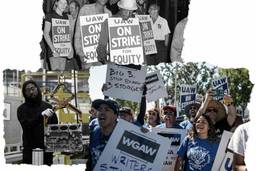
In a late April editorial titled “CPS CEO Macquline King did not need to cave to the Chicago Teachers Union,” the Chicago Tribune editorial board expressed dismay over Chicago Public Schools’ decision to mark the historic importance of May Day, a holiday meant to commemorate a worker-led campaign for an eight-hour work day. The editorial claims that celebrating May Day risks turning schools away from being “places of learning.” Why would the Chicago Tribune have such strong objections to observing an event that originated in Chicago in 1886, which is celebrated across the globe as International Workers’ Day?
One possible reason could be tied to the newspaper’s history. The Chicago Tribune’s owner in 1886, Joseph Medill, supported police action against the unionists who were protesting growing income inequality and worker exploitation across the country. Medill, who owned a mansion in the city’s wealthy Gold Coast area, called labor organizing “a species of civil war” and vowed to use his publication to indict — literally and figuratively — the working people responsible for organizing the May Day protests, which turned deadly after an unknown assailant threw a bomb during a gathering at Haymarket Square, leading police to fire on demonstrators.
The Chicago Tribune played a key role in helping turn public opinion against the organizers behind the protest movement. The gambit worked, helping lead to a circus trial that resulted in the execution of four left-wing leaders following a judge’s ruling that lacked clear evidence.
Fast forward to the present. Indivisible, the organization that has helped organize mass public protests under the moniker of “No Kings,” recently endorsed May Day as a critical test for civil society to demonstrate economic noncompliance with an increasingly authoritarian Trump administration. Under Trump’s second term we’ve seen Immigration and Customs Enforcement (ICE) agents engage in abductions and executions, massive tax breaks for the rich funded by cuts to Medicaid and nutritional supports for hungry children, an illegal war in Iran that’s spiking prices and making it harder for workers to make ends meet, and all-out efforts to undermine democracy itself. This May Day, organizers are planning to demonstrate against attacks on working people and democracy alike.
The recent claims by the Chicago Tribune editorial board echo the arguments made not just by Medill in the late 19th century, but also civic elites in Birmingham, Alabama in 1963, when around 1,000 children skipped school to protest Jim Crow segregation. Ahead of that walkout, some of the city’s most prominent political and religious leaders lambasted the planned protests and asked the Black community to “withdraw support from these demonstrations” and press for “negotiations among local leaders, and not in the streets.” Can you imagine how much longer Jim Crow segregation would have lasted if the Civil Rights Movement had taken heed to these elites’ call for moderation? The answer to injustice is action, not compliance.
There is growing evidence that we live in a country that is backsliding into authoritarianism, and scholars like Harvard Kennedy School’s Erica Chenoweth show us that there is a path to reverse that backsliding. In essence, it requires an alliance of social movements, labor unions and other powerful institutions like city governments, the media, public schools and universities to push back.
That’s why teaching and organizing around May Day matters. A growing movement of workers and community groups is uniting against the billionaires in control of our government to defend free and fair elections and our basic rights to free speech, civil rights, labor organizing, and immigrant protections.
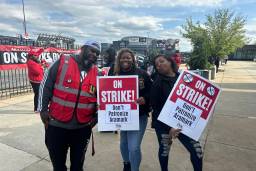
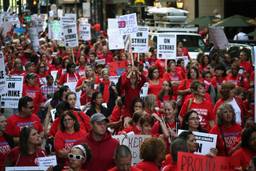
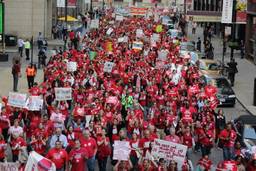
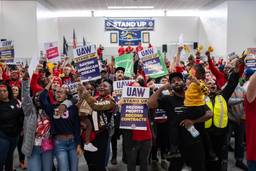
This year, a coalition of labor and community groups — including the Fair Immigration Reform Movement, Democratic Socialist of America, National Nurses United and Indivisible — is helping organize May Day protests in cities and towns across the United States under the banner of May Day Strong.
The Chicago Tribune editorial board and the titans of corporate America would likely prefer we forget the real lesson of May Day — that workers have the power to change our society for the better and build a more equitable future. This May 1 is a chance to show that the proud history of collective worker action is the only viable path to winning the transformative change working families need and deserve.
— — —
For those in Chicago who want to continue the struggle against billionaires and authoritarianism after May Day, please join In These Times for a special event on May 5 at 7 p.m. CST: May Day! What’s Next? There will be a special panel featuring Congresswoman Delia C. Ramirez, In These Times columnist Eman Abdelhadi, CTU Vice President Jackson Potter, UWF member Jasson Perez, and moderated by In These Times Senior Editor Miles Kampf-Lassin. Get your tickets now!

Get 10 print issues of our award-winning, worker-first journalism here!

As a high school student in Chicago in 1995, Jackson Potter led a walk-out to push for equitable school funding in Illinois. He later taught at Englewood High School and was the union delegate there when the district slated the school for closure. He and Al Ramirez formed the Caucus of Rank and File Educators (CORE) in 2008 and the Grassroots Education Movement (with other community organizations) shortly after. He and future Chicago Teachers Union president Karen Lewis served together as the first co-chairs of CORE. After working as CTU’s staff coordinator for eight years, Jackson went back to teaching from 2018 to 2022 and now serves as the union’s vice president.