The NYU Strike Showed How to Reverse the Downward Spiral in Higher Ed
By withholding their labor earlier this year, non-tenured faculty at New York University won major gains—and helped create better learning conditions for their students.
Peter Cole
While teaching and conducting research can be wonderful experiences, working conditions in higher education have become increasingly horrible. In the United States, massive state disinvestment coinciding with 50 years of neoliberalism has resulted in both soaring tuition costs for students and large-scale budget cuts to universities. As a result, faculty teaching loads have increased while wages have stagnated. Meanwhile, university administrators across the country have replaced full-time and permanent faculty with insecure, part-time positions, and rarely replaced faculty who retired or moved. Whereas in the 1970s, more than half of U.S. faculty were tenured or on the tenure-track, today that figure stands at just over one quarter.
Students suffer because their professors have far less availability and are far more stressed. Faculty are forced to hustle, often taking on additional jobs, and are left with less time for teaching and research, thereby undermining the mission of universities. Unsurprisingly, universities have, on the whole, become far worse institutions for both students and teachers.
In the face of this downward spiral for higher education, university workers are fighting back on behalf of themselves, their students and their institutions. New unions of faculty and student workers are being formed at a rapid pace. Union faculty often make the argument that teachers’ working conditions are students’ learning conditions, meaning if those whose job it is to teach are worse off, so is the educational experiences of students. And when they take action and withhold their labor, higher education workers can make real gains.
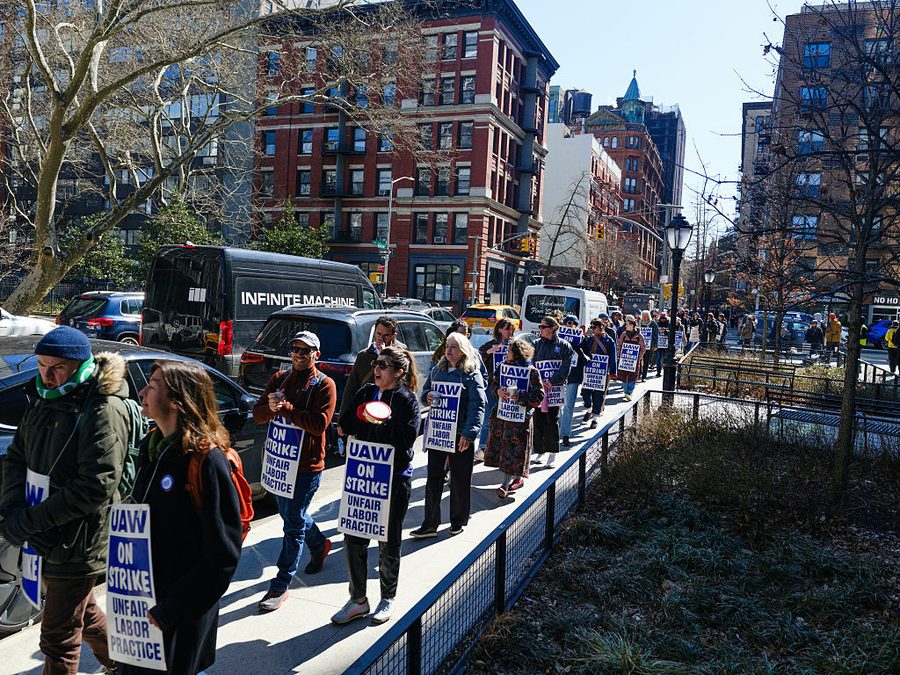
That was put on display this March when nearly 1,000 non-tenured faculty at New York University (NYU) went out on a two-day strike — and came out victorious with a strong first contract. Following more than a year of negotiations, the union — Contract Faculty United, affiliated with the United Auto Workers — won a minimum $14,000 raise for all members starting next semester, higher minimum salaries for new hires and 3.5% annual raises for the duration of the contract.
The union also successfully negotiated on behalf of those earning the lowest salaries, who will receive the highest raises. Another consequential gain was the guarantee of long-term employment for these non-tenured faculty. As the Village Star-Revue reports, the contract will guarantee these workers “the highest minimum salaries of any unionized, full-time, non-tenure track faculty in the country.”
NYU is the largest private university in the country, with an enrollment of more than 60,000 students and a $6.7 billion endowment. At elite, wealthy private universities, non-tenured faculty and graduate students generally teach fewer courses than at public universities and community colleges. But at NYU, non-tenure track faculty teach about a quarter of all courses.
In These Times recently spoke with Jacob Remes, a leader in Contract Faculty United-UAW, about the union’s success. Remes is a clinical associate professor of history at NYU’s Gallatin School. According to Remes, many members were “itching to strike” because “people were so sick of being insulted.” Remes believes that the strike was educational for the membership and even “transformative,” in how it generated a sense of power and community.
Of course, the victorious strike did not just happen overnight. There’s a nearly decade-long history involving Remes and other faculty who organized among their fellow workers for years. Non-tenured faculty began their union campaign in 2017. The drive was stalled by the Covid pandemic in 2020, but negotiations between the union and NYU’s administration eventually began in 2024. After ten months of pressure, the administration agreed to voluntarily recognize the union.
Remes stressed how important it was that his union did not pursue the typical path of workers who are seeking to organize a union and receive employer recognition — an election administered by the National Labor Relations Board (NLRB). As many union activists and their allies have come to understand, the current NLRB is broken and unable to do its job of promoting unions because of a decades-long anti-union onslaught by employers, including those in education. While about 70% of Americans are pro-union and millions of workers would be happy to join one, union membership hovers at around 10% of the U.S. workforce, with only 6% in the private sector — lower than before the NLRB was created in 1935.
The union’s victory early this year, as Remes sees it, was made possible by Contract Faculty United-UAW’s successful fight to represent a much larger group of faculty than the administration had argued for, and the subsequent victory when the administration was forced to recognize the union. According to Remes, “if we had done the NLRB route, we would have a union hundreds of people smaller, therefore with substantially less power.”
After the union won voluntary recognition, “the administration…dragged their feet for 17 months,” according to Remes, before finally agreeing to the first contract won earlier this year following the strike. The administration only delivered its final comprehensive offer just minutes before the strike deadline — already extended by three hours — but since the union found it unsatisfactory, the strike went on as planned.
Ahead of and during the strike, the union ran a campaign to seek support from students and their families who were encouraged to send emails to the university’s Board of Trustees imploring them to negotiate in good faith with the union. The student government association was supportive as were many student activist groups. Many students joined their professors on the picket line, while others refused to attend classes despite the requests of administrators. One student quoted by The New York Times said, “The fact that the people who are running the university are making upward of a million dollars, whereas our professors can’t make enough to comfortably live, is so insane.”
One other relevant factor was the local political scene under new Mayor Zohran Mamdani. While Mamdani didn’t walk the picket line, according to Remes, Deputy Mayor of Economic Justice Julie Su, a newly created position, played an important role during the strike, talking with administrators on the union’s behalf and passing information along to the union about where the administration could move. Before the strike, a group of 66 elected officials urged NYU in a letter to “come to a fair agreement,” warning that an extended strike could “seriously disrupt life for tens of thousands of New Yorkers who are students, employees, and members of the NYU community.” In Remes’s words, “New York City feels like a city where workers are ascendant, unions are coming into their own, and where employers have to reckon with us.”
Contract Faculty United-UAW has demonstrated what unions can do — including prioritizing the lowest paid faculty. As Remes boasts, “We’re the largest union of any non-tenure-track faculty in the U.S.”

Get 10 print issues of our award-winning, worker-first journalism here!