More Than A Slogan: Labor's New Gambit to Tax the Rich
Washington State just enacted a historic “millionaire tax”—and as organizers set their sights on state legislatures, more could soon follow suit.
Rebecca Burns


The threat of a city government shutdown loomed large in Chicago in December 2025 as the city faced an end-of-year deadline to close a projected $1.2 billion deficit.
To counteract the impact of President Donald Trump’s 2025 tax law, Mayor Brandon Johnson had pitched a budget in October that would require some of the law’s biggest beneficiaries to pay more. His proposed payroll tax — on corporations with more than 1,000 employees — would, according to his administration, amount to less than 0.01% of the Trump tax cuts bestowed on companies like Google and Walmart.
But a standoff ensued after a group of Chicago City Council alderpersons — led by Nicole Lee, a former United Airlines executive — announced they would refuse to cross a “red line”: a new tax on the city’s largest corporations, including United. The group raised the specter of businesses fleeing Chicago in droves, despite a Chicago Sun-Times analysis casting doubt on this claim.
To avoid city service cuts, the money would have to come from somewhere, so Lee proposed a raft of options: garbage fee hikes, video gambling machines and an unprecedented plan to sell $1 billion of residents’ unpaid water bills, ambulance fees and city assessments to private debt collectors. As the clock ticked down, ads attacking the Johnson plan blanketed the airwaves, funded in part by hedge fund billionaire Michael Sacks (who had also maxed out his donations to some of the pro-corporate alderpersons).
On Dec. 20, 2025, a majority of the council voted for a budget that nixed Johnson’s proposed tax.
In other words, rather than raise taxes on corporations, “We had a majority of alderpeople say that they would rather sell the debt of the most vulnerable people in the city,” according to Ishan Daya, codirector of the Chicago-based think tank Institute for the Public Good.
Johnson called the budget “morally bankrupt” and let it pass without his signature, averting a shutdown. But he did sign an executive order prohibiting the sale of city-owned medical debt and coercive collection practices. Under those terms, it’s unclear whether the city will find a buyer, raising the possibility of a midyear budget shortfall.
Chicago’s budget showdown illustrates the battle lines forming around state and local budgets this year as the bipartisan logic of austerity collides with Washington’s new priorities — a federal government set on eliminating social programs while giving its deportation machine more funding than most of the world’s militaries. Starting this year, states will be forced to come up with billions of dollars more for Medicaid and food assistance if the programs are to continue.
With those stakes in mind, Chicago progressives are regrouping to take the fight to the state legislature, where Illinois is one of at least eight states that will consider new taxes on the ultra-wealthy this year. In March, Washington enacted a new 9.9 percent tax on incomes over $1 million, a watershed change in a state that previously did not tax personal income at all.
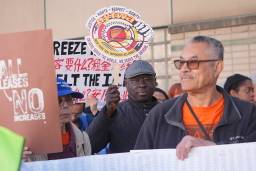
Many of these tax-the-rich measures are championed by labor-community coalitions also preparing for mass actions on May Day as they make the case that austerity and authoritarianism are two sides of the same coin.
“The Department of Education has been dismantled to pay for the invasions of cities like Chicago and Minneapolis,” according to Stacy Davis Gates, president of the Chicago and Illinois teachers unions. “Billionaires are going to have to pay their fair share, because if they don’t, then we won’t survive this moment.”

The call for the rich to pay their fair share isn’t just rhetoric. According to the Institute for Taxation and Economic Policy, all but six states have tax systems that exacerbate inequality. Nationwide, the bottom 20% of earners effectively face state and local tax rates nearly 60% higher than those in the top 1%.
The regressive roots of some state tax systems date back to Reconstruction, when organized white violence against Black policymakers helped roll back tax increases levied to fund schools and public services for formerly enslaved people. In 1890, Mississippi was the first of a wave of Southern states to enact constitutional barriers to tax increases. Then, to shore up its hollowed-out tax base (without angering white landowners) during the Great Depression, Mississippi created the first sales taxes, a strategy that quickly spread.
Following decades of pressure from progressive reformers, Congress enacted the modern form of our federal income tax in 1913, which later allowed the government to fund, for example, New Deal and Great Society-era social programs. Federal revenue-sharing has, at times, also allowed cities like New York to maintain extensive public services, but on their own, cities are “actually pretty limited in their abilities to raise revenue,” according to Columbia University historian Kim Phillips-Fein.
That mismatch can hamstring the social agendas of municipal leaders like Johnson and New York City Mayor Zohran Mamdani. In January, Mamdani acknowledged his city was facing a fiscal crisis at a “scale greater than the Great Recession,” setting up a fight to raise local taxes on the wealthiest New Yorkers, which will require state authorization. Both houses of the New York Legislature also called for state tax increases on top earners in their March budget proposals, but Gov. Kathy Hochul remains opposed.
Meanwhile, more than 25 states have been slashing corporate tax rates, personal income tax rates or both, with 14 states now taxing the poor and the rich the same way— with the “flat tax” model revered by conservative groups that spend millions to lobby legislators for it.
That included Massachusetts until 2022, when voters approved a ballot initiative adding a 4% surtax on annual taxable income over $1 million. That millionaire tax has brought in more than twice the revenue that was projected, with $5.7 billion to date allotted toward public schools, transportation, affordable childcare and free tuition at the state’s community colleges.
The Massachusetts Teachers Association (MTA) organized heavily in favor of the measure, and MTA president Max Page points to two factors that made the difference: Campaigners targeted the tax solely at incomes above $1 million, meaning just 27,000 households (in a state of 7 million) would be affected.
And the ballot language spelled out that the revenue would go toward education and infrastructure, undercutting talking points about wasteful government spending.
Page points to another key takeaway for campaigners in other states: While no single organization can beat back billionaire influence on its own, “unions need to step up,” he says. The MTA put more than $15 million into the years-long campaign, but that investment has already generated almost a billion dollars for public schools.
The success of that tax also offers a counter to the talking point that millionaires will just leave the state. Two years in, Massachusetts was home to more millionaires, and its cumulative wealth has grown by $580 billion, according to a report from the Institute for Policy Studies. That gives credence to another 2016 study, based on more than a decade of tax returns, that the wealthy are actually less mobile than the population at large.
In January, Page and the MTA hosted 300 members of unions and community groups from more than a dozen states to share organizing lessons and strategize for a 50-state push for new, progressive tax legislation.
That push has already found success in Washington State, which, until March, was one of just nine nationwide to eschew personal income taxes entirely. A new “millionaire tax,” championed by a community-labor coalition and signed into law by Gov. Bob Ferguson on March 30, is expected to generate at least $3 billion for K-12 education, healthcare and other essential services.
Before 2021, when Washington passed a 7% tax on capital gains over $250,000, it ranked as the most regressive tax state in the nation. In 2024, that capital gains tax survived a repeal effort funded by hedge fund manager Brian Heywood, who argued it was a backdoor version of a progressive income tax, prohibited by the state’s Constitution. (The state Supreme Court deemed it an “excise tax” instead.)
The Washington Education Association helped defeat the repeal initiative, and its president, Larry Delaney, says his members play an important role in countering the “fear or myths” that opponents circulate about efforts to tax the rich in a historically anti-tax state.
“We’re a union of 84,000 educators,” Delaney says. “So it’s our role to educate our members, who are in every community in the state, to then go to soccer games and church socials … and talk to people about what this is and what it isn’t.”
That role could again prove critical as conservative groups line up to stop the millionaire tax from taking effect in the 2028 tax year. Heywood has already announced plans for a referendum asking voters to repeal the new law.

In California, members of SEIU United Healthcare Workers West are gathering signatures for a first-of-its-kind ballot initiative to impose a one-time 5% tax on wealth over $1 billion. If assessed on the state’s approximately 200 billionaires, backers say the tax could stave off the collapse of the California healthcare system by covering $100 billion in federal cuts.
California Gov. Gavin Newsom has pledged to defeat the effort, claiming it would just drive billionaires out. Other detractors have suggested that it would simply be too difficult to implement.
But Brian Galle, a professor at the University of California, Berkeley Law who worked with the healthcare union to design the tax, says critics are wrong on both points: Should the billionaires pack their bags, the tax applies to anyone who lived in the state as of January 2026 — keeping would-be tax refugees on the hook.
And countries like Switzerland, whose wealth tax raises about 1% of the country’s GDP, have effectively closed some of the most vexing loopholes, including how to value money stashed in privately held businesses.
Galle adds that, while progressive income taxes like those in Massachusetts are effective, a wealth tax is essential in the United States. “Most rich people are rich because they hold valuable investments,” Galle says, but those investments are only taxed when they’re sold — allowing the wealthiest people in the country to engage in an indefinite cycle of “buy-borrow-die” and pay an effective tax rate 20% lower than the general population.
State-level experiments like California’s could serve as proof of concept to build momentum and circumvent a potentially hostile Supreme Court, Galle says: “If you believe that billionaires have too much power and influence today … it looks like states are the best place to try to tax that excessive power and influence.”
Max Page, at the Massachusetts Teachers Association, says his union is already exploring what a wealth tax might look like for Massachusetts. In the meantime, he sees the 50-state movement to tax the rich as achieving multiple aims. In addition to making tax systems fairer and raising desperately needed money for the common good, such a movement is needed, he says, “to undermine billionaire control, not just of this administration, but more broadly in our politics.”

Get 10 print issues of our award-winning, worker-first journalism here!

Rebecca Burns is an award-winning investigative reporter whose work has appeared in Business Insider, the Chicago Reader, the Intercept, ProPublica Illinois and other outlets.