Terrorized By ICE, Unable to Pay Rent, Minnesotans Are Getting Ready for a Rent Strike
A tenant organizing push in the Twin Cities has support from labor unions representing more than 25,000 workers.
Rebecca Burns and Sarah Lazare

First, she started checking for suspicious cars each day before leaving the house for work. Then, she began skipping work whenever she saw Facebook posts about Immigration and Customs Enforcement (ICE) agents nearby. By the end of December, she wasn’t working at all. And since the first week of January, Anain, who declined to use her last name, has barely left the home she shares with her spouse and two young daughters in South Minneapolis, the neighborhood where she’s lived for more than 20 years.
To pay their rent, Anain and her spouse have had to dip into their savings. With neither of them working, “we don’t know how long we’ll be able to keep going,” she says in Spanish.
For immigrant families like Anain’s, the crisis in Minnesota is far from over. While Donald Trump’s administration last week announced the end of so-called Operation Metro Surge, arrests haven’t stopped, and massive economic fallout looms. In Minneapolis alone, workers too afraid to leave their homes have lost an estimated $47 million in wages, triggering a potential eviction crisis.
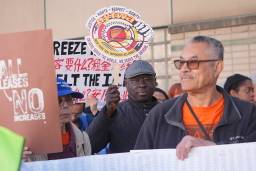
Less than a month after the January 23 day of action that saw stunning levels of participation among Minnesotans, local labor and community groups are planning another dramatic escalation. On Tuesday, five local labor unions and a new, Twin Cities-wide tenants union announced plans to organize for a massive rent strike on March 1, unless Minnesota Gov. Tim Walz meets their demands for an eviction moratorium and $50 million rent relief fund.
Walz’s office did not respond to a request for comment.

The push is being led by Twin Cities Tenants, a new organization aiming to recruit at least 10,000 tenants to pledge to withhold rent starting March 1. A rent strike of that size would be the largest such action in a century andtrigger a roughly $15 million economic disruption, according to the group.
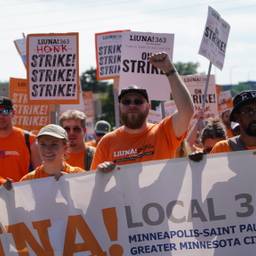
The rent strike coalition also includes Service Employees International Union (SEIU) Local 26, SEIU Healthcare Minnesota & Iowa, UNITE HERE Local 17, the Amalgamated Transit Union (ATU) 1005, and Communication Workers of America (CWA) 7250 — labor unions that together represent more than 25,000 workers. An even wider constellation of labor and community groups has signed onto the call for an eviction moratorium.
Anain, who is taking the strike pledge as a member of Twin Cities Tenants, says it’s heartening to see so many organizations flanking her. “We didn’t stop working because we wanted to; we were practically forced to stay home,” she says. “We contribute to the city, and I think we also deserve support.”
A HOUSING CRISIS FUELED BY ICE
In Los Angeles, Chicago and Minneapolis, organizers have called for the reinstatement of eviction moratoria akin to those enacted during the pandemic, as ICE incursions leave hidden housing crises in their wake.
A December survey of more than 100 immigrant renters in Los Angeles revealed that one in seven had received a recent eviction notice, and nearly 60% were considering self-deporting due to their inability to pay rent. Eviction filings are also rising in Minnesota, where a new analysis estimates that immigrant households statewide may have missed up to $51 million in rent payments as a result of lost income during Operation Metro Surge. That compounds residents’ existing struggles with housing costs: In normal times, the total average rent owed by Minnesota tenants to their landlords already exceeds the state’s budget for emergency rental assistance twentyfold.
Yusra Murad, a public health graduate student at the University of Minnesota who co-authored the study, notes that the new rent debt estimates are based on the number of immigrant households likely to be directly impacted by ICE operations. That doesn’t account for workers who may have missed rent payments due to lost wages from restaurant closures or other economic consequences of the months-long federal occupation.
The actual need on the ground “feels almost impossible to quantify,” says Murad, who also works for the tenant group Inquilinxs Unidxs por Justicia (IX) and volunteers for a Minneapolis mutual aid fund raising money for rent relief.
With such funds routinely exhausting their resources, “people are getting really clear that there’s no GoFundMe that’s going to cover the gap,” says Tara Raghuveer, director of the Tenant Union Federation (TUF), a national organization supporting the rent strike drive.
Since the pandemic, local tenant groups like Inquilinxs Unidxs have racked up a series of impressive victories, including a prolonged rent strike that forced a notorious landlord to sell his properties to a housing cooperative. Twin Cities Tenants, which launched last month, brought together members of multiple tenant organizations aiming to scale up their organizing to match the size of the crisis.
Before launching a rent strike, the group will stage a series of escalating actions leading up to a mass strike authorization vote on February 28, if enough tenants make the pledge. For the strategy to work, Raghuveer says, thousands of people who can pay their rent must be willing to create a “protective buffer” around those who can’t.


AN INJURY TO ALL
Labor unions may be key to building that buffer. While Minnesota’s labor and housing movements have a history of working together, unions’ willingness to back a rent strike represents a new height of coordination.
To help make the rent strike a reality, UNITE HERE Local 17 plans to phone-bank members and recruit potential leaders, according to Geof Paquette, the union’s lead internal organizer. A majority of UNITE HERE Local 17’s members are immigrants and/or people of color who have already been deeply affected by the Trump administration’s deployment of thousands of armed, masked federal agents to the state.
In January, the union launched a massive food distribution program to deliver weekly groceries to hundreds of members hiding in their homes, and it’s even been possible to provide some members with rental assistance. “But if 100 workers need their rent paid for one month, that’s going to wipe out the hardship fund,” Paquette says.
Paquette says he first heard about plans for a rent strike from a member as he gave her a ride back from work. The union member explained to In These Times and Workday Magazine that she had sought help from a tenants union after a landlord tried to keep her security deposit. She’s still a member of both groups.

Community and workplace conditions are often deeply intertwined, and Greg Nammacher, president of SEIU Local 26, says his union has “learned the hard way” that gains at the bargaining table can quickly be eroded by economic pressures, like rising housing costs. So when the union fights for the 8,000 members it represents across the property services industry, “we cannot limit ourselves narrowly to just traditional wages and benefits,” Nammacher says.
Kieran Knutson, president of Communications Workers of America Local 7250, says his union’s participation in the rent strike drive is motivated by a simple principle. “[The tenants union] asked us to support, and we have a strong philosophy of ‘an injury to one is an injury to all,’” he says.
Local 7250 represents 650 Minnesota workers in the telecom, satellite television, home security and video game industries. Knutson says his members aren’t among the workers most heavily targeted by immigration authorities, though some have been racially profiled. Nonetheless, the union has proven willing to mobilize against ICE. As Workday Magazine and The American Prospect previously reported, some 80% of the local’s Minnesota members were “absent” on January 23 as part of the day of protest.
The membership of Amalgamated Transit Union 1005, another backer of the rent strike drive, includes drivers who are “paycheck to paycheck,” and a “large immigrant population,” explains president David Stiggers. His union is learning who’s struggling with housing, “and who is willing to say, ‘I’d be willing to stand up for what we’re doing,’” he says.
“A lot of local labor, they have started to understand that the community is labor and labor is the community,” Stiggers continues.
“The occupation that’s taken place has woken so many of us up to the fact that we are all part of what’s happening with this,” he says. “It directly affects everyone. And so we’ve shown how community pulls together.”
This article is a joint publication of In These Times and Workday Magazine, a nonprofit newsroom devoted to holding the powerful accountable through the perspective of workers.

Get 10 print issues of our award-winning, worker-first journalism here!

Rebecca Burns is an award-winning investigative reporter whose work has appeared in Business Insider, the Chicago Reader, the Intercept, ProPublica Illinois and other outlets.

Sarah Lazare is the editor of Workday Magazine and a contributing editor for In These Times. She tweets at @sarahlazare.