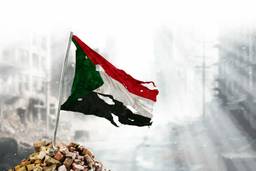
Sudanese Filmmakers Forge New Paths
Young women forced from their homes in the ongoing war are creating a new form of resistance cinema.
Mohammed Ahmed Wad Al Sak
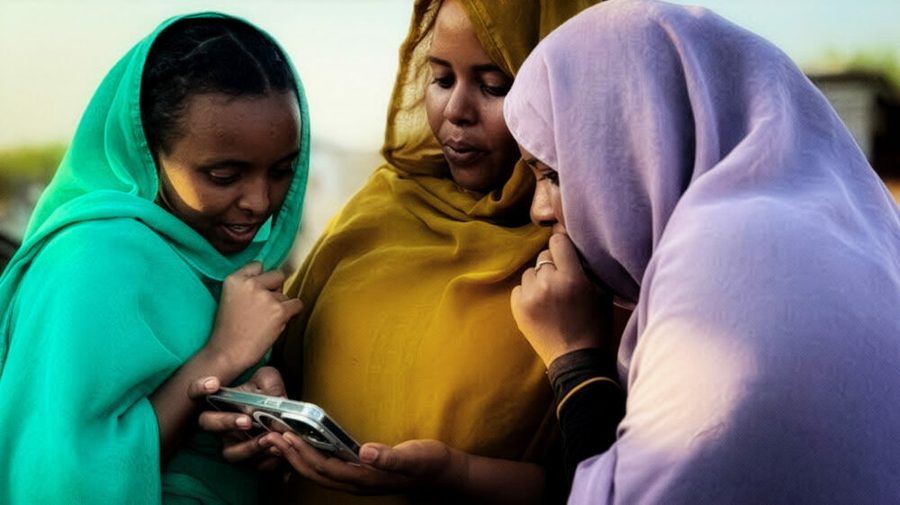

PORT SUDAN — The rain falls gently on the tin roof of a cramped workshop as Areej Hussein cradles her overheating iPhone 15. Around her, 11 young women sit, their stories of displacement heavy in the sweltering air.
“When the war came in April [2023], I watched our mothers and sisters arrive with nothing but the clothes on their backs,” says Hussein, her voice a whisper. The 26-year-old graduated from Red Sea University in 2022, a year before the war began and disrupted her plans of a traditional journalism career. She dips a cloth in cool water and wraps it around her phone, a technique she’s perfected after countless shoots in the 113-degree heat, which causes phones to shut down. The women work in the early morning, filming in whatever shade they find.
Hussein’s first film, Toknan (“Knowledge,” in the local Beja language), tells the story of a pioneering woman who rejected marriage to pursue education. “I saw my own mother and sister in their faces, women who had become invisible in their own country,” she reflects. “I wasn’t just a photographer … I was documenting survival itself.”
Sudan’s conflict began on April 15, 2023, when fighting erupted between the Sudanese Armed Forces and the paramilitary Rapid Support Forces. More than 12 million people have been displaced and 21.2 million forced into acute food insecurity. According to a November 2025 briefing by UN Women, “sexual violence, forced displacement and the collapse of essential services have transformed Sudan into the world’s most extreme crisis for women and girls.”
The film project emerged between filmmaker Mohammed Fawi and social worker Tasabih Hegazy. “I would see these women sitting under trees, telling the most extraordinary stories to anyone who would listen,” recalls Hegazy, 27. “We wanted to create space for women to tell their stories in their own voices.”
The main challenge remains funding — the films survive on small donations and volunteer labor. Yet constraints have fostered innovation. The films represent a genuine new form, more intimate than traditional documentary, more immediate than conventional narrative cinema, more authentically Sudanese than anything from established film centers.
“People think limitations crush creativity,” 24-year-old Malaz Habib says. She serves as photographer and sound engineer. But “when you can’t rely on expensive equipment, you have to rely on human connection.”
“We’re not trying to compete with Hollywood,” Hegazy explains. “We’re creating something that can only exist here.”
Dr. Eithar Khairy, 29, traded her stethoscope for a smartphone when displacement made practicing medicine impossible. Her film I Am Here follows Randa, a deaf mother of five who became a disability rights activist.
“Randa faces injustice every day, but she’s unbreakable,” Khairy explains. “I chose that title because sometimes just existing, just being present and refusing to disappear, is its own form of resistance.”
Thirty-year-old Ikram Mohammed has been displaced three times since the war began. For a recent documentary project, she spent three days living alongside the women she was filming.
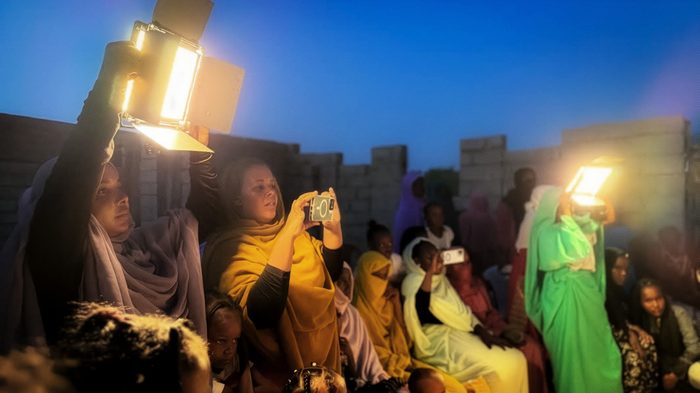
“We weren’t just filming their stories,” Mohammed explains. “We were becoming part of their world, understanding how they’ve rebuilt their lives from nothing.” When the finished film was screened for the women themselves, she witnessed something unexpected.
“I saw it in their eyes,” she says, “the moment they realized their stories had value.”
Some members of Sudan’s emerging film community have been forced even further from home. Ibrahim Ahmad, known as Snoopy, fled first to Wad Madani, then crossed into Kenya. From Nairobi, he’s directing Khartoum, a meditation on loss and memory that uses green screens for a city that may no longer exist.
“We found ourselves having to rebuild not just the story, but our entire understanding of what Sudanese cinema could be,” he explains via video call, the connection cutting out. “The war destroyed everything we thought we knew about filmmaking in Sudan — the institutions, the infrastructure, the assumption that we could work in our own country.”
His film employs interviews conducted remotely, archival footage and a narrative structure that mirrors the fragmentation of displacement.
“We’re not just documenting the war,” Ahmad reflects. “We’re inventing new ways to remember what we’ve lost.”
The films have also gained recognition beyond Sudan’s borders. Ali Ahmed’s Jawabat (“Answers”) explores loss and communication with the disappeared and has been featured in 10 film festivals, winning an award at Egypt’s Luxor African Film Festival.
“The messages [in the film] represent all the things we want to say to people we’ve lost,” Ahmed explains. “They’re one-sided conversations, not knowing if our words will ever reach them.”
On a recent evening, the women from the film workshop gathered to screen their latest works. The audience included other displaced women and locals, many seeing themselves reflected on screen for the first time.
One film follows an elderly woman teaching children to read using stones and sand. Another documents women starting a small tea business. A third captures quiet rituals as everything else has been stripped away.
“Every woman here has a story that could change how people understand this war,” says Hussein, her phone finally cool. “We’re not waiting for someone else to tell them.”
As night falls, the workshop grows quiet except for soft sounds of fingers tapping screens — editing, uploading, sharing. In a country where so much has been destroyed, these women are building something new from fragments, creating a cinema of survival as innovative as it is necessary.
This article was edited in collaboration with Egab

Get 10 print issues of our award-winning, worker-first journalism here!