The People Fighting Back: Inside Maine’s Immigrant Defense Movement
An excerpt from ‘Breaking ICE’ on how Maine became the blueprint for an immigration defense movement that caught fire in the Trump era.
Sonali Kolhatkar
In These Times is proud to be independent, pro-labor and anti-fascist. Support our work today and help left-wing journalism thrive.
Within hours of federal immigration agents killing a 26-year-old man named Joan Sebastian Guerrero, in Biddeford, Maine, hundreds protested in the streets of the small town demanding answers. Just days earlier, ICE agents shot and killed a 52-year-old man named Lorenzo Salgado Araujo, in Houston, Texas, also sparking protest. Although seemingly disparate — one in a small town in the nation’s whitest state, and the other in a large, cosmopolitan city in one of the most populous states — the two killings have a common throughline: both are the result of an officially-sanctioned imperative to hunt down and hurt people who Donald Trump’s administration and the Republican Party have deemed enemies.

But most Americans aren’t falling for it. From Maine to Texas, Wisconsin to California, North Carolina to Minnesota, communities are organizing and fighting back against the most well-funded police institution in history. In my forthcoming book, Breaking ICE: Community Defense Against State Terror and MAGA Fascism, I gathered interviews with community activists and thinkers about the tactics and strategies they are adopting to keep their communities safe. Among them is Ruben Torres, the advocacy and policy manager for the Maine Immigrant Rights Coalition (MIRC). Below is our conversation from February in which we spoke about how Maine, which has a relatively small immigrant population, has adapted the defensive measures that activists around the country popularized.
The Trump administration unleashed federal immigration enforcement agents on states around the nation, including those with relatively miniscule immigrant populations. This includes Maine, the whitest state in the country, where a mere 4 percent of the population is of immigrant origin. ICE agents wreaked havoc on the state in early 2026. Even after Republican Senator Susan Collins requested an end to the operations, tensions remained high and ICE sightings continued.
Immigrant-rights advocates in Maine adapted the defensive measures that activists around the country popularized. Ruben Torres is the advocacy and policy manager for the Maine Immigrants’ Rights Coalition (MIRC), and during a conversation we had in February 2026, he shared the unique nature of Maine’s anti-ICE activism.
SONALI KOLHATKAR: ICE dubbed its activities in Maine Operation Catch of the Day, a deeply dehumanizing label. How has this operation played out on the ground?
RUBAN TORRES: Operation Catch of the Day, as it was dubbed by the federal government, started on January 20, 2026, in Maine. My organization, the Maine Immigrants’ Rights Coalition (MIRC), and our partners manage an immigrant defense hotline that has become colloquially known as the ICE Watch Hotline. Through that hotline, we’re able to monitor the situation on the ground and get a good understanding of our community’s needs. We also hosted a lot of community conversations with immigrant leaders from across the state to understand how the operation was playing out.
While the government claims to be targeting the “worst of the worst” and going after criminals, we saw a completely different reality. We saw families being torn apart in grocery stores and other places that were once considered safe. People lost their sense of security and grew fearful and scared of what their world had become.
KOLHATKAR: In Minneapolis, we saw people being grabbed by ICE agents from their cars, sometimes with their children. And those who were taken were quickly disappeared into detention centers as far away as Texas. Did that play out in Maine as well?
TORRES: Yes. We saw some similar tactics in the sense that people were being followed to and from health-care appointments, windows were being smashed, and children were being left alone in cars crying as their parents were ripped away. We also saw state corrections officers and law enforcement officers being arrested as a part of this operation. The ICE agents’ tactics are based on creating fear and confusion among community members. If their goal was to target the “worst of the worst,” we saw the exact opposite happen.
KOLHATKAR: Were people sheltering in place in order to stay safe? Were parents fearful of sending their children to school?
TORRES: During the height of the operation, we heard reports of approximately one in three students missing school, especially in Southern Maine’s school system. People were scared to take their children to school, and children were scared to go to school. There was even greater absenteeism within the adult education system.
Health-care appointments were also impacted to the point where Maine Health, the health-care provider in Southern Maine, started offering telehealth options for folks because of the skyrocketing cancellations during that time.
While Senator Susan Collins announced that the enhanced operations ended on January 29, 2026, as of this conversation in early February, we are yet to see any official confirmation from the administration or from the Department of Homeland Security. People still haven’t returned to their normal lives out of fear that they may get caught in the dragnet of federal immigration enforcement.
KOLHATKAR: Senator Susan Collins, a Republican senator, seemed to realize that the ICE raids were jeopardizing her chances of reelection. What does that say to you about what’s really happening — not just in Maine, but all over the country? Surely, Republican lawmakers realize that nobody wants these federal raids, including their own voters, who might have thought they would be immune from ICE arrests and deportation?
TORRES: What we’re seeing right now, which is different from the past, is immigration enforcement at your doorstep. That’s changing the way people think about immigration, not just here in Maine or Minneapolis, but across the country. In areas that were once considered safe and community-oriented, we see ICE agents walking around with guns, patrolling neighborhoods, and staking out cars.
The Maine Immigrants’ Rights Coalition published a map of where the calls to our hotline were originating from during the ICE surge. That map shows activity from the top of the Maine border to the bottom, with calls coming in from all across the state. It’s not just a concentrated pocket. What was once discussed as a theoretical question at the dinner table is all of a sudden on our doorstep, banging on the door.
KOLHATKAR: Who did the ICE raids primarily target?
TORRES: Our data shows the vast majority of folks arrested were working-age men of color, most of whom do not have criminal backgrounds. In many cases, those who were arrested were the main breadwinners of their families. Given that, we realized we needed to work with partners who are providing care and services to families, especially mothers, including newly pregnant mothers.
KOLHATKAR: I understand that a significant fraction of those apprehended by ICE were African immigrants from nations like Angola?
TORRES: Yes. Maine is very interesting in that the vast majority of our immigrant population tends to be asylum seekers from sub-Saharan Africa, which is quite different from the rest of the nation. Most of the asylum seekers are from Angola, Rwanda, Sudan, South Sudan, and the Democratic Republic of Congo. We also have people who are Khmer, Vietnamese, and Filipino, as well as Hispanic immigrants, including people who are Ecuadoran and Mexican.
KOLHATKAR: How have MIRC’s rapid-response hotline and other actions helped keep people safe?
TORRES: We initially started that hotline in October 2025 in collaboration with the People’s Coalition on Justice and Safety (PCJS), which is another organization that is part of the MIRC membership. The creation of the hotline was in response to the so-called “Big Beautiful Bill,” which infused a massive amount of money into federal immigration, customs, and enforcement. We wanted to be able to combat misinformation around ICE operations through a phone number that people could call to report sightings, and where they could also get verified information about ICE operations in order to know if it’s safe to go into an area.
We partnered with a couple of organizations — includings the Immigrant Legal Advocacy Project (ILAP) and the American Civil Liberties Union (ACLU) — to host and share “Know Your Rights” trainings and materials so people had information from a trusted legal source. We translated a lot of those materials into the languages spoken by our immigrant communities. We’ve also made “Know Your Rights” information available in American Sign language (ASL) for folks who may be deaf or hard of hearing.
KOLHATKAR: How have nonimmigrant residents of Maine — a majority of whom are white — shown solidarity?
TORRES: In Maine we saw the full force of our community. “Community” is a strong and powerful word in our state because of our geographic makeup. We are very spread out and rural, and a lot of times your neighbor and your community are all you have to rely on.
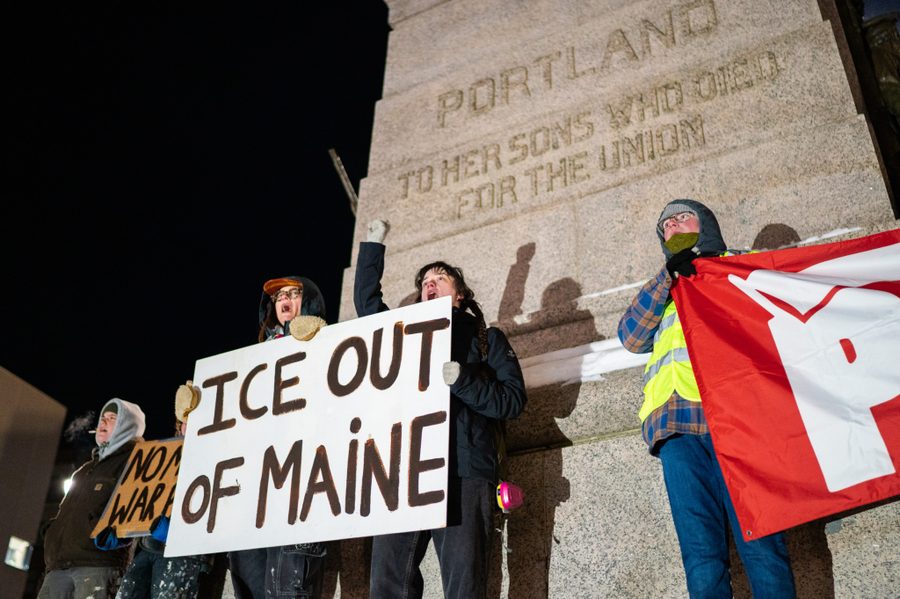
In Portland and other cities and towns around our state, people came out in support of their immigrant community members. There was a recent business blackout during which a number of small establishments around the state chose to either shut their doors or to donate a portion of that day’s revenues to local organizations supporting the community and their immigrant neighbors. Donations ranged from 20 percent all the way up to 100 percent of their revenue.
We also saw community members step up in frigid temperatures — as low as 8 degrees Fahrenheit and below — to protest the actions being taken in our state.
And we saw smaller acts of solidarity, with people taking immigrant community members’ kids to school, organizing pickups and drop-offs, making grocery store runs, and ensuring people had their medications and were able to get to doctor’s appointments when they needed. They made sure people had food on their table if they were too scared to go to the grocery store.
We had a major snowstorm during that period, and there were rumors that ICE was patrolling snow-ban parking lots, arresting people who showed up there, or questioning them about their immigration status. 44 In some neighborhoods, people came out of their homes, cleaned off their neighbors’ cars in nearby apartment complexes, and allowed them to use their driveways so folks didn’t have to worry about going to a snow-ban parking lot.
KOLHATKAR: Do you foresee that in Maine, the ties formed between immigrant and nonimmigrant residents will be strong enough to weather future attempts at division?
TORRES: I think that what we’re going to see is a stronger sense of community built through connections, reliable information, and conversations that happen organically while you’re at the grocery store, or helping your neighbor shovel out their driveway.
I think it’s also going to bring immigration policy to the forefront of conversation in a way that we haven’t seen before. People are going to have to do a lot of reading to understand how immigration pathways have been cut, slashed, or permanently paused, and how we ended up in this mess today because we haven’t addressed the root problems about why people migrate.
Breaking ICE is a new book published by Seven Stories Press.
For 50 years, In These Times has amplified the movements fighting for workers, against fascism and to build a more democratic future. Become a monthly sustainer today and keep independent journalism publishing for the next 50.

Get 10 print issues of our award-winning, worker-first journalism here!
Sonali Kolhatkar is host and executive producer of Rising Up With Sonali, an independent, subscriber-based syndicated TV and radio show. She’s an award winning journalist and author of Talking About Abolition: A Police Free World is Possible, and Rising Up: The Power of Narrative in Pursuing Racial Justice.


