Sweeping Federal Indictments of Ice Observers Net Minnesota Unionists
“I think this is intended to make workers shy away from being vociferous in their opposition to state sponsored violence.”
Sarah Lazare and Amy Livingston
In These Times is proud to be independent, pro-labor and anti-fascist. Support our work today and help left-wing journalism thrive.
— — —
Minnesota trade unionists active in worker assemblies are among the 15 people indicted by the federal government today, as part of a sweeping crackdown on organizing in opposition to the ICE and Border Patrol since December 2025. Among a slew of other allegations, the indictment cited some of the individuals’ participation in assemblies of trade unionists and other workers held at the United Labor Centre in Minneapolis as evidence that the activists participated in a criminal conspiracy.
All 15 of the people indicted are charged with “conspiracy to impede or injure a federal officer,” which activists describe as an effort to use draconian charges to crush Minnesota’s widely celebrated organizing against the armed federal agents who descended on the state this past winter.
“Trade unionists active in worker assemblies are among those who were arrested,” says Kieran Knutson, president of Communications Workers of America Local 7250. “The trade unionists I’ve known for years are stand-up people who believe in solidarity. They believe an injury to one is an injury to all. They are outstanding union activists in their union and workplace, and I’m proud to know all of them.”
Marcia Howard, the president of the teacher chapter of the Minneapolis Federation of Educators, confirmed that trade unionists are among those detained. “I find it telling that they are going after unionists, including educators I know of right now, that they are going after workers. I’m really pissed off,” she said.
Howard is withholding the exact number of trade unionists and their union roles out of concern for their privacy.
“I think this is intended to make workers shy away from being vociferous in their opposition to state sponsored violence by saying things like, ‘Fuck ICE and ICE out.’ Of they want us to get to a point that we’re scared to say the things we should be able to say, then fuck everything,” Howard added.
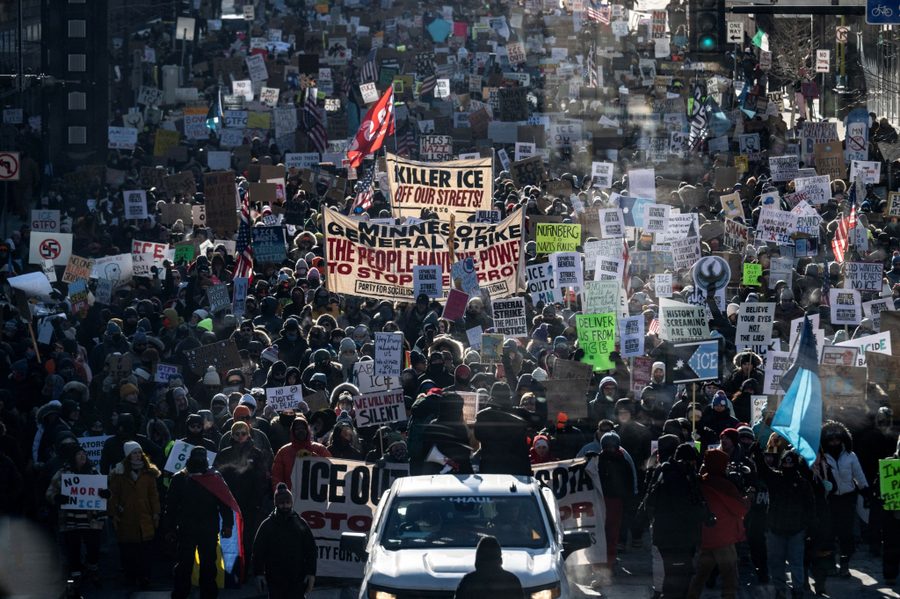
At the AFL-CIO convention in Minneapolis earlier this month, Minnesota’s labor movement was honored for its robust organizing against ICE, which included participation in food distribution to members in hiding, rapid response networks, and a mass economic shutdown on January 23, under the banner of “No Work, No School, No Shopping.”
Several of these gatherings have taken place since December 2025. Hundreds of workers, both union and non-union, joined together to discuss ways to organize against ICE, to build community and labor ties, and to debate resolutions on topics ranging from solidarity actions on May Day to US wars.
Knutson describes them as “an attempt to create a democratic space for workers to be part of decision making about how the workers’ movement participates in the anti-ICE resistance, and in the labor movement in general.”
“Most union members can go to their union meetings if their unions have meetings and participate this way, but this was a way of doing that across different unions, across different industries, across different trades, in a way that’s directly democratic, to talk about and discuss and debate issues, you know, it wasn’t a front group for any one political trend. A number of unions sponsored it.”
These latest federal arrests on first amendment protected activity are part of a broader attack on Trump’s political enemies he has ramped up in recent months, with a specific focus on “antifa,” the “left,” and advocates of the rights of transgender people.
This article was published by Workday Magazine and is being reprinted with permission.
— — —
For 50 years, In These Times has amplified the movements fighting for workers, against fascism and to build a more democratic future. Become a monthly sustainer today and keep independent journalism publishing for the next 50.

Get 10 print issues of our award-winning, worker-first journalism here!

Sarah Lazare is the editor of Workday Magazine and a contributing editor for In These Times. She tweets at @sarahlazare.

Amy Livingston is a labor educator at the Labor Education Service at the University of Minnesota.