How Communities Poisoned by Data Centers and Toxic Spills Can Stand Together
“No one’s coming to save these communities. They have to fight for themselves.”
Maximillian Alvarez

Across the country, AI data centers, toxic spills and industrial disasters are turning regions into “sacrifice zones”. Corporate capture of the government and decades of deregulation have allowed these companies to place profits over public health and the environment. However, people across the country from all walks of life are coming together to fight back.
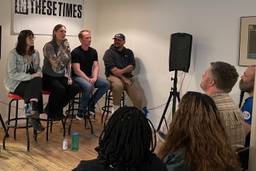
At the 2026 Railroad Workers United (RWU) convention, Maximillian Alvarez spoke with a panel of leaders who are bringing communities together to continue this fight. The panelists include: Jeff Kurtz, an RWU member who also served as a state representative in the Iowa House of Representatives; Jami Wallace, founder of the Chemically Impacted Communities Coalition (CICC); Dr. Nicole Fabricant, a professor of anthropology at Towson University; Scott Smith, founder of the Blue Shirt Justice League; and Lesley Pacey, Senior Environmental Officer at the Government Accountability Project.
This conversation has been edited for length and clarity.
Maximillian Alvarez: I wanted to just sort of jump in and ask, first and foremost, what does it mean that we are all here sitting at this table together? And Jeff, I’m going to start with you because so much of this started with the railroad struggle in 2022. And I wanted to just ask you to go a little farther when it comes to the struggle of railroad workers on the rails. What does it mean for railroad workers’ struggles to be sitting here at this table with these other folks?
Jeff Kurtz: Well, what it means is one of the things that we’ve talked about is the fact that there’s a mystique around railroad work, and as workers, we have not been very good about informing the public of how that work is done. And with the help of these people, it’s much easier. We can get information from the government that we could never get before, knowing these people, so that helps our struggle so much more. And then with outlets like you, we can get to the general public, and we can remove the veil of that mystique, and we can let people know that this stuff is happening right under your nose. It’s dangerous. It doesn’t need to happen.
Maximillian Alvarez: [A]nd Jami, you are from East Palestine, Ohio. I wanted to ask, again, what it means for you and the struggle of you and your neighbors in East Palestine to be here at this conference, but also what that message means for all of us today.
Jami Wallace: I feel like the rail workers have been screaming about the issues with the safety and the precision scheduling. And now that my eyes have been opened, I say over and over that this derailment did not start when that axle caught on fire. It started with the culture of safety at Norfolk Southern. So coming here and hearing from the railroad workers, hearing some of how things work, it made me be able to understand the things that happened in East Palestine, and I feel very strongly that the rail workers have the same interest as trackside communities. At the end of the day, if they’re not safe, we’re not safe. They’re the ones that do the jobs, and if we don’t all come together and fight, more East Palestines are going to happen.
Maximillian Alvarez: I wanted to bring Scott and Lesley in here and ask [about] the kind of work that y’all have been doing before East Palestine, and then how East Palestine drew you into this struggle, and also if East Palestine has kind of changed the nature of the work that you’ve been doing.
Scott Smith: East Palestine was a defining moment. Actually, I was on the fence about going there because I was watching it from a distance, and Courtney Miller, who unfortunately passed away from the train derailment and everything she went through, reached out to me, begging me to test her water, and I go into communities. I don’t solicit anybody. I got there, and that’s when I realized this was unlike any other disaster I’d been to because I put my gear on, went in the creek, and within a few minutes I had a Norfolk Southern contractor coming out of the woods [asking who I was]. And one thing led to another, and now I’m 34 trips and 38 rounds of testing [in] and still going back. And East Palestine is a defining moment. I have never seen such a blatant, call it, corporate capture corruption. That you watch the [Environmental Protection Agency (EPA)] just be the absolute public relations arm for the billion-dollar Norfolk Southern. So I dug in my heels and stood on principle, and this was a fight worth having.
Maximillian Alvarez: Well, again, beautifully and powerfully put, and we’re only even scratching the surface here, right? So, [Lesley], talk to us about how you came into this struggle and what East Palestine has sort of meant for the work that you do at the Government Accountability Project.
Lesley Pacey: So we got involved in East Palestine because we were kind of watching it, like Scott, from afar, and we would see where they wouldn’t test for dioxin in East Palestine. There were multiple lawmakers asking for this, media, and residents, and they wouldn’t do it. So it really piqued our interest. I actually, and this is unconventional, reached out to Scott and said, “What’s going on over there?” Because generally, with the Government Accountability Project, we’re a whistleblower organization. Scott’s a little bit different. He’s a private citizen, but he was doing something that no one has done before, which is going into these communities and getting all the receipts from the soil and the water. But East Palestine is so important because of the scope of the disaster here. You have the EPA going against 40 years of its own statutes to detonate a carcinogen, and we later find out, of course, that they didn’t need to do that. So they’re basically an accomplice to the crime, and it’s sort of a microcosm of these disasters everywhere. And our government really has been telling lie after lie, which we’re starting to piece together with these whistleblowers between Scott’s testing and some of our other whistleblowers that have shown that they didn’t do the things they were supposed to do with flying the chemical-sensing airplane, turning chemical sensors off over contaminated creeks. We’re kind of really understanding now how these lies come about, how they’re able to do them.
Maximillian Alvarez: So they’re coming for all of us, and when I say us, I mean anyone who’s not rich enough to like basically go try to run and hide in Lake Tahoe or some crap, right? I mean, if you’re a working person in this country, you are in the line of fire, and that same goes for people who are in the front lines of climate change, because they’re showing the exact same playbook. They’re throwing us overboard at every chance they can, and more of it’s coming. So, what do we do about it, and how do we fight it?
Nicole Fabricant: Yeah, I think that actually arming youth with the tools from those communities, like when I talked about naturalizing your environment, the tools and raising consciousness, is a way to begin at the very grassroots, and I saw that in South Baltimore immediately. I think power is at the grassroots, and it’s so important to start there. But it’s clear we aren’t going to necessarily, with just the data, take on these corporations. That these are much bigger struggles that are global, that reach to the mountains of West Virginia, where they’re extracting the coal, to the railroad workers that are carting the coal to South Baltimore. Coalitions are so important, and that’s why this table is really critical because of Scott’s information and Jami’s chemically impacted communities. You know, really thinking about how we tether our struggles, and I’m not so sure it’s just about changing laws because I don’t believe necessarily that the laws are ever written for the people. I don’t believe that the government as it stands will ever. So I don’t know what the end goal is, but I do know that if we continue along this path of vulture capitalism, as Max said, we’re all living in a sacrifice zone. No matter who you are. That’s what East Palestine taught me.
Maximillian Alvarez: Well, and just to kind of push a little more on the labor side, RWU exists because of the built-in problem on the rails of all the unions being split up. So what are you guys doing on the RWU side to get around that division that still exists within organized labor?
Jeff Kurtz: We start to understand each other better when we talk to each other, and especially in the railroad industry because I don’t know everything a [maintenance-of-way] guy does, but I’ve got a pretty good idea. So you know, I exchange information with him. We understand each other better that way. And that way, when we go to fight the rail corporations, we’re more united. And now, you know, what happens to him is important. So this is, you know, and this is another thing. You know we spend so much time on the job, especially out on the railroad, that we can’t develop real solidarity. Workers have to have more time off so they can be with their families, but they can be with their fellow workers too.
Maximillian Alvarez: No, I think there’s so much wisdom in that for all of us, not just in labor, but all of us around this country, right? And so we can all learn from that. That’s like if we’re arguing on the internet and looking at each other through these stupid partisan lenses, we’re going to miss what’s right in front of us, and we’re going to keep losing until it’s too late. And so, again, I return to the question of how do we make sure that doesn’t happen?
Jami Wallace: You know, I feel like we have to take the fighters from all these different communities and bring them together. Not just bring them together, but give them the resources that they need. And no one’s coming to save these communities. They have to fight for themselves. So what I would like to do is I’d like to go into these communities when something like this happens and do what no one could do for me: hand me that playbook. I wish no other community to come after me but to have those resources that I wish I would have, and I do believe it takes a team. You know, we each have our place in this. And I feel like that in any type of organization, it makes everybody’s skills to make the world go round. So we want to share ours.
This episode of the Working People Podcast was originally published on July 1, 2026.

Get 10 print issues of our award-winning, worker-first journalism here!

Maximillian Alvarez is editor-in-chief at the Real News Network and host of the podcast Working People, available at InTheseTimes.com. He is also the author of The Work of Living: Working People Talk About Their Lives and the Year the World Broke.