Train Crashes Destroyed Their Towns. Will Yours Be Next?
Host Maximillian Alvarez sits down with a panel of community members from Lac-Mégantic, Quebec and East Palestine, Ohio to discuss life inside a sacrifice zone.
Maximillian Alvarez

Nearly 10 years before the train derailment and subsequent chemical disaster in East Palestine, Ohio, the town of Lac-Mégantic, Quebec experienced one of the deadliest rail disasters in North America. On July 6, 2013, a runaway train derailed in the center of town, leveling buildings and dumping millions of tons of crude oil onto the surrounding area. 47 people were killed in the explosion.
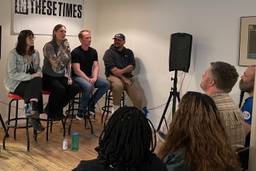
In July, Maximillian Alvarez and Dr. Nicole Fabricant sat down with a panel of guests from East Palestine and Lac-Mégantic to discuss what happens when your town becomes a sacrifice zone and how residents can join together to fight back against the corporations responsible.
This conversation has been edited for length and clarity.
Maximillian Alvarez: Welcome, everyone, to Working People, a podcast about the lives, jobs, dreams, and struggles of the working class today. My name is Maximillian Alvarez. I’m the host of this podcast, and I’m also the editor in chief and co-executive director of the Real News Network.
Dr. Nicole Fabricant: I’m Dr. Nicole Fabricant. I teach anthropology at Towson University. I’ve been working for 15 years in an overburdened area of Baltimore, a community named Curtis Bay, where [many] toxic, polluting industries are housed in one residential area. This zip code has some of the highest rates of respiratory illness in the entire country.
Maximillian Alvarez: For the past three years on this show, along with covering other essential working-class stories and labor issues, we’ve been speaking regularly with working people in Ohio and Pennsylvania, whose lives have been forever changed by the Norfolk Southern train derailment and chemical disaster [in East Palestine] in early February of 2023.
Dr. Nicole Fabricant: But before East Palestine, there was Lac-Mégantic, one of the deadliest rail disasters in North American history. On July 6, 2013, an unattended 74-car freight train carrying crude oil rolled downhill and derailed in the town center of Lac-Mégantic, Quebec. A fire broke out on the lead locomotive while the train was parked. Firefighters responded, and in the process of fighting the fire, shut down the engine, inadvertently disabling the air brakes that had been keeping the train stationary. After they left, the train began to roll, gathering speed over 11 kilometers of downhill track before derailing at a curve in Lac-Mégantic’s downtown core. The resulting explosions and fire were enormous, destroying 40 buildings in the town center, including a popular bar that was full of patrons at the time — 47 people were killed. About 2000 residents had to be evacuated, and a large portion of Lac-Mégantic’s downtown was obliterated. It remains a stark example of how these cascading institutional failures, regulatory, corporate, and operational, can lead to catastrophic consequences.
With the help from the incredible folks at Railroad Workers United (RWU), we’ve brought together a truly historic panel of residents who survived the Lac-Mégantic disaster in Canada and the East Palestine rail disaster here in the United States.
Robert Bellefleur: My name is Robert Bellefleur. I am the spokesperson for the [Citizens’ Coalition for Railroad Safety]… which was created in 2015 following the Lac-Mégantic tragedy.
Gilbert Carette: Hi, my name is Gilbert Carette, Lac-Mégantic resident and member of the Lac-Mégantic Citizens’ Coalition for Railroad Safety. We started this coalition, and we’ve been working hard for the safety in this town, and we want the rail out of Lac-Mégantic.
Gilles Fluet: My name is Gilles Fluet, and I was an eyewitness to the arrival of the ghost train in Lac-Mégantic.
Anne-Marie Saint-Cerny: My name is Anne-Marie Saint-Cerny. I’ve been an activist against contamination in sacrifice zones … for more than 30 years. I was in Lac-Mégantic five days after the tragedies because I understood the intense contamination that would have happened there, and there I decided to go to the bottom of that to name the people responsible [for] what happened.
Jami Wallace: My name is Jami Wallace, and I’m from East Palestine, Ohio. I lived within the one-mile zone when the Norfolk Southern train derailed in my community. I subsequently found out that my house was contaminated, and if we had blindly listened to the Environmental Protection Agency (EPA) and went back into our house, that great harm or death could have came to my family. Ever since then, I’ve been fighting.
Christina Siceloff: My name is Christina Siceloff, and I am from Darlington, Pennsylvania, and live about six miles from where the train derailed in East Palestine, Ohio. After the derailment, there was a following vent and burn that occurred, and most of the plume from that had gone over my home and the surrounding areas around East Palestine, and have been dealing with health issues in my family ever since.
Gilles Fluet: Continuing from the explosion in the city and train derailment, I’d never been through anything like that before. I felt like I was in a bad dream. I also realized later that it was frowned upon to name the real, potential culprits.
Robert Bellefleur: I saw the plumes of smoke, and I have to admit it was surreal — it was as if Lac-Mégantic had just been bombed. It was outsiders who came to manage the crisis in Lac-Mégantic — not even the city council was involved in the decision making. We were stripped of our powers as citizens and as a community to the benefit of the governments, who did everything they could to stall the situation, hide the real causes, and exclude us from the important decisions that needed to be made.
Maximillian Alvarez: And Jami, Christina, for our guests in Canada and for folks listening to this, could you just remind them what actually happened to your towns and how you experienced it firsthand?
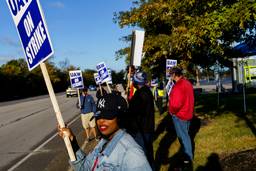
Jami Wallace: On February 3 of 2023, a Norfolk Southern train derailed in East Palestine. [Norfolk Southern] wanted to get the railroad back up and running, so they did a vent and burn where they caught these tankers of chemicals on fire. It went from one tanker to five tankers of vinyl chloride that they ended up exploding. The mushroom cloud looked like an atomic bomb was dropped.
We were told less than 48 hours that it was safe to go home, that there were no high levels of chemicals, and that everything was great. I didn’t have to be a scientist — I didn’t have to be smart to look at that plume and know that less than 48 hours [later] they couldn’t tell us with certainty that it was safe to go home. As soon as people went back home, the symptoms started: the nosebleeds, the rashes, the coughing and respiratory issues. They gaslit us, tried to tell us that it was stress, that it was mental mass psychosis. We have 64 people in our community with cancer now.
It’s amazing when you hear these other stories and you hear all the same things happening, and this is in a different country, but it’s the same playbook.
Christina Siceloff: When everybody was being told that everything was fine, the air was fine, the water was fine, we were seeing thousands of fish popping up in the creeks that were dead. So, I went to the creeks and saw the sheen that was left from the chemicals that were in the water that traveled down to the Ohio River, and that was the start of me going to the creeks for the next two and a half years to show that the government was saying one thing, and we were experiencing another.
Robert Bellefleur: The thing is, in Lac-Mégantic, we felt that control was coming entirely from outside, they sent us press spokespeople from the various governments to control the message, to calm the public, to prevent them from rebelling. However, when we asked them to set up a public inquiry commission, the answer was a categorical no, so we felt manipulated and divided by the government forces that had taken control of the situation.
We, as citizens, decided in 2015 to form a citizens’ coalition for rail safety because the transport of oil and hazardous materials had resumed six months after the tragedy. I went to inspect the railroad tracks surrounding Lac-Mégantic, and found that the rails were still in very poor condition, even though hazardous materials — 10x more dangerous than the shale oil that had set the town ablaze — were now being transported on them.
In reality, Lac-Mégantic has experienced three disasters. First, the train derailment. Following that, the complete demolition of the downtown area against the wishes of the residents. And third, they succeeded in dividing the community over the bypass project. They turned it into a project of social division, and there are friends and families in the region who haven’t spoken to each other since then.
Anne-Marie Saint-Cerny: The authorities that were in charge of safeties, environmental authorities, and all that — they were all absent. If there are no community surveillance, if there are no communities implicated, there is nothing. I saw that for the first time in Mégantic, which was the biggest massive death of modern Canada… there were no authorities to keep the people safe.
Jami Wallace: We learned very quickly in East Palestine that no one else was going to fight for us if we didn’t fight for ourselves. When you’re exposed to these type of chemicals, we know from every other chemical disaster it can take years before these things show up in our communities. The derailment itself was a disaster. The vent and burn was a disaster. The flooding that occurred in our creeks afterwards, another disaster. And then that whole economic recovery, that’s another disaster.
You should see what it’s done to our small community that I always thought was tight-knit. We always looked out for each other, but the focus on the economy has overshadowed any focus whatsoever on human health. I literally was getting goosebumps on my arms listening to the similarities, and that’s where we all need to come together, because it’s not just about East Palestine. These disasters are so much bigger than that.
Maximillian Alvarez: [What] have these whole awful, unforgivable, life-changing experiences taught you that you most want to communicate to others out there who are going through this now, or who may go through it one day?
Anne-Marie Saint-Cerny: These are industrial tragedies that are going to go on exploding again and again… All of us together, we have to never surrender. We have to hold the line — and how do we do that? We expose the fact. Facts will come and will make themselves known, and people will eventually change.
Jami Wallace: We need to take all these fighters from all these different communities and bring our voices together. The bigger our voices can be, the louder we can be, the better the chances that will be heard.
Maximillian Alvarez: All right, gang. That’s gonna wrap things up for us today. From Lac-Mégantic to East Palestine and beyond… It’s clear that corporations and our governments are turning more and more of our communities into sacrifice zones, and more and more of us are being set up for sacrifice.
All of us have a role to play in this fight, and we here at Working People, the Real News Network, and In These Times will continue our work to lift up the voices and stories of the people like you who are on the front lines of this fight, and to bring people together on and offline.
This episode of the Working People Podcast was published on July 6.
Thank you for reading this story. At a time when corporate media is dominating the web and our airwaves, independent journalism is more important than ever, and that’s what we provide at In These Times. We offer some of the best reporting, investigations and analysis on the growing movements for justice in the U.S.—and our work is firmly pro-labor and anti-fascist. To continue producing it, we need your support.
If you believe in the power of an independent press, please make a donation to In These Times today. By becoming a sustaining member, you can ensure that our work reaches even more readers.
And if you become a sustainer right now, you'll get a free year-long print subscription and a special subscribers-only print from artist Molly Crabapple.
Thank you.

Get 10 print issues of our award-winning, worker-first journalism here!

Maximillian Alvarez is editor-in-chief at the Real News Network and host of the podcast Working People, available at InTheseTimes.com. He is also the author of The Work of Living: Working People Talk About Their Lives and the Year the World Broke.