“Kill the Cuts”: Federally funded researchers warn DOGE cuts will be fatal
What are workers saying at the front lines of the Kill the Cuts rally in Washington, D.C.?
Maximillian Alvarez

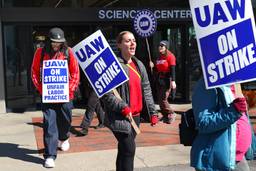
On Tuesday April 8, unions unionized federal workers and their supporters around the country mobilized for a national “Kill the Cuts” day of action to protest the Trump administration’s cuts to life-saving research, healthcare, and education programs.
As organizers stated on the Kill The Cuts website, “By cutting funds to lifesaving research and medical care, the Trump administration is abandoning families who are suffering and costing taxpayers billions of dollars. These cuts are dangerous to our health, and dangerous to our economy. On Tuesday, April 8th, 2025 workers across the country are standing up and demanding NO cuts to education and life-saving research.”
In this on-the-ground edition of Working People, we take you to the front lines of the Kill the Cuts rally that took place in Washington, D.C. and we speak with workers and union representatives whose lives and work have already been affected by these cuts.Speakers include: Margaret Cook, Vice President of the Public, Healthcare, and Education Workers sector of the Communications Workers of America (CWA); Matt Brown, Recording Secretary of NIH Fellows United (United Auto Workers Local 2750); Rakshita Balaji, a post-baccalaureate researcher at the National Institutes of Health (NIH); and Amanda Dykema, shop steward for American Federation of State, County, and Municipal Employees (AFSCME) Local 1072 at the University of Maryland, College Park.
Margaret Cook: I am the public healthcare and education worker sector Vice President of Communication Workers of America. Representing over 130,000 state municipal and higher education workers across the country and in Puerto Rico, including thousands of researchers, lab technicians, public healthcare clinicians and nurses, and thousands of additional support and wraparound staff, many of whom have seen their work shut down, cut off, and possibly killed by these cuts you’ve heard from all of these people about today.
Cuts that are illegal! Cuts that are unethical! Cuts that are immoral! Cuts that are unacceptable! Cuts that are fatal! And I don’t mean just figuratively. Because as you’ve heard today, these are cuts to research that will save lives. And so our message is pretty clear today. Kill these cuts before they kill us!
You got the world’s richest man on one hand and the world’s most arrogant man on the other. These men are living in a fantasy world, which may explain one of the reasons why they are so hostile to science. I’ve sat back, and I’ve listened to them talk about how they need to cut back on the size of our federal government and to do so by going on a rampage against these workers who are doing some of the most critical and vital work that our government does. Well, what they aren’t telling you, because they’re liars and cheats, is that today the size of the federal workforce is the smallest it has been since the Great Depression, at just over 1.5% of the jobs in this country.
The reality is we need more public investment, not less. Because what is it that our investments really do? What these workers do is they discover, they educate, they provide care, and they prevent and act in emergencies. In labs and research settings across this country, these workers are discovering cures and treatments for diseases that threaten all of us.
I firmly believe for us to meet the incredible challenges and realize the potential of our country, we need so much more public investment. That’s why we’ve got to unite across our unions, across all kinds of work and across our communities to stand up, speak out, resist these attacks, and defend the services and work we do for the people we serve and work for. Lives are on the line. These cuts are wrong. So I say again, kill these cuts or they’ll end up killing us.
Maximillian Alvarez: Give listeners a sense of how deep this goes and what the impacts are really going to be.
Matt Brown: This is truly an existential crisis for biomedical research in America. Flat out. The cuts that we’re seeing are going to decimate the amount of research that we can get done on these awful diseases that people face. Do we want biomedical research to continue or not?
Maximillian Alvarez: Who are these cuts actually hurting right now?
Matt Brown: These cuts are going to affect every single person. Historically, scientists and researchers have been considered somewhat “apolitical,” because, hey, who doesn’t know somebody that’s been affected by cancer? It’s pretty easy to fund cancer research because it can be so devastating. Everybody’s going to be affected by this. It’s not just the researchers here at NIH. It’s not just the researchers at universities, but it’s going to be every single person who has or has known someone with a really awful life altering disease.
Maximillian Alvarez: What was the rallying message that we heard here today? What are these unions doing to fight back?
Matt Brown: I think the rallying call is to look around us. Look at who are the people that are trying to save each other’s lives. Here it’s the organized workers that are involved in biomedical research around the country. We’re not hearing things from NIH leadership. We’re not hearing things from university leadership. We’re hearing things from the organized researchers who are getting their butts out here to try to save what we do. And that’s really what this is, it’s about getting as many people out here as possible and all moving in the same direction. To not just save our jobs and not just save science, but to save lives around the country.
Maximillian Alvarez: What do these cuts look like from your side of things, and how have you and your colleagues been responding to it?
Rakshita Balaji: It’s almost like a trap door. You’re sort of walking into work, you’re getting prepared. Maybe you got your kids ready for the day, maybe you got up and made breakfast and lunch. You got into work and suddenly the floor just falls apart beneath you, because you no longer have access to your work email. You no longer have access to your data. You are no longer as appreciated as you thought you once were as a federal employee, and all of a sudden you are left stranded without a job, maybe on administrative leave, not knowing if you’d have the chance to come back. And it sort of is almost like a disappearing act.
Maximillian Alvarez: What is the message here about what workers and unions in these agencies and what the labor movement can do to fight back against the Trump agenda?
Rakshita Balaji: The first word that comes to mind is solidarity. I mean, we’ve now seen an ultimate betrayal take place from our own employers and from our own administration showing us that we’re not valued. And so the only solace, and the primary solace that I think is the most powerful, has been within one another.
The community that we fostered, I think that’s our strength and that’s what we want to preserve through all of our labor movements and unions. We’re not afraid to speak the truth time and time again and to talk about our experiences, and we will not be shut behind a door and left out of this conversation anymore.
Maximillian Alvarez: What’s the on the ground impact of this?
Amanda Dykema: What we’re seeing is a chilling effect that faculty, students and staff really have to work together and get organized to fight against. They want people to stop this kind of research. They want people to be scared, and we are here to get organized and work together so that we can fight against that.
Maximillian Alvarez: If these things go through unchallenged, what are the long-term effects going to be for the University of Maryland specifically and higher ed in the United States more broadly?
Amanda Dykema: The University of Maryland is a preeminent public research university. It’s the flagship of the state, and we have hundreds of millions of dollars of research funding every single year, and it funds all kinds of work. We heard today from a climate scientist. I work really closely with a lot of people in the College of Education who do work on K-12, and we have researchers in the humanities, in history, in museums, in data science. All of those agencies that fund that type of work have been subject to significant cuts, and those people will not be able to do their jobs or there’ll be a greatly reduced scope. And the trickle down effect or the very obvious effect of their research, and when it comes to broader impacts on society, we’re not going to see those things. We’re not going to learn what is the best way to teach kids or the best way to create climate resilient communities. We’re not going to learn those things if we don’t have this research funding.
Maximillian Alvarez: What was the message today about how workers and unions can fight back?
Amanda Dykema: The number one thing, I’m going to say it every time, is get organized. If you have a union at your workplace, join it. We’re more powerful together. If you don’t have a union at your workplace, work on getting one. We have to work together to protect ourselves.
This episode of the Working People Podcast was published on April 11.

Get 10 print issues of our award-winning, worker-first journalism here!

Maximillian Alvarez is editor-in-chief at the Real News Network and host of the podcast Working People, available at InTheseTimes.com. He is also the author of The Work of Living: Working People Talk About Their Lives and the Year the World Broke.