Workers Win As Longest Running Strike In The US Ends
After a lengthy legal process, the US Third Circuit Court of Appeals decisively sided with striking journalists at the Pittsburgh Post-Gazette.
Maximillian Alvarez

Editor’s note: Following the recording of this episode of Working People, Block Communication Inc., the parent company of the Pittsburgh Post Gazette announced it was shuttering the newspaper – which has existed in some form since 1786 and is the largest local outlet covering the Pittsburgh metropolitan area – in a move seen by many as retaliation for its workers’ successful labor actions.
Maximillian Alvarez: It truly fills my heart to say these words, which I’ve been waiting to say for over three years now. The longest ongoing strike in the United States has come to an end, and the workers won. Here’s the announcement from a press release posted by the Newspaper Guild of Pittsburgh last month:
“Striking workers of the Pittsburgh Post-Gazette sent their return to work offer to the company on Monday November 17, heralding the end of the longest running strike in the United States. They offered to return to work at the Post-Gazette’s North Shore office on the morning of Monday, November 24 and asked the company to inform strikers if they are being asked to report at a different time or place.
One week prior, the United States Third Circuit Court of Appeals ordered the Post-Gazette to restore the terms of the 2014 through 2017 contract that the paper illegally unilaterally discarded on July of 2020 including the health care plan, some workers paid time off, the short term disability plan, and the right to fight discipline for managers, among other collectively bargained workplace rights.
The health care plan the company imposed effectively cut workers’ wages by 1000s of dollars each year as the Post-Gazette dumped costs onto its employees. Members of the newspaper guild of Pittsburgh struck on October 18, 2022 demanding the restoration of the 2014 through ‘17 contract terms and dignified health care.
Unlike with the many previous rulings against the Post-Gazette’s years long union busting campaign, the Third Circuit court’s order is backed by enforcement powers that include the ability to have non compliant owners and managers detained, as well as daily multiplying fines, the Post-Gazette has stated its intent to appeal the ruling, but the court ordered amount of compensation to workers, including those currently working at the Post-Gazette grows every day. Strikers voted on making the return to work offer last Thursday, with 84% voting in favor.”
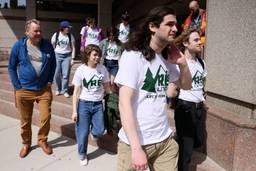
And on Monday, November 24 after more than one thousand days on strike, the brave, strong, resilient workers who held the line the whole time were cheered on by supporters at a rally in downtown Pittsburgh before they once again entered the Post-Gazette building to return to work.
Now, as you heard from the passages I read from the press release, it’s not as if everything has just suddenly gone entirely back to normal, and all the issues at the center of the strike have been resolved and tied up with a bow the Post-Gazette’s union busting, law breaking owners refuse to just take the goddamn L and we’ll see what happens in the coming weeks and months.
We’re joined once again by Bob Batz Jr., a veteran editor and writer who served throughout the strike as interim editor of the Pittsburgh Union Progress, the incredible strike newspaper created by workers on strike at the Pittsburgh Post Gazette.
We’re also joined by Steve Mellon, a veteran photographer and writer and a regular contributor to The Pittsburgh Union Progress.
And we’re also joined by Natalie Duleba, a web editor, newsletter writer and award winning contributor to the Pittsburgh union progress.
Bob Batz Jr.: Our first day back was a big deal, as you might imagine. After not being at work for three years, I missed two trains on the way in, so I was almost late for my first day back at work in three years, which would have been something – pretty embarrassing. But I got there in time for the rally. I’m not a big rally guy, but this was a beautiful, perfectly orchestrated, short, telling, emotional rally.
I think it helped a lot of us go back in those doors that we didn’t know were going to be unlocked or not for us. We didn’t know what was waiting for us. It was quite cordial. I think on both sides, everybody carried themselves quite well.
But I think the one thing that made it difficult for me, and that I still carry with me today and I will tomorrow, is the fact that the legal battle continues, it makes it difficult.
We went back with this great court win, but it hasn’t been enforced yet.
And I think that, to me, is what characterizes my feelings right now. I don’t feel like I’m a hero in any way. Thank you, Max. But we did what we had to do to last on strike for what was 1132 days. 1132 days. We went back at 10:01 am. So we didn’t quite make it to 1133 days.
But we still got some work to do. We still got to get this big court win enforced, and that’ll change life at the Post-Gazette quite a bit – from our health care to the rest of our contract. So in the meantime, that’s what we’re looking forward to. So I’m on this sort of daily vigil for news and developments on that as we get back to work at the PG.
Natalie Duleba: We got our first decision in our favor in early 2023 and that was a huge moment of celebration. I think at that point, it had been five months. It happened in like, February 2023, maybe. We thought that was going to change things, and the company immediately appealed, and we had to wait a whole other year for the National Labor Relations Board – the full five person board to hear the appeal – and we got that decision in our favor in 2024 sometime.
Up until mid June we thought that the Third Circuit wouldn’t even hear our case until fall 2025. That was the timeline that we had kind of been given. And the company did ask for an expedited schedule. So we were lucky enough to have the hearing in early July in Philadelphia.
When the decision came down, honestly, it felt like we had been saying any day now for weeks and weeks. What this ruling does is – those two previous things, there’s no enforcement part of that, the company can just appeal and the order and the rulings aren’t enforced at all – whereas the Third Circuit, as you said, has enforcement powers. They have teeth behind what they’re telling the company.
Not only is it restoring the expired 2014-2017 contract, it’s also resetting bargaining to the status quo of that contract, and it also has a stipulation that the company has to give a report on bargaining to the National Labor Relations Board every 30 days.
But not only that, there are people who are no longer employees of the Post Gazette who will benefit from the ruling because the imposed conditions went into place in July of 2020, when the companies declared an illegal impasse and said, “We’re not going to negotiate anymore. We’re just going to enforce what we legally can.”
Maximillian Alvarez: The Pittsburgh Union Progress was where y’all channeled so much of your professional expertise, your journalistic energies, and I really wanted to just take a moment to give three cheers to the Pittsburgh Union Progress and everyone who worked on it.
I think, genuinely, it’s one of the most remarkable stories and achievements in journalism that I can recall.
This was a full on strike newspaper. Not just a paper about the strike. It was a paper produced by striking journalists and media workers. And it was an incredible paper.
It’s still online. You can go back and look. I have a close tie to the Pittsburgh Union Progress, because Steve himself, who’s on this call with us, was doing the most in depth, humane, on the ground reporting during the East Palestine train derailment and chemical disaster in 2023.
It was actually after I interviewed Steve on this show about the Post Gazette strike, that I was reading his reporting in the strike paper, and I asked him if he could help connect me to folks in East Palestine, which he did.
Steve Mellon: It was very much a working people’s paper put together by working people who were doing it because they had a passion for journalism and passion for these stories. That felt really good.
I’ve been a journalist since 1980 and I was more effective and more efficient as a journalist for the three years I’ve been on strike than I have ever been working for somebody else.
Bob and I talked early on: “Let’s cover working people. We’re on strike. We have that audience.”
So we spent a lot of time covering everybody: from baristas to electrical workers in their labor actions.
Max, East Palestine is a working class community. We saw what happened there. How could you not cover that? These are stories that a lot of places just aren’t covering or if they are, they’re not allowing those voices to rise to the surface: the working people’s voice.
They’re talking to the elected leaders. They’re talking to the business folks. But they’re not knocking on the doors of the people who live on Forest Avenue or Clark Street and hearing their voices.
I’m really proud of that. One thing it did for me is that it gave me a purpose and a sense of identity. There were a lot of days when I wasn’t a very good striker. I didn’t feel like going to the picket line sometimes, and it felt good to go to do – I felt like I was contributing to the community in a way that was really helpful.
It was challenging at times, because I was brought up in old school journalism. I was taught that you need to be separate from your subject and have this distance.
That really broke down in East Palestine. I spent so much time out there. I became friends with a lot of these people. Max, I know that you’re the same way, and grew very close to them.
We saw a need there. The Union saw a need in East Palestine that went beyond just us telling their stories. And so we started food delivery – we didn’t start it – but we were asked to help with the nonprofit’s efforts to provide food and other support for the people who are affected by that derailment.
I’m extremely proud of this union during the strike. We stepped up and helped in that effort.
I know the people in East Palestine. What’s interesting, Max, is that East Palestine is a very red area. These are people who are from a very conservative area. And once a month, a handful of us would get in our cars and drive to East Palestine. We’re on strike. We’re pretty progressive folks. We would get together and work together to solve a problem. And that happened because of the strike, and it happened because of the strike paper. There are a lot of different legacies of the strike. That was near and dear to my heart.
This episode of the Working People Podcast was published on Dec. 18, 2025.

Get 10 print issues of our award-winning, worker-first journalism here!

Maximillian Alvarez is editor-in-chief at the Real News Network and host of the podcast Working People, available at InTheseTimes.com. He is also the author of The Work of Living: Working People Talk About Their Lives and the Year the World Broke.