May Day and the Potency of Solidarity Against Division
International Workers’ Day, aka May Day, represents a fight for a different vision of society—one where we, not a billionaire minority, can make the decisions that impact our lives.
Miles Kampf-Lassin
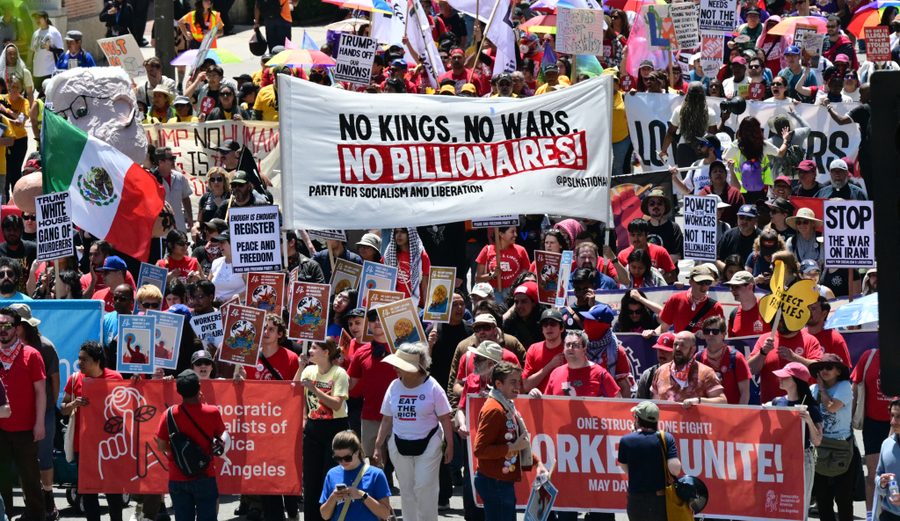
The May Day holiday is rooted in the history of collective worker action. But it’s grown into much more.
In Chicago, 140 years ago, brave organizers fought and died for an eight-hour workday, put to death by the state. The flame they sparked still carries on today. In countries across the globe, from Brazil to France, May 1 is celebrated as International Workers’ Day. For generations, it has stood as a commemoration of the sacrifices those organizers — and the generations who came after — made to improve the lives of working people everywhere.
May Day also represents a fight for a different vision of society, one in which working people strip power away from the ultra-rich who wield the reigns of our political and economic systems — and one where we, not a billionaire minority, can make the decisions that impact our lives.
As a movement journalism outlet, In These Times spent May 1 amplifying the voices helping drive the revival of May Day in the United States as a pro-worker day of protest and celebration. We published pieces from the groups organizing May Day actions, including the Democratic Socialists of America, the Workers Circle, Beyond the Bars and the Chicago Teachers Union (CTU). And on May 5, we hosted a panel discussion at our Chicago offices with U.S. Rep. Delia Ramirez (D-Ill.), CTU Vice President Jackson Potter, professor and In These Times columnist Eman Abdelhadi and United Working Families member Jasson Perez to reflect on lessons from this past May Day and to chart where the movement can go from here.
This year, protesters in hundreds of cities and towns throughout the United States took to the streets to reclaim May Day’s too often forgotten history of class warfare from below and to demand a future free from enforced drudgery at work, from inhumane policies that ravage our communities and from the Trump administration’s increasingly authoritarian rule.
May Day Strong reports that millions of workers participated in more than 5,000 actions nationwide. These included displays of civil disobedience, such as blocking airports, bridges and the New York Stock Exchange, as well as consumer boycotts, school walkouts and mass rallies.
These efforts didn’t create the level of upheaval necessary to challenge capitalist power relations, but some organizers see this past May Day as a structure test for future campaigns. One is a possible general strike — called for by Shawn Fain, president of the United Auto Workers, along with other labor leaders — on May 1, 2028, just months before a pivotal presidential election.
While this modern incarnation of May Day is centered on the proud history of labor organizing as a vehicle for social change, the day has also traditionally been celebrated to mark the spring rites of rebirth and renewal. By demonstrating in formation, working people have shown how we can renew the potency of solidarity against division — and carry on the centuries-long fight for justice, for freedom, for life.
As Marxist historian Peter Linebaugh wrote, decades ago, in A May Day Meditation: “With our comrades we remember recent victories, and we mutter against, and curse, our rulers. We take a few minutes to freshen up our knowledge of what happened there in Chicago in 1886 and 1887 before striding out into the fight of the day.” This sentiment continues to be echoed by those marking May 1 as a day to garland the working class.
In an interview with Democracy Now! this May Day, Justin Lashley-Maloney, an SEIU 32BJ member in New York City, put it this way: “We just won our contract last month and it’s proof that solidarity is power. So today we’re out with our immigrant family … to tell the world we’re not going to take the abuse of ICE. And all workers today, on May Day, are standing together.”
Standing and striding together — that’s the promise of organized worker power embodied by the spirit of May Day.
With your support, In These Times will continue to be a press never for the billionaires, but for the workers of the world.

Miles Kampf-Lassin is Senior Editor at In These Times. Follow him at @MilesKLassin