Graduate Student Workers Find Unity Amid Intense Repression
Amid Trump’s attacks on higher education and academic freedom, labor leaders are fighting back.
Maximillian Alvarez

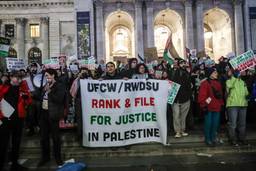
Maximillian Alvarez: Today’s conversation is a critical follow-up to an episode that we published back in late April where I spoke to a panel of graduate student workers at the University of Michigan and Columbia University. Just three months into the new Trump administration, we were talking about federal abductions of pro-Palestine student protesters like Mahmoud Khalil, Trump’s gangster style shakedown of Columbia involving massive funding cuts. We were talking about Columbia firing and expelling Grant Miner, president of Student Workers of Columbia, just before bargaining sessions with the union and the administration were set to begin. We were also talking about the breaking story that on the morning of April 23 at the direction of Michigan Attorney General Dana Nessel, law enforcement officers, including FBI agents, raided the homes of multiple student organizers connected to Palestine solidarity protests at the University of Michigan.
Now, as I said in that last episode, the battle over our institutions of higher education have been and will continue to be a critical front where the future of democracy is decided.
We are joined once again by Conlan Olson who is a PhD student in computer science at Columbia University and is on the bargaining committee for Student Workers of Columbia. Also calling in from Columbia, Vayne is a PhD candidate in history at Columbia University and is also on the bargaining committee for Student Workers of Columbia. We are also joined by Jared Eno, a grad worker in sociology and public policy at the University of Michigan and a rank and file member of Graduate Employees’ Organization (GEO). Can you all walk us through what’s been happening in your lives and on your campuses since last April?

Vayne: Since April, we’ve seen that Columbia has gained a lot of experience in repressing student action and activism and our labor movement. As of October 2025, over 100 students have been suspended or expelled or arrested for Palestine-related actions at Columbia and Barnard. The most recent event was a disciplinary warning given to union members for picketing. Even though most of Columbia’s responses to protesters have been completely unjustified, there’s always been this understanding that they were going to respect labor law, but now, they’ve been empowered by the federal administration to cross that line.
Conlan: Increasingly, we’ve seen that Columbia is unconserved with its public image, unconcerned with the law, and unconcerned with violating the NLRA. So a lot of the traditional legal tools that we have to fight repression, or the idea that we can appeal to public opinion are being undermined. We’ve realized that what we have left is our ability to withhold our labor. We know that grad students run the university, and if we can successfully withhold our labor, we will shut the university down. We fully intend to use that power to fight for a university that actually works for all the people in it and actually contributes positively to society.
This lesson is also echoed in larger activist movements across the US. For example, we’ve learned that there’s really no legal guardrails or safeguards against ICE taking arbitrary actions against non-citizens and citizens alike. Communities and activists have realized that what we still have left is our ability to be there on the ground and take militant action together. But, mobilizing that is hard, and that’s a lot of the work that we have going forward.
Jared Eno: Similarly, in fall 2024 Attorney General Dana Nessel had been recruited by the University of Michigan Regents to bring felony charges against folks for the encampment and other actions in solidarity with Palestine. Nessel had just sent in the FBI to raid folks’ homes around that time. Shortly after that, she was forced to drop all criminal charges. This was the result of a long and intense campaign waged by workers, students, community members alike. There was a lot of outrage seeing how the Regents, who continue to politically and financially support the utterly depraved Israeli genocide of Palestinians, were in cahoots with the state Attorney General.
As has happened at Columbia, the Regents have unilaterally changed the rules of the student conduct process to make it easier to punish those who oppose their fascist agenda. In addition to the attacks on the Palestine solidarity movement, the Regents have ended the university’s DEI programs and ended gender-affirming care for minors at University of Michigan’s hospitals, a major provider for the region. They did that without fighting the federal government’s intimidation tactics. There’s now a lot of conversation among workers about how we can fight back, and how workers need to look to each other as a way out of this and figure out how to build collective power.
Alvarez: Can you give our listeners a sense of what it’s like on campus right now?
Conlan: Things feel really bad at Columbia. The window has been pushed so far towards fascism that even moderate acts of supposed goodwill are meant to feel like wins. So, it’s really important that we stay very disciplined, very strong, and continue to take militant action. The higher education union fight is just one of many fights going on in the US, let alone around the world. Something that a lot of people at Student Workers of Columbia feel really deeply is the importance of keeping solidarity demands front and center. Even as Columbia will try to get us to stand down by buying us out with a small compensation increase, we have to remember that we are a union that’s committed to protecting non-citizens, making Columbia align its investments with its supposed moral values and end its support of the genocidal Israeli apartheid regime.
Eno: The University of Michigan is at this point, a surveillance state. There are cops everywhere. There’s a lot of fear, particularly among international workers. The campus police department, the UMPD, is a key driver in all of this. Just a couple of weeks ago a pro-Israel student group brazenly brought former IOF soldiers to campus as part of a national tour called “Triggered: From Combat to College,” purposefully playing on the outrage of bringing genocidaires to campuses where people do not accept genocide. People turned out to protect their community against the IOF and, of course, UMPD protected the genocidaires instead of protecting the community and violently assaulted and arrested three people.
But, there are a lot of people who are coming together everywhere who do not want this. One thing that’s been so inspiring and so life-giving for me is seeing people just talking to each other, whether it’s door knocking, phone banking, or getting together to discuss how to push back against disciplinary charges.
Even beyond the campus, there are communities that we are embedded in and a part of. One of the major organizing points right now is that the University of Michigan is attempting to build a $1.2 billion data center in Ypsilanti, next door to Ann Arbor, which will have severe negative impacts on the ecosystems, power grid, and quality of life there. This is a collaboration with Los Alamos National Lab and is designed to support the US nuclear stockpile. But community members and folks formally within the university have come together to push back on this.
Alvarez: That is one of the many reasons why folks listening to this, even if they currently have no connection to higher education, should care about this fight. People need to look at universities and campus communities as microcosms of the kind of solidarity that working people need. What are folks in your communities doing to fight back to defend each other’s rights, academic freedom and free speech?
Vayne: One of our biggest fights as a union has been around our bargaining conditions, which felt so untethered to things that have been happening, but it was a terrain we couldn’t give up on. But that’s not to say we weren’t also organizing on all these other fronts. We were building these strong mutual aid and safety networks. We really have to fight for every inch of our power to keep it on our side, knowing that Columbia, like many other employers right now, is going to take any opportunity they can to try to weaken us.
Conlan: On the contract side, we’re fighting for articles that solidify our right to teach and learn about topics that we choose because we’ve seen that Columbia has no qualms about squashing our academic freedom. Accepting forms of censorship like this one at a time is how we backslide step by step into full scale fascist control over knowledge production. The fight over academic freedom serves as a really important step to resist this piecemeal erosion of our ability to think and do things that we want to do.
Eno: We have to do this for ourselves. Let’s be clear, these universities are just corporations, hedge funds, capital pools that have universities and hospitals attached that weaponize the idea that they’re interested at all with knowledge and humanity. We can see that they’re not, but they are full of human beings like you and me and that’s where the potential is. I think last time GEO comrades talked about the ICE hotline that grad workers had set up. That was a wonderful example of workers getting together to solve a problem given that the university was not taking action. It’s an example of how we can turn to each other and show each other what’s possible. This is not a time to be letting fights go, because our power is in our unity. That is, not only unity between people on campus and off campus, but also unity between people here on occupied Turtle Island and in occupied Palestine.
This episode of the Working People Podcast was originally published on Nov 6.

Get 10 print issues of our award-winning, worker-first journalism here!

Maximillian Alvarez is editor-in-chief at the Real News Network and host of the podcast Working People, available at InTheseTimes.com. He is also the author of The Work of Living: Working People Talk About Their Lives and the Year the World Broke.