Zombie Lobbyists Occupy Washington
Swarms of money-hungry corporate gladhands fight over the brains of our elected leaders in the nation’s capital.
Beau Hodai
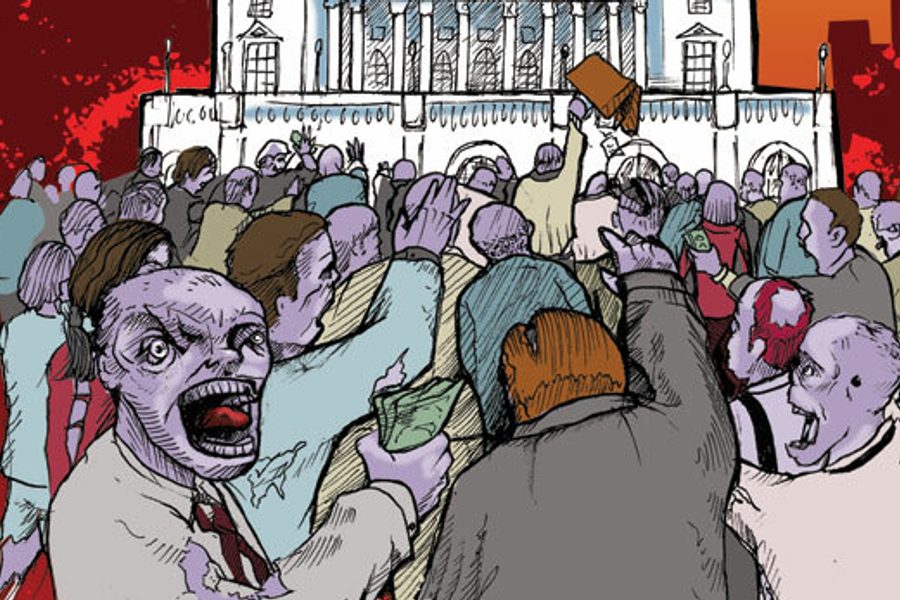
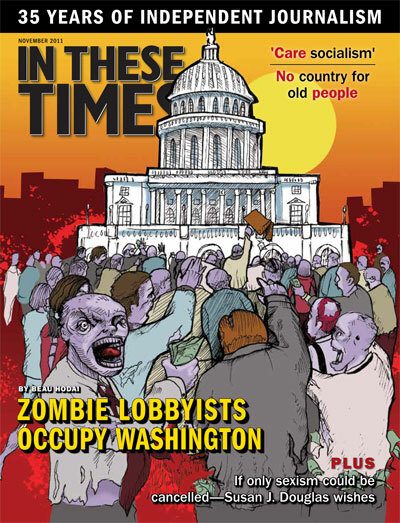
They come creeping from the K Street salons, money dripping from their lips. They skulk the halls of power, bemoan the pain of regulation on the steps of Capitol Hill. Their shrill howls for the brains of our elected representatives cut the D.C. night.
They are lobbyists. On any given day, more than 10,000 of them swarm the nation’s capital – twenty-six for each U.S. representative and senator. They are the emissaries of this nation’s wealthy and immortal – corporate citizens.
These beasts have managed to abrogate the laws of life and death. While the actors on the stage of elected government blur by the populace in never-ending campaign theatricals, corporate lobbyists are not bound by electoral cycles – they are impervious to term limits, impeachment and sane regulation.
Elected officials and their staffers pass from the life of public service into the walking death of the corporate sector, and many join the lucrative ranks of the lobbyist. Once bitten by the money bug, few escape its taint.
A corporate pledge for the people
On September 23, 2010, the U.S. House GOP leadership stood proudly behind soon-to-be Speaker John Boehner (R-Ohio) in the warehouse of Tart Lumber Company in Sterling, Va., and delivered a promissory letter to a lionized American electorate. The U.S. House of Representatives Republican Conference “Pledge to America” proclaimed:
Voices in and out of a government whisper that our standing as the world’s leader of democracy and economic growth is ending. The American people do not accept these counsels of timidity, failure and despair. … Legislators in Washington have imposed an agenda that doesn’t reflect the priorities of the people. What’s worse, the most important decisions are made behind closed doors, where a flurry of backroom deals has supplanted the will of the people.
Beside Boehner, lawmakers present included Rep. Kevin McCarthy (R-Calif.), current House majority whip, and Eric Cantor (R-Va.), current House majority leader.
Speaking from his podium before the nation’s assembled press, Boehner waved the “Pledge to America” over his head and assured the public that the soon-to-be House Republican majority had heard Americans’ grumblings of discontent.
“Across America, the people see a government in Washington that isn’t listening, doesn’t get it and doesn’t care. Today that begins to change,” Boehner said. “This new governing agenda, built by listening to the people, offers plans to create jobs, cut spending and put the power where it belongs: in the hands of the people.”
The Pledge echoes former Speaker Newt Gingrich and anti-tax activist Grover Norquist’s 1994 “Contract With America.” It promises to accomplish the same objectives – decreased taxation, regulation and government (defense spending excepted) – by permanently extending the Bush tax cuts, repealing the Patient Protection and Affordable Care Act (PPACA, aka “Obamacare”), removing Fannie Mae and Freddie Mac from governmental control and support, and reducing government spending through massive cuts to public programs.
Most ironically, the Pledge pays lip service to ending the “backroom deals” that have come to define the political culture of Capitol Hill. This clichéd disdain is laughable given that Brian Wild, the chief architect of the Pledge, is a congressional staffer and corporate lobbyist who has gotten rich by “supplant[ing] the will of the people.” Good government advocates will argue that Wild must be dizzy from spending the past 12 years passing through the revolving door that connects the backrooms of government with the board rooms of K Street. But this “revolving door” metaphor fails to describe what is actually taking place with Wild and others.
Yes, members of Congress and their staffers – Republicans and Democrats – go back and forth between government offices and lobbying firms. But while the fiscal entity that writes their paychecks is ever-changing (hence the image of a revolving door), their allegiance to the immortal corporations, on whose dime they toil, never wavers.
CASE STUDY 1: Born Brian Wild
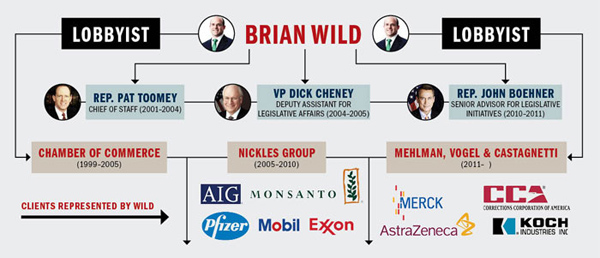
According to reports on file with both the U.S. Senate Office of Public Records and the Office of the Clerk of the U.S. House of Representatives, Brian Wild – the Pledge crafter who was also responsible for monitoring the concerns and ideas voiced in the GOP’s online forum “America Speaking Out” – was a registered lobbyist for the U.S. Chamber of Commerce from 1999 to 2005. He also served simultaneously as executive director of the Chamber’s Office of Advocacy and Grassroots Programs.
Wild lobbied against bills to raise the federal minimum wage, against the Patient’s Bill of Rights Act and against environmental regulatory legislation. He also lobbied for tort reform bills aimed at asbestos-related claims and in favor of bills to make it more difficult for debt-saddled citizens to declare bankruptcy.
As chief of staff for Rep. Pat Toomey (R-Pa.) from 2001 to 2004, Wild slid easily between the roles of lobbyist working for the Chamber of Commerce and staffer on Capitol Hill working directly with members of Congress. (Toomey left office in 2005 for the presidency of Club for Growth of Washington, D.C., which operates as both a corporate think tank and political action committee. In 2010, backed by Club for Growth, Toomey won Arlen Specter’s Pennsylvania Senate seat.)
Between June 2004 and October 2005, Wild worked as deputy assistant for legislative affairs to Vice President Dick Cheney.
Between 1999 and 2005 – the years Wild was a registered lobbyist for the Chamber, a staffer for Toomey and Cheney, and the executive director of the Chamber’s Office of Advocacy and Grassroots Programs – the Chamber spent more than $227 million to lobby both houses of Congress, the White House, the Office of the Vice President and federal agencies. The Chamber was concerned about private contractors working in Iraq, “homeland security,” defense, immigration, healthcare, labor, financial industry regulation, tort reform, energy policy, taxation, appropriations and foreign trade policy.
Wild left the office of Vice President Cheney in 2005 to work as a lobbyist with the Nickles Group, which was formed earlier that year by former Sen. Don Nickles (R-Okla.), who chaired the Senate Budget Committee from 2003 through 2004, and three of his former senior Senate staffers. During his time with Nickles, Wild lobbied for notable corporate citizens such as Exxon Mobil, Anadarko Petroleum Corporation, Southern Company Services, Comcast, Pfizer, Bristol-Myers Squibb, Hoffman-La Roche, Monsanto and American International Group.
Wild left Nickles in April 2010 to work as “senior adviser for legislative initiatives” and “policy and communications director” for then-House Minority Leader Boehner, lending his Chamber-honed grassroots advocacy skills to the Republican sweep of the 2010 midterm elections.
A month following Boehner’s swearing in as speaker of the House in 2011, Wild announced that he would be joining the lobbying firm of Mehlman Vogel Castagnetti, Inc. (MVC). MVC founding partners include Bruce Mehlman, a former general counsel and adviser to the House Republican Conference; Alex Vogel, a former chief counsel to former Senate Majority Leader Bill Frist (R-Tenn.); and David Castagnetti, who worked as a congressional liaison for Sen. John Kerry’s (D-Mass.) 2004 failed presidential campaign.
As a principle at MVC, Wild currently lobbies on behalf of clients such as America’s Health Insurance Plans, Ascension Health, Humana, Astrazeneca Pharmaceuticals, Merck, SLARS Coalition (“Student Loan Auction Rate Securities Coalition” – an organization of investors holding asset-backed securities derived from bundled student debt), the American Petroleum Institute, Koch Industries Public Sector, Wal-Mart and Corrections Corporation of America.
While Wild was at Nickles, the group lobbied against federal regulations proposed in PPACA and related laws, such as a ban on denying coverage to individuals for pre-existing medical conditions, and against the formation of a federally-administered health insurance program – the elusive “public option.”
But the Nickles Group did not lead the opposition to the reforms contained in PPACA. Nickles is small-fry – just one of a multitude of lobby shops funded by corporate interests.
A game changer
According to the Center for Responsive Politics Executive Director Sheila Krumholz, more than $3.6 billion were expended in federal campaigns during the 2010 midterm election cycle. This was a 28-percent increase from the $2.8 billion spent in the 2006 cycle.
Some of this increase, she says, can be attributed to the “hydraulic theory of money in politics,” which holds that money is like water under pressure – if there is a way to inject itself into the system, it will.
One new inlet for this monetary pressure – and anticipated in the 2012 election cycle – was created by the U.S. Supreme Court’s 2010 decision in Citizens United v. the Federal Communications Commission. According to “Fading Disclosure,” a September 2010 report by Public Citizen’s Taylor Lincoln and Craig Holman, Citizens United expanded an existing disregard for elections law and campaign finance disclosure. Public Citizen found that during the 2006 midterm election cycle, nearly 100 percent of electioneering groups reported the sources of their funding, as required by law. During the 2008 election cycle such reporting had fallen to less than 50 percent (thanks, the report says, to changed Federal Election Commission rules). By the beginning of the general election reporting period after the Citizens United ruling in 2010, it stood at a mere 32 percent.
The Public Citizen report notes that this breakdown in donor reporting took place primarily among right-wing independent groups, such as Toomey’s Americans for Prosperity, a 501©4 nonprofit founded by billionaire David Koch in 2004. The report goes on that an increasing number of these independent groups are incorporating as 501© entities, which are supposed to be heavily restricted in their political activity and are not required by law to disclose their donors – as opposed to 527 nonprofit groups, which can engage in political activity but must disclose their donors.
As an example of this sort of activity, Lincoln and Holman cite American Crossroads and its affiliates, which were founded by GOP operative Karl Rove and Ed Gillespie – uber-lobbyist and former chairman of the Republican National Committee (RNC).
CASE STUDY 2: Born Kenneth Kies
With the new ground rules of Citizens United in place, candidates and their parties are under pressure to pander to the now-publicly anonymous corporations that fund them. Here is where lobbyists – often ambiguously described as “consultants” – come into play.
Services provided by these consultants include: fundraising, campaign strategizing, political messaging, polling, vetting of campaign platforms and the manipulation of public opinion through “issue-oriented” communications.
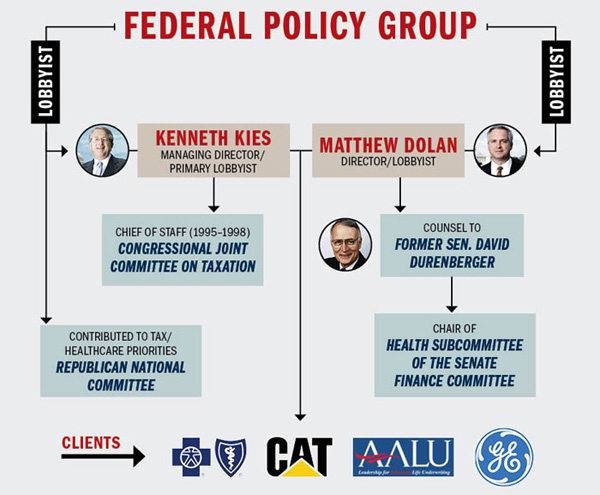
For example, between Nov. 23 and Dec. 31, 2010, the RNC – charged with setting the legislative agenda for the newly elected GOP House majority and the Republican Party – employed the “political consulting” and “strategic planning” services of the Federal Policy Group (FPG), a subsidiary of the tax policy advisory group Clark & Wamberg.
For services rendered, the RNC paid FPG $105,657 in 2010, with an additional $75,000 owed to the firm at year’s end. All told, in 2010, 22 corporations and trade associations spent $3.9 million buying FPG federal lobbying services.
True to the nature of the corporate lobby beast, FPG’s managing director and primary lobbyist is Kenneth Kies, who, between 1995 and 1998, served as the chief of staff on a Congressional Joint Committee on Taxation. Similarly, FPG director and lobbyist Matthew Dolan served as counsel to former Sen. David Durenberger (R-Minn.), chair of the health subcommittee of the Senate Finance Committee.
FPG seems a natural fit for the RNC. Since the 2010 midterm elections, the GOP’s political platform has centered around issues of taxation and health care.
Kies told In These Times that his firm provided “technical and policy advice” to the RNC on issues of “tax and budget policy” concerning the Bush tax cuts, which were set to expire in December 2010, and President Obama’s budget proposal – all of this at the time when the outgoing lame duck 111th Congress (then controlled by Democrats) and the White House were engaged in a budgetary battle that resulted in the tax-cut extension.
In 2010, FPG’s top clients included General Electric, which paid $840,000 for FPG lobbying services; Caterpillar Inc., which paid $300,000; Blue Cross and Blue Shield Association, which paid $280,000; Association for Advanced Life Underwriting, which paid $260,000; and Overseas Shipholding Group, which paid $240,000. According to the Center for Responsive Politics, these corporations have contributed $610,300 to federal Republican legislative candidates and $288,700 to Democratic candiates so far in the 2012 cycle.
Kies himself contributed $34,900 to GOP campaigns through the first half of 2011. In addition, from January through June, Kies, as a representative of FPG, reported $30,400 in bundled contributions to the National Republican Senatorial Committee, a PAC administered in large part through the RNC.
When asked whether the Republican candidates might have gained an economic advantage by employing a lobby firm whose income largely comes from corporations and trade associations, Kies replies: “Well, we do some fundraising, yes … but we don’t control what our clients do with their fundraising.” He adds, “It’s the way all fundraisers in Washington work. You schedule a date. You send out invitations to people you know that you think might be interested in participating,” Kies says.
Are these interested people representatives of FPG corporate clients? “Yeah, sure,” says Kies. “That’s what everybody would do. We don’t invite people off the street. We invite people we know.”
Can the undead be reformed?
“Lobbyists are paid by clients to represent their interests. They are essentially hired guns,” Public Citizen’s Craig Holman told In These Times. “Lobbyists are more marketable to their clients depending on how they can get their foot in the door of candidates and officeholders in order to wield influence. It is all part of the corruption on Capitol Hill. This is the influence-peddling business that lobbyists are in charge of.”
For GOP lobbyists like Wild and Kies, as well as for the clients they serve, peddling influence is lucrative.
In 2007, Holman worked with members of the House Progressive Caucus to draft and promote the Honest Leadership and Open Government Act of 2007 (HLOGA).
HLOGA called for reform of congressional gifting, lobby disclosure, and greater “revolving door” post-governmental employment restrictions for lawmakers and legislative staffers.
The bill was a reaction to the tremendous unchecked power held by lobbyists such as those exposed in the scandal involving uber-lobbyist Jack Abramoff and Rep. Tom Delay (House Majority Leader, 2002 through 2006, R-Texas). This scandal contributed to the loss of the GOP’s congressional majority in 2006, a majority that had been held for 12 years – since the “Republican Revolution” and the coinciding issuance of the GOP “Contract with America” in 1994.
Reforms enacted through HLOGA include the quarterly filing of lobbyist activity reports, creation of a publicly-available online lobbyist disclosure database, online availability of lawmaker statements of personal financial disclosure and greater reporting of lobbyist campaign-contribution bundling activity.
It is worth noting that the information in this article would have been much more difficult to gather had it not been for HLOGA.
As originally introduced, HLOGA extended the standing one-year “cooling period” to a period of two years, during which lawmakers formerly employed by either the House or Senate would be prohibited from lobbying any of their former congressional colleagues. Also, certain senior staffers employed by either the House or Senate would have been prohibited from lobbying the branch of Congress in which they had been employed during the cooling period.
While these provisions were approved by the Senate in 2007 and enacted as law, provisions of HLOGA that pertained to the House in this area were significantly more lax: Former staffers may lobby to their heart’s content immediately following public employment, so long as they do not lobby for one year the office that formerly employed them. As such, HLOGA in the House represented a continuation of the status quo.
Had the Senate’s standards applied to the House, Wild may have thought twice about leaving the Nickles Group, as he took a paycut to work for Boehner.
But the money game in Washington is an equal opportunity corrupter. Attempts by good government groups like Public Citizen to control the infestation of lobbyists in Congress were stalled not by Republican lawmakers, but by Democrats.
As an advocate working for passage of this reform and lobby disclosure bill, Holman noted that the most vehement opposition to the so-called post-public employment revolving-door lobby restrictions came from a contingent of senior Democratic Party representatives.
According to Holman, the members of Congress who spearheaded opposition to these reforms in the House were Democratic Reps. Alcee Hastings (D-Fla.), Neil Abercrombie (D-Hawaii) and Allen Boyd Jr. (D-Fla). All three of these dissenting lawmakers had substantial ties to powerful committees.
At the time of his opposition to HLOGA’s revolving-door reform, Hastings was chairman of the House Committee on Rules Subcommittee on Legislative and Budget Process. Hastings also served in 2007 as co-chairman of the Democratic Caucus Special Committee on Election Reform. Abercrombie served as chair of the armed services subcommittee on tactical air and land forces and as Majority Whip-At-Large.Boyd co-chaired the Blue Dog Coalition, a conservative subset of House Democrats who purportedly promote “fiscal conservatism” within the party.
While Hastings still serves in the House and while Abercrombie was elected Governor of Hawaii in 2010, Boyd wasted no time in finding private sector-lobby employment following a failed bid for re-election in 2010.
In February of this year, D.C.-based lobby firm, Twenty-First Century Group, hired Boyd on as a senior advisor. Not surprisingly, Boyd’s biography on the firm’s website touts the former representative’s service in both the House Appropriations Committee, as well as his leadership role in the Blue Dog Coalition. While Boyd is currently not a registered lobbyist in either house of Congress, he will be able to lawfully lobby his former colleagues as of February 2012. Current Twenty-First Century clients include such notable corporate citizens as Time Warner Cable and Verizon.
True to K Street form, the firm is headed up by CEO Jack Fields, formerly Rep. Jack Fields (R-Texas), who served on the House Committee on Energy and Commerce and was chairman of the subcommittee on telecommunications and finance. Fields was a leading proponent of the Telecommunications Act of 1996, the passage of which marked unprecedented deregulation for both media broadcasting conglomerates and telecommunications providers. In short, the bill was an absolute boon to Twenty-First Century clients Verizon and Time Warner Cable.
And so the business goes: Legislators become lobbyists, and lobbyists become legislative aides or campaign consultants – and increasingly secretive corporate money keeps the whole elaborate charade going. Forget the familiar metaphor: Who needs a revolving door when there’s no wall left between public service and private gain?
This report was produced as part of a collaborative investigative effort to expose the influence of corporate money on the political process by members of The Media Consortium, in partnership with the We the People Campaign. To read more stories from this series, visit www.CampaignCash.org, or follow #CampaignCash on Twitter.

Get 10 print issues of our award-winning, worker-first journalism here!