Amazon Workers Keep Walking Out
At a Riverside delivery station, workers have walked out three times since December as they organize without a recognized union.
Alex Press

RIVERSIDE, CALIF. — In February, a worker at Amazon’s DJT6 delivery station in Riverside was confronted inside the warehouse by a former coworker. She had accused him of harassment. The man had already been fired but somehow got back inside the building.
Emmanuel Cadena, who works at DJT6 and knew the woman, said the man blamed her for his firing. Another worker stepped in.
“He flashed the gun and said, ‘If you and your friend have a problem, you can see me outside,’” Cadena said.
The confrontation happened near the conveyor belt where workers were sorting packages. Amazon did not pause work, according to Cadena. “There’s no sort of cover in any capacity,” he said. There were no security guards at DJT6 at the time.
Amazon spokesperson Sam Stephenson said, “The safety of our employees and partners is our highest priority, and we take matters like this incident seriously.” He said Amazon immediately notified local law enforcement and provided resources to employees, and that the company has “proactively added additional layers of security” at DJT6.
Workers say that response came only after they pushed for it. They went to management and demanded security guards; Amazon brought in temporary ones, then made them permanent after workers pushed some more.
For Cadena, 26, who has worked at DJT6 for just over a year, the incident pushed him deeper into an organizing campaign with Teamsters Local 1932 that had gone public in December. Since then, workers have walked out four times, pressed management over safety issues and demanded that Amazon recognize and bargain with their union — which the company has so far refused to do. The Teamsters say a majority of workers at the facility have now signed union authorization cards.
On September 2, workers walked out for the third time since December, this time in a one-day unfair labor practice (ULP) strike over what the Teamsters describe as retaliation against workers advocating for safer working conditions. It was the first time workers on both of DJT6’s primary shifts had walked out together.
Cadena got to the station early. Workers on the night shift were already outside picketing. Cadena, who works days, went inside. At 6:20 a.m., he and his coworkers gathered near the exit. Management had put three tables together in the break room and covered them with snacks. “I had never seen so many snacks before since I started working here,” Cadena said. There was more variety than usual, too. “They could have done this the whole time.”
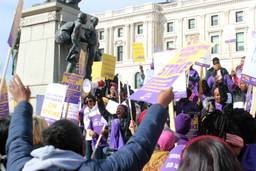
One worker gave a short speech. Cadena estimated that between 50 and 80 workers then walked out together and joined the picket line, where workers carried a banner reading “FAIR PAY FOR ALL WORKERS” and signs telling Amazon to “OBEY THE LAW.”
Kain Kazsuk, a 27-year-old night-shift worker who has worked at DJT6 for nearly two years, has participated in all three walkouts. He joined the organizing effort last August.

The campaign went public in December with a walkout during Amazon’s holiday rush. The overnight shift left the building around 1 a.m., and the picket lasted about five hours. Amazon told KVCR that fewer than 1% of employees at the facility participated.
Afterward, Kazsuk said, managers treated some of the most visible organizers differently. “The day after the walkout, it was almost like we were being shunned,” he said. Eventually, though, “once they kind of realized that this union thing was not just like a one-time walkout,” Kazsuk said, “it kind of became more normalized.”
Workers have pressed management on other problems, too. Kazsuk said workers concerned about the noise from the conveyor system went to the Occupational Safety and Health Administration. Amazon later reworked sections of the conveyor and added sound-dampening material, he said. Workers also began holding what they call “marches on a manager,” approaching managers in groups on the warehouse floor about problems they want addressed.
“At this point, if there is an issue, we’re going to do something about it,” Kazsuk said. “We’ve taken back a lot of the power in the warehouse.”
In March, workers walked out again after Amazon fired Andres Aguayo, a DJT6 worker involved in the organizing. Aguayo told KVCR that he and other workers had been approaching supervisors about safety problems and coworkers’ concerns. “They figured I was enough of a problem that they didn’t want me working,” he said. He said Amazon accused him of misconduct but did not provide evidence.
Asked about Aguayo’s firing, Amazon told In These Times, “Mr. Aguayo was terminated for violating company data policies.”
Amazon’s Inland Empire
DJT6 sits in the Inland Empire, the warehouse belt stretching east from Los Angeles through Riverside and San Bernardino counties. Amazon opened its first warehouse there in 2012. By 2021, when The New York Times Magazine reported on the company’s growth in the region, it was the Inland Empire’s largest private employer, with 14 facilities, two logistics air hubs and more than 40,000 workers.
Amazon workers in the region have repeatedly organized over working conditions. During the pandemic, more than 400 workers at the company’s LGB3 facility in Eastvale signed a petition demanding safer conditions. In August 2022, workers at the company’s KSBD air hub in San Bernardino walked out over pay and extreme heat.

DJT6 itself has been part of the Teamsters’ Amazon campaign for several years. In October 2023, unionized delivery drivers from Palmdale brought their picket line there during Amazon’s Prime Big Deal Days promotion. The drivers worked for an Amazon Delivery Service Partner; the National Labor Relations Board (NLRB) later alleged that Amazon was a joint employer and had unlawfully refused to bargain, among other violations.
Two years later, workers employed directly by Amazon inside DJT6 launched their own public campaign. The Teamsters say a majority of the workforce signed union authorization cards in December, though the union has not petitioned the NLRB for an election.
Making Amazon Bargain
Near the end of the night shift Wednesday, Kazsuk and another worker tried giving management formal notice of the strike. Managers declined to take the letter, he said, so they left it on a table in the managers’ office.
Kazsuk estimated that 45 to 50 night-shift workers left. Some marched up the road with a banner and chants. Others who did not want to be publicly identified simply left. The picket continued into the day shift.
“The trucks stopped,” Kazsuk said. “The line of cars was not able to move the inventory.” Amazon Flex drivers posted on Reddit that they couldn’t enter the station for scheduled delivery blocks; some said Amazon later notified them they would still be paid.
Amazon told The Press-Enterprise that the protest was “initiated and attended by mostly outside organizers.”
Kazsuk rejected Amazon’s characterization. Teamsters organizers had advised the workers, he said, but “it was all us, boots on the ground in the warehouse, talking to our coworkers.”
The day shift had been involved in the organizing before Wednesday, Kazsuk said, but had not previously staged a walkout. He described support as growing “slowly and steadily” since December. More recently, “I’ve seen a lot of people who were previously against the whole idea now supporting it.”
Asked about the Teamsters’ assertion that a majority of DJT6 workers had signed union cards, Stephenson said, “Despite claims to the contrary, the Teamsters don’t represent any Amazon employees or partners, at this site or at any Amazon facility.”
Cadena and Kazsuk are directly employed by Amazon. At the company’s JFK8 warehouse on Staten Island, directly employed workers won an NLRB election in April 2022. Amazon challenged the result and refused to bargain. This April, the NLRB ruled that Amazon had unlawfully refused to recognize and bargain with the union, which affiliated with the Teamsters in 2024. Amazon said it would appeal. Four years after the election win, workers still do not have a first contract.
At DJT6, Kazsuk said the rules of the job can change constantly: Something workers are told to do one day can be prohibited the next and required again the day after that. Cadena sees similar problems on the day shift. He works in OTR, the part of the station that dispatches drivers. He said workers had faulty microphones that required him to take off his work gloves to turn them on and off. Amazon replaced them last month, eleven months after he started. At another point, a shade tent used by workers directing drivers broke. Cadena said a pregnant coworker spent several days working outside in the sun before it was replaced.
“They’re not ever going to admit that the reason that they’re doing it is because we made a fuss about it,” Kazsuk said.
“If we have any more issues, we will definitely make our voices heard,” Cadena said. “If walking out again is the means necessary to make our voices heard, then we got to do what we got to do.”

Thank you for reading this story. At a time when corporate media is dominating the web and our airwaves, independent journalism is more important than ever, and that’s what we provide at In These Times. We offer some of the best reporting, investigations and analysis on the growing movements for justice in the U.S.—and our work is firmly pro-labor and anti-fascist. To continue producing it, we need your support.
If you believe in the power of an independent press, please make a donation to In These Times today. By becoming a sustaining member, you can ensure that our work reaches even more readers.
And if you become a sustainer right now, you'll get a free year-long print subscription and a special subscribers-only print from artist Molly Crabapple.
Thank you.

Get 10 print issues of our award-winning, worker-first journalism here!
Alex Press is a labor reporter. Her work has appeared in The New York Times, The Washington Post, The Nation and Jacobin magazine, among other outlets. You can follow her on Twitter @alexnpress.