How One Minnesota Union Is Helping Members Survive the Federal Siege
UNITE HERE Local 17 is one of many unions, community organizations and faith groups calling for a work stoppage tomorrow, showing a key way Minnesotans are organizing against ICE.
Sarah Lazare

MINNEAPOLIS, MINN. — When Feben Ghilagaber delivers food to fellow union members hiding from the thousands of federal immigration agents swarming Minnesota, the lights to their homes are often off when she gets there.
“People are scared for their lives,” she tells me as we drive to UNITE HERE Local 17 office in Minneapolis, a labor union representing more than 6,000 workers in hotels, stadiums and convention centers in the Twin Cities metro area. It also represents many of the workers at the Minneapolis – Saint Paul International Airport and Ghilagaber, an airport food service worker and steward for the union, says the people she delivers food to “are sitting in the dark.”
“ICE,” she says, “is attacking everybody.”


The majority of Local 17’s members are immigrants and/or people of color, which puts them at risk of being detained for merely being in public where border patrol and ICE are present. And they’re present everywhere.
Under its so-called Operation Metro Surge, the Trump administration has deployed thousands of federal agents to Minnesota, where they have raided homes, schools and daycares, detaining school-aged children and violently attacking many of those resisting their presence. An ICE agent shot and killed poet and mother, Renee Good, on January 7 and she has become a rallying cry for the efforts to push ICE out of the area. In some stretches of town, an individual could be at risk of detention or abuse if they are racially profiled as an immigrant for simply walking — or even driving — down the street.

One way the union responded to this crisis two weeks ago was by starting a massive public food distribution system so that union members do not go hungry while they are in hiding. It’s the latest manifestation of a labor movement tradition to keep families fed while workers strike. One example, that In These Times columnist Kim Kelly wrote about in 2023, is the women’s auxiliary that fed striking coal miners during the Warrior Met Coal Strike in Alabama from 2021-2023.
But what’s crucially different in the Twin Cities is that organizers are now forced to build and flex this muscle in the face of a federal assault that has left their members devastated, with the goal of helping them survive and stay with their loved ones to fight another day. “Around 16 of our members have been detained,” Sheigh Freeberg, Local 17’s secretary-treasurer, told me as we sat in his office this week. “Some have been released, many are in concentration camps in Texas.”
Two weeks ago, the union sent out a text message to every member it had cell phone numbers for about its emerging food distribution program. “It was just the simple message of, ‘The union has the capacity to provide food resources to people who are affected by our current situation.’ And with an ask of, ‘If that is something that could be useful for you, respond yes to this message,’” Freeberg explains. For everyone who responded with a “yes,” the union did an intake call, and also worked with stewards to identify those in need. Rank-and-file leaders, after all, often know best who is struggling and not coming to work.

The effort ballooned from there. Freeberg took me to another office room at the headquarters piled high with dozens of cardboard boxes labeled “emergency food box.” On a long table against a wall, food was sorted into canned goods, bread, cooking oil, and other kitchen and pantry basics. A piece of butcher paper mounted on the wall gave instructions for volunteers about what to pack in each box: one pack of tortillas, three cans chicken.
The goal, he said, is to give members enough to cook with for a week, and then return every week, so that their kitchens are never empty. Volunteers help with the delivery, as well as the sorting, and the union’s international sent two staff members to support the effort. They greet me politely then urgently return to work on their computers at a table next to the boxes.

Some 200 members are receiving such deliveries, Freeberg says, making this a considerable operation that is only poised to deepen as the federal assault continues. “A lot of what we’re doing in Minneapolis is we’re trying to build the scaffold for resisting ICE, and part of that is making sure that our people don’t go outside,” Freeberg says. “Which is so fucking frustrating and sad, but it is awesome that the union gets to be the reason that they get to stay safe.”


Other food distribution efforts have also scaled up dramatically throughout Minnesota in response to the federal deployment. One mutual aid network has distributed 12,000 boxes of food since the federal surge began. It’s indicative of the efforts of so many Minnesotans who have responded to federal agents descending on their communities with an outpouring of collective action and support. That has included organizing rapid response networks, patrolling neighborhoods to protect school children (especially at the beginning of school and at dismissal) and organizing for an eviction moratorium so that those who do not feel safe going to work are not kicked out of their homes.

Neighborhood by neighborhood, block by block, residents have been creating structures to keep people a little safer, or at least less alone. It’s a stunning portrait of David vs. Goliath: people wearing whistles and winter jackets, up against heavily armed and masked federal agents who are funded to the tune of billions of dollars.

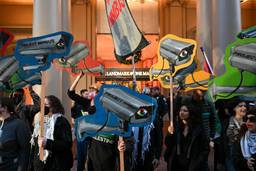
And while UNITE HERE Local 17 has been scaling up its food distribution network, it has also been organizing a mass labor action aimed at shutting down business as usual tomorrow, January 23. Under the banner of “no work, no school, no shopping,” a coalition of major unions, community organizations, and faith groups plan to withhold their labor and march in subzero temperatures.
Ghilagaber has been organizing toward this effort at the same time she has been “making sure people are fed.”
“What we see is so scary,” she tells me, “we try to be a voice for people who are hiding.”
This article is a joint publication of In These Times and Workday Magazine, a nonprofit newsroom devoted to holding the powerful accountable through the perspective of workers.

Get 10 print issues of our award-winning, worker-first journalism here!

Sarah Lazare is the editor of Workday Magazine and a contributing editor for In These Times. She tweets at @sarahlazare.