Fighting Cancer Has Given Me New Insights on the Anti-Fascist Challenge We Face
To resist authoritarianism, our work must be deeply relational. We must act even in uncertainty. Nurturing builds power.
Amisha Patel

At 15, with my skinny legs swinging off the exam table, I sat and listened as my gynecologist stood before me with serious eyes and told me that I had a high risk of developing cancer someday. It was a shocking message to get as a teenager; nonetheless, I made immediate decisions to protect myself.
I stayed on birth control pills for years despite wild swings of emotion, including long stretches of depression, in an effort to keep cancer away. For years, I thought I would become a genetic engineer to one day help find the cure to cancer. I endured over 25 endometrial biopsies to try and keep my chance of getting pregnant intact. The cancer threat shaped me in so many ways.
At 19, while my emotions continued to swing, I found my first life buoy: community organizing. Mentored by two pioneering community leaders named Keisha and Peter Evans, I worked with two other students to launch a youth of color environmental justice organization in East Palo Alto, California. The organization brought together middle and high school students for a founding campaign targeting a toxic waste facility in the high-poverty, majority Black and Brown town. It was my first experience connecting my individual sense of power to growing collective power. Guided by our mentors, we focused on popular education to expand the consciousness of youth of color around systems of oppression, and through that work, I began to make critical connections for my own life. Though I had no idea at the time, this experience was a critical step toward moving me to a life committed to organizing.
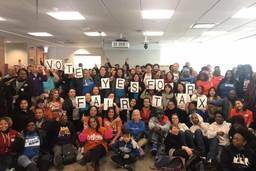
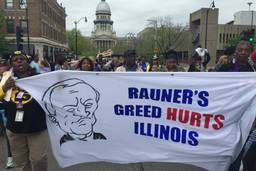
For the next 30 years, I spent my life building relationships with Asian youth to tell their stories of gender-based violence, organizing hospital employees and Head Start workers into a union, building power with young workers across SEIU, and leading a powerful community-labor coalition in Illinois that increased the minimum wage in Chicago, seized back hundreds of millions in Tax Increment Financing money from highly profitable corporations, and fought to make the rich pay higher taxes. We built power with Black parents in Peoria around education justice issues and trained thousands of low-to-moderate-income residents across the state around issues of race, class, and gender. We organized politically as well, which led to our members running an alderman’s zoning committee as their Puerto Rican neighborhood faced rapid gentrification. We helped elect Delia Ramirez to Congress and Brandon Johnson as mayor of Chicago, building off our decades of organizing to cohere a shared analysis and vision of the future.
When I started union organizing, I also joined a peer counseling community that is rooted in a collective understanding of the impact of oppression and trauma on our lives, especially in our earliest years. It is a process that centers an equitable give-and-take of deep listening, focused on collective liberation. My counseling class was made up of Black and Asian Chicagoans, and for me as a young Asian woman mainly organizing Black and white low-wage workers, having this space to process was key to me being able to show up as an organizer day after day. Organized labor was and still is a tough place to be as a young woman of color, and I’ve seen so many others leave organizing because of how ruthless it can be.
Today, at 50, I see the numerous ways that my cancer journey and my organizing life have intersected to reveal clear learnings on how to approach any seemingly insurmountable challenge. This period of consolidation of an authoritarian state collides with my own growing threat of unbounded tumors. Here are a few lessons:
I could not face my third round of cancer without literally about 100 friends, family, peer counselors, and community members who have flanked me and my wife through this terrifying time. For me, leaning on people, and letting myself be helped, held, loved and cared for, has not been easy. Like many organizers, I am used to handling all the things. As this disease progresses, I find myself moving more and more toward my people.
During previous rounds of chemo, I always shaved my own head, but last September, I decided instead to ask my wife Neena to do it. Sitting in a chair, looking in the mirror, I suddenly realized that based on where I am with my disease, I may never again have hair on my head. The reality of potentially being bald until I die hit us both like a ton of bricks — less about the hair itself, but what it signaled — that I would forever be a marked cancer patient, and that I would die fighting this disease. It was then that I realized that this moment was bigger than just the two of us. I immediately texted a few friends and asked who might be able to join a video call in a few hours during which we would shave my head. Two hours later, eight friends called in and accompanied Neena and me as we cried, laughed, and shimmied to my hastily created hair-themed playlist. It was exactly what we needed.
Authoritarianism requires our isolation. Our broken connections, our aloneness. Our anger directed toward each other. The U.S., with a mainstream culture rooted in competition and isolationism, has been a prime breeding ground for fascism for so many years. In fact, the U.S. has been practicing fascism against Black and Native people since its founding.
To resist and build the world we want and need in this moment, our work must be deeply relational. Mutual care is not just a survival strategy, but also a direct route to community power building. Chicago, Los Angeles, D.C., and of course Minnesota offer us clear examples of the ways that communities have come together to resist Trump’s fascist border control, by organizing hundreds of neighborhood Signal chats; providing open trainings and guidance to each other; and showing up to disrupt, document, and stop abductions of neighbors to exemplify not just care in action but also what collective organizing can do against brutal state-sponsored violence.
We cannot win without each other.
At this point in my disease, the goal is to keep me alive long enough to find the medicine that will hold my tumors in check. Metastatic cancer at its best is a chronic disease, and my hope is that I can manage the tumors and keep living my good life. At some point in this last recurrence of cancer, as I jumped from drug to drug, hoping to find something that worked, I realized that I was waiting for that last part — the “something that worked” part — before I found a new role in movement building. I knew I needed to fight fascism, even as I was fighting my own cancer, which left me with uncertain energy and capacity. I was terrified of letting anyone down, of how to make a move during so much uncertainty.
What we need are possibilities, not certainty. And this principle is true in organizing against authoritarianism in this moment. We will never know it all, will never have the full set of conditions and dynamics to be able to plot out all of our steps. And we also cannot be afraid to move, even in times of turbulence and unpredictability. In fact, moving in such moments is even more critical.
Planning with metastatic cancer can feel impossible, but plan (and try) I must. I just need to be ready to pivot all the time — make a plan, pivot, make a new plan, pivot again. We must continually assess, continually shift, rest as needed, and then keep moving.
Now, I am happily part of a new project fighting authoritarianism, and I show up as best I can. It is deeply unsettling not to know how I will feel each day, but I remind myself that this uncertainty is OK. My life, like the majority of our lives, will always be hard. But my life is also very clearly so good. We need to stop promising people ease, or even that things will be better anytime soon. It might all be harder for a while, so how do we create and maintain the community bonds, the agency to try things, and move forward collectively? Having people, and moving collectively, is key to my life being good. It fills me deeply and fuels me to keep trying. And good is the goal — not easy.
Fighting brutal forces takes a real emotional toll on our minds and our bodies. We must have better tools and practices to deal with that trauma. Creating spaces to collectively grieve, to release the impact of the emotional and physical hits that we are taking in this moment — watching our neighbors be beat up, dragged, ripped apart from their families, and killed — cannot be ignored. How do we release these impacts, so that they do not fester inside us, and so that our thinking remains clear?
In my fight against cancer, I face so much discouragement and terror — triggered by new bloodwork, or a scan, or something that feels different from what I have experienced before. If I let those worries and fears build up in me, I would be so overwhelmed and immobilized. But by letting those fears out, in a community of counselors who are also working on their own pain — through crying, shaking, laughing and other physical releases — I am able to dissolve the fears and think freshly about the moment. I am able to reach for hope, but it takes significant time and energy, both of which are in short supply under capitalism. As Mariame Kaba says, “Hope is a discipline.” My vulnerability is a fast track to closeness, connection, and yes, even possibility.
We have so many traumas that we carry, and I see them disrupt our movements’ ability to cohere. We lack the skills in movement to address our upsets with each other, upsets that are rooted in our early and often lifelong experiences of oppression. I see this clearly in Chicago movement organizing. As someone who has been part of this movement-building space for decades, I reflect on situations where I wish I could have led differently, not just focusing on our campaign outcomes but also ensuring that we were addressing our leaders as whole humans. Leaders are fractured by so many assaults and pressures. The need to address the whole human is what Indigenous Hawaiian leader Norma Wong describes as the human quotient, which includes four essential capacities: courage, compassion, aloha (self-reflection and mutual relationship), and strategic wisdom. We struggle in movement to assess the first three aspects, leaving us vulnerable to fractures that not only stop the work, but also too often can set us backward. The lack of space for these types of practices has led to a buildup of mistrust that leaves us with collectively less power, to all of our detriment.
But when we can do this work together, so much is possible. For example, a few years ago there was a campaign co-led by two powerful and driven women of color from two different organizations. They hit a rough spot, which quickly escalated, given the past traumas that they both had experienced, the lack of tools in the ecosystem to manage through conflict, and the deep fatigue they were already experiencing taking on white supremacy and the carceral state. They both agreed to mediation, and in the weeks leading up to the session, I worked with one of them on what came up for her in the conflict, and supported her in doing deep emotional work on what had gotten activated through it. When these two women came to their session, they both came ready to be vulnerable and open, and through support, not only resolved the conflict, but went on to collaborate to this day as trusted comrades.
As I have waged campaign after campaign against cancer, I have noticed that it is easy to get caught up in what is directly in front of me and lament the difficult moments. This isn’t to say that I don’t get to feel the deep pain and trauma of continually shifting and emerging side effects and their rampaging of my body. But I cannot stay inside the trauma. I have learned that I must grieve the pain, feel the discouragement, and then keep reaching for possibility. Without a vision of where I want to go, I can get tossed around emotionally by the present-day difficulties.
In organizing, the same is so true. We too often wage short-term campaigns that do not necessarily lead to transformative wins. I think a lot of this is because we have not built a long-arc strategy and vision. In contrast, we are now witnessing the manifestations of the right’s long-arc plans. The authoritarian moment we are in today is the result of decades of planning and organizing on the right, which is now also formulating decades of plans further into the future. Even as we pursue important short-term goals on the left, we must conceptualize a long-arc vision and keep it in our sights.
Moreover, we need a political vision that is not just about one side winning and another losing. We need a vision where there is room for all. We are often not very good at this notion of “all under heaven intact” that comes from the Art of War and Buddhist traditions, but if we don’t have onramps for people to join us, we will never build the majority we need.
I don’t need all my tumors to disappear to have a good long life. My long-arc vision for my good long life includes tumors — they just need an environment where they chill the fuck out and don’t take over the rest of me. I must nourish the cells that are working hard to keep me alive, while doing all I can to remove the threat against my life — but I have no illusions that I will ever remove every cancerous cell from my body. The goal is not domination but building enough power to move forward in material ways. What’s our radical vision for justice that includes everyone?
There are of course many limitations to my analogy, but my experiences as an organizer and as a cancer patient inform each other in day-to-day ways that guide my life powerfully. My body is waging battles against forces that may kill me, while authoritarian consolidation grows and its deadly consequences become even more evident. We need to ask these questions of our movements, and ourselves: How do we refuse isolation and move toward each other? How do we take action amid unpredictable and shifting circumstances? How do we acknowledge and release the impacts of trauma as we organize? And how do we build a long-term vision that we can strive toward together, even in the hardest of times?
I never did find the cure to cancer as a genetic engineer. But my 30 years of organizing and power building work have led me to understand the work that is needed to stop this horrible disease — dismantling the oppression, corporate greed, environmental destruction, and consolidation of power destroying our families and communities. Now more than ever.
This story was originally published by Truthout.

Get 10 print issues of our award-winning, worker-first journalism here!