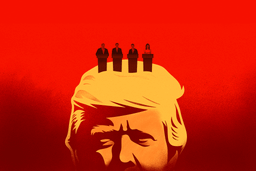
As Workers Struggle, Our Political Class Goes All In On a Permanent War State
From blood banks to food insecurity, a snapshot of a country whose raison d’etre is increasingly open sadism and violence
Sarah Lazare

Less than 24 hours after the U.S.-Israeli coalition bombed oil depots around Tehran on March 7, blanketing the city of 10 million with smoke that blotted out the sun, Brenda — 6,300 miles away in South Baltimore — found out she had lost her food stamps. She had checked the status of her SNAP benefits after I had first interviewed her a few days prior about the United States spending billions on war with Iran while Americans like her struggle to eat. When she logged in to the online portal, she discovered her food stamps had been terminated.
She’s tried to stay positive in the weeks since. “You can spice up ramen noodles with a boiled egg, make it more than just noodles, make it taste like you’re not eating the same thing over and over again,” says Brenda, who is going by a pseudonym to protect her privacy. But it stings that she can’t afford to give her 13-year-old daughter healthy options, like fresh fruits and vegetables. Her daughter is “impressionable, she’s worried about her weight and her size and things,” says Brenda, who makes $16 an hour working at a cafe that’s a bus ride from her house.
“So not having access to food stamps, it’s much cheaper to buy processed foods that are not that healthy for you. That kind of bums me out a little bit, because I can’t offer her the better things that she should be eating.”
This everyday, ordinary, American food insecurity may not seem connected to U.S. wars abroad, but it is. The daily price tag of the war on Iran — which is currently paused as both sides hash out a very precarious “ceasefire,” comes to $2.1 billion a day, according to analyst Stephen Semler. (It’s worth highlighting that, as of publication, U.S.-backed mass slaughter in Lebanon continues unabated.) This could more than cover the daily cost of food stamps for 41 million people, on top of other programs, like Medicaid for the 16 million people expected to lose their coverage due to Trump administration cuts, as I reported for The American Prospect. Instead of funding robust social programs, we’re relying on national debt to finance a military that’s bigger than the militaries of the next nine countries combined. The president is now using that apparatus to threaten “whole civilization” annihilation against Iran.
As programs for the poor are gutted and slashed, about half of the annual federal discretionary budget goes to the military. Meanwhile, one in seven U.S. households struggles to have enough to eat, and food insecurity is at its highest level since 2014.
The tension between genuine safety and security afforded by social welfare and the fictitious, fear-driven kind promised by permanent war was on even starker display this past week as President Donald Trump openly discussed plans to gut social programs to pay for his obscene, record-breaking 1.5 trillion military budget — an almost 50% increase. At an Easter lunch on April 1, Trump said the federal government “can’t take care of” childcare, Medicaid and Medicare because we’re “fighting wars.” Medicare, Medicaid and Social Security are already on the chopping block under the false pretenses of “improved efficiencies” and “eliminating fraud.” Accelerated by the open sadism of Trump, long-stewing political currents of perma-war, imperial tantrums and deadly sanctions are reaching obscene new heights. Despite some rhetorical opposition from top Democrats, just enough always manage to vote for the war budget, and there’s little reason to think they won’t do so again later this year.
U.S. society prioritizes funding for the military over funding for social programs, a reality that is accentuated during a war of aggression like the one the US and Israel are jointly waging in Iran and Lebanon, but that also exists during times of relative calm. From 2001 to 2022, the United States spent an estimated $8 trillion on post-9/11 wars. During this time, inequality in the country surged, with the wealthiest 0.1% now owning 24% of the stock market, while two in five Americans — and nearly one in two children — are considered low-income or poor.
At the same time the United States’ bloated, ever-expanding military apparatus is disproportionately paid for by the working class, it crowds out public programs for the poor. It worsens inequality and transfers wealth from people eating ramen because their food stamps have been cut, to CEOs who make tens of millions of dollars a year by selling weapons used to blow up an elementary school in Iran or a school bus in Yemen.
Wars are fueled by stories of average, everyday Americans who must be protected from a dangerous enemy, or “a vicious group of very hard, terrible people,” as Trump put it in a February 28 speech announcing the Iran war. “Our objective is to defend the American people,” the president said in that speech, later proclaiming that the additional $200 billion the Pentagon is requesting for war, and the staggering $1.5 trillion he is requesting for next year’s proposed military budget, are “a small price to pay to make sure that we stay tippy-top.”
Meanwhile, the American public is fed a nonstop stream of scare stories to Bring The War Home involving nonexistent “Iranian sleeper cells,” “nuclear threats” and FBI-manufactured “terror plots” that the FBI allegedly stops at the 11th hour — all mindlessly repeated by our media with little skepticism. All so these abstract Bad Guys 6,000 miles away can be more palatable, more our problem, more hated.
But U.S. society’s addiction to war and “readiness” does not keep America’s working class safe, much less fed and housed. While there are certainly workers who financially benefit from America’s permanent state of war — for example, engineers who work for weapons companies — an increasingly large corpus of evidence shows far more workers don’t benefit, and are, in fact, hurt by public funds being skewed toward war. And this isn’t some theoretical problem or abstraction. The people being harmed have names and addresses. They line up at food pantries and blood banks where they sell their plasma for cash. They work in fast food and in factories, or they’re out of work because their plant is idle, and they’re making hard choices about whether to spend money on medicine or rent. They go to under-funded schools and hospitals as their money is used to fund wars overseas. What happens when we tell the stories of the actual Americans the war is being “fought for”?
This is not an effort to establish American innocence or make the victimization of U.S. citizens the basis for opposing wars. Unjust wars of belligerence and domination are wrong whether they make Americans rich or poor. The people who suffer in the greatest numbers and severity are those who are crushed in the buildings that collapse under U.S. bombs, who pull their limp and lifeless children from the rubble, who are starving and dying because they don’t have medicines due to U.S. sanctions and blockades. One survey found the 2003 U.S.-led invasion of Iraq resulted in the deaths of 1 million Iraqi people. And the U.S.-backed Israeli onslaught on Gaza, denounced as a genocide by leading scholars and human rights observers, has resulted in the killing or maiming of 65,000 children, at least 1,000 of them babies. So how can we speak of the U.S. military’s harms to America’s working class? Because this harm is, simply, reality — one more piece of evidence that wars serve death, and not life. That they transfer wealth and lethal power to the very few, at the expense of the many.
As Brenda told me for a piece I published in The American Prospect, “The government could end all of the suffering in our country. We could have health care and access to food, healthy foods, fresh food, we could have good doctors. We should be asking, ‘Why are we investing billions of dollars into another war across the seas?’”
We need not look to the lowest rungs of U.S. society to see that wars of belligerence are wrong, but perhaps, if we do look there, we can find the beginnings of a working-class coalition that can push back against imperialism, in that estuary where self-interest meets solidarity.
On an overcast Tuesday morning in late March, the Grifols plasma donation center in Chicago’s Portage Park neighborhood is bustling. People walk in and out of the building, which has a glass door next to tall glass windows a security guard occasionally peers out of. The center pays for donations, but you can only go up to twice a week, a tall, 49-year-old man wearing a black coat explains to me as he walks out. He works in lawn care 40 hours a week, and gives plasma twice a week, too, because it’s helpful to the people who need the donations, and because he needs the extra money.
A 62-year-old man stopped to talk to me on his way in. He was wearing a plaid shirt and torn jeans, with hair to his shoulders and a goatee. He’s a musician who taught guitar lessons and performed “side gigs,” but he stopped about a year ago when his mom got sick. She has since died, and now he is left looking for a part-time job. He recently applied for Social Security, and he hopes it will go through next month, but in the meantime, food prices are soaring, and his back has been hurting. “Everything went up, my car broke down,” he says.
A short, 60-year-old woman in gray sweat pants and pink lipstick told me she was here for “money, being able to cope with the bills, and the high costs.” She worked as a nurse for 30 years, taking care of seniors. It left her with back pain, and then, when her mother died in 2021, the grief sent her spiraling into addiction. She’s been homeless on and off for three years, an experience that she says has torpedoed her mental health.
The geographer Ruth Wilson Gilmore uses the term “organized abandonment” to describe the intentional abandonment of communities, to pave the way for wealth accumulation, land expropriation, extraction and environmental destruction. The concept is a challenge to the notion that neglect is incidental, an unfortunate byproduct; the abandonment of people is a feature of our political and economic system, the result of decisions that get made in corporate boardrooms and city halls and on Capitol Hill. “Forgotten places are not outside history. Rather, they are places that have experienced the abandonment characteristic of contemporary capitalist and neoliberal state reorganization,” she wrote in her 2023 book, Abolition Geography.

To fully understand how America’s poor have been systematically abandoned and disinvested, it is necessary to look at the huge amounts of money being funneled into the American military apparatus. The military-industrial complex has a powerful lobbying arm that does a very good job of protecting arms industry funding. About half of the U.S. military budget goes to contractors every year. From 2020 to 2024, $2.4 trillion went from the Pentagon to military contractors, according to a July 2025 report by William D. Hartung and Stephen Semler. Contractors, in turn, use some of these huge windfalls to hire a small army of lobbyists. There were 950 in 2024 alone, the report finds. But it’s not just formal lobbyists. Companies also finance a constellation of think tanks, which then push out intellectual materials that are generally favorable to high levels of military spending. The top 100 military contractors contributed “more than $34.7 million to the top 50 think tanks in America between 2019 and 2023,” Hartung and Semler determine in their report.
The people giving plasma at Grifols in Portage Park, or stretching their pantries in Cherry Hill, don’t have that kind of lobbying muscle. They are dramatically outspent by companies like General Dynamics (lobbying expenditures were $60.9 millionin the past five years), RTX, formerly Raytheon ($64.8 million), and Lockheed Martin ($70.9 million), whose entire business model depends on keeping the military budget bloated and siphoning public funds into their shareholders’ pockets.

But there is another structural factor that disadvantages the poor. Since the so-called war on terror began, the United States has increasingly relied on national debt to fund wars, rather than tax increases or war bonds. “What was really unprecedented was that we cut taxes four times: In 2001 as we went into Afghanistan, in 2003 as we went into Iraq, in 2017 during Trump’s first term, and then again last year, even as we continue to increase spending for the military in particular,” explains Linda Bilmes, a professor at the Harvard Kennedy School.
According to Heidi Peltier’s estimate in a 2020 paper, approximately 40%of wars after 9/11 “have been financed by foreign borrowing.” With debt, of course, comes interest. Even if all war spending were to stop immediately, “interest payments on the $2 trillion of existing war debt would rise to over $2 trillion by 2030 and to $6.5 trillion by 2050,” Peltier determines.
National debt is a hotly debated matter, and its expansion is not inherently bad if it were used to address an urgent, life-and-death problem. Dramatic action to curb climate change, however much it expands the national debt, would arguably be worth any price tag, given that the very existence of humanity is at risk, and entire countries will be swallowed by the ocean at our current pace. Certainly, the costs of this wholesale destruction would be astronomically greater than any national debt. Likewise, debt spending on single-payer healthcare in America would save lives and have the added benefit of replacing a medical system that wastes extraordinary amounts of public money.
But what does it mean to use national debt to finance war and killing? Future generations are paying interest on something that is not mitigating climate disasters like famines and mega-storms, or delivering a system that better provides healthcare. Instead they’re paying for acts of war, like the repeat attacks on a boat in Venezuela in September 2025 to make sure everyone on board had been killed, or the bombing of a hospital in Kunduz, Afghanistan, in October 2015 that killed 42 people. What lasting good do these acts provide that makes the debt incurred for future generations worth it? In his 2020 novel of the same name, science fiction writer Kim Stanley Robinson imagines “The Ministry for the Future,” a global body created by the 2015 Paris Agreement that is tasked with protecting the rights of future generations, who cannot advocate for themselves in the present. If we had a Ministry for the Future, what would its leaders say about the fact that we are asking future cooks and house cleaners, teachers and nurses, to pay interest on starving Cubans and leveling schools in Minab, Iran?
When debt becomes the key vehicle for funding military budgets, this creates political pressure to find cuts elsewhere. To be sure, there is no rule of nature that says when we have high levels of debt spending on the military, we can’t also increase the debt with spending on other social programs. President Barack Obama did this with his 2009 stimulus package in response to the Great Recession. But the political reality in the United States is that a huge national debt creates political pressure to reduce spending somewhere. And under this system, the military budget predictably soars, while other funding is crowded out, as Peltier puts it. Historically, Peltier says, military budgets end up growing whether or not the country is at war, “whereas these other programs end up getting cut.”
“Let’s say you’re a congressman making decisions about trying to rein in spending,” Peltier explains. “There certainly are progressives in Congress who are trying to lower defense spending, but there aren’t a lot of people in Congress trying to lower defense spending, partly because nobody wants to be the congressman who is seen as being unpatriotic or losing defense jobs in their districts.”
There is another consequence, too: Society does not meaningfully debate war spending. Bilmes tells me that, in addition to debt spending, “we now fund wars through a combination of off-budget, off-ledger budgetary mechanisms, including emergency supplemental funding, special budgetary vehicles and other budgetary mechanisms that circumvent the normal process of vetting that budget materials go through.” This results in what she calls the “ghost budget.”
The ghost budget, Bilmes says, makes spending decisions much less transparent. In a 2025 paper, she noted that, “during prior wars, the Senate and House fiscal committees, which control tax policy in the country, were obligated to hold hearings on the financing of the wars because Congress is required to approve any tax increases.” Compared to the wars in Korea and Vietnam, she writes, “it is evident that these committees devoted far less time to evaluating the cost of the post-9/11 wars than they had during previous wars.”
The people who don’t have enough to eat, who are struggling to get by as grocery prices and rents soar, are also “part of the ghost budget,” says Jennifer Greenburg, assistant professor of international relations at the University of Sheffield. Their stories do not register in discussions of military spending, even though federal budgets profoundly impact their lives.
If endless wars are not robustly debated at the top, they are at the bottom. Like the majority of Americans, the four people I interviewed at the blood bank said the United States was wrong to wage war on Iran, and were frustrated with the president whose administration is waging it.


“Trump friggin lied, man, he’s full of shit,” the musician told me. “He’s gonna bankrupt the whole fucking country. We’re just gonna be like the Roman Empire. The cracks are much bigger because of this dumb idiot. I’m sorry to say that. I’m not usually political. But it’s started to affect me in some ways … God, I’m spending more on groceries, the gas prices, everything.” He was against the war in Iran, he affirmed, “and any fucking war.”
But this is not to indicate that a pure form of solidarity reflexively emerged. The musician told me he’s worried about Iranian “terrorist” attacks in the United States. The former nurse said, “There should not be any war, as far as I’m concerned,” then went on to say that she opposes some sanctuary city policies in Chicago, concerned that homeless U.S. citizens are being neglected in favor of immigrants. Organized abandonment may be a feature of our system. But there is no guarantee that those who are dispossessed, neglected or consigned to premature death will find each other and build common cause.
There is a deep-set belief in American politics that the “defense-industrial base” helps protect the American dream, by creating manufacturing jobs as others dry up. This is a belief promoted by the weapons industry, which presents itself as a job creator when lobbying for more contracts.
The military industry’s output “isn’t just a strategic necessity, but an economic opportunity, said Jim Fein of the Heritage Foundation, in an April 2025 commentary. “Workers … can benefit from an increased number of manufacturing jobs — if the federal and state governments take the steps necessary for such an industrial program to succeed,” (The Heritage Foundation receives funding from the weapons industry.) Such claims are echoed from the highest echelons of power. U.S. arms sales around the world “help create good jobs at good wages in America,” Peter Navarro, then-assistant to Trump and the director of the Office of Trade and Manufacturing Policy, said in a New York Times op-ed published in March 2019.
Of course, flooding any sector with trillions of dollars of public funds will create jobs. But the way job creation happens in the military sector actually has the impact of increasing inequality, according to Heidi Peltier, a senior research associate at Brown University’s Watson School of International and Public Affairs.
When public money goes to education, most of that spending goes to hire teachers and staff, Peltier explains. Spending on military contractors, on the other hand, is much more capital-intensive: Money goes to weapons systems, fuel and vehicles, and less of every dollar spent goes to labor itself.
Jobs for military contractors also pay more. Peltier determined in a 2020 paper that military contractors pay wages from 20% to 166% above the national average for jobs like mechanical engineering, security services and electrical repair. A sector flush with public funds, after all, can afford higher salaries. This creates an incentive for engineers to go into weapons development, rather than, say, the green energy sector.
It also contributes to the fact that there are fewer jobs to go around for every dollar spent on weapons contractors, versus education or healthcare. In a June 2023 paper, Peltier determined that for every $1 million spent on the military, 6.1 jobs are created. The same amount of spending on healthcare creates 11.6 jobs, or almost twice as many. And $1 million in education spending creates 17.1 jobs, or nearly three times as many.

The fact that the weapons industry does not broadly distribute public funds compounds with the fact that military spending “crowds out” funding for social welfare programs, Peltier says. “We can think of investing in the military as a question of trade offs, and when we’re spending money in the military, we’re not spending money somewhere else.”
These “trade-offs” must certainly include the people harmed by U.S. wars, those being bombed in their homes, steel plants and hospitals in Iran.
There is no guarantee that communities that are abandoned and consigned to hunger, terrible working conditions, rising grocery prices, and even premature death will reach out in solidarity with those who are being bombed by the same government neglecting them. But there is ample opportunity to do so once you name the problem, and determine to leave no one behind. There is U.S. labor movement precedent for this, encapsulated in the slogan “an injury to one is an injury to all,” and it can be a counter-force to organized abandonment.
It’s a principle articulated by Mary Turner, an intensive care unit nurse in Minnesota who is on the council of presidents for the National Nurses United labor union. “The thing is, the hospitals get bombed, and they’re half functioning, they lose power, those health care workers don’t leave their post,” she told me. “That’s the thing about doctors, nurses, and all health care workers. We don’t abandon our patients, like the government does. The government abandons them, but we don’t.”

Get 10 print issues of our award-winning, worker-first journalism here!

Sarah Lazare is the editor of Workday Magazine and a contributing editor for In These Times. She tweets at @sarahlazare.